In this article we’ll cover what turning methods there are. We’ll look at what jobs are done on a lathe. The operations performed on a lathe are varied. These are called lathe operations.
The lathe operations are as follows:
Facing
Longitudinal/step turning
Taper turning
Chamfer turning
Profile (contour) turning
Grooving
Parting off
Thread cutting
Drilling
Boring
Reaming
Tapping
Knurling
Eccentric turning
Spring winding
Facing
During machining, the length of workpieces is a bit longer than what the final part needs to be. During facing, the tool moves along the radius of the workpiece’s circular surface, which we call the face. This shortens the length of the part and clears the face surface of roughness.
For detailed information on this topic, see:
See: Facing

Longitudinal – Step Turning
Step turning creates two surfaces with a sudden change in diameter between them.

Taper Turning
Taper turning creates a ramped transition between two surfaces of different diameters, through the cutting tool’s angled motion.
For detailed information on this topic:
See: Taper Turning Methods

Chamfer Turning (Chamfering)
Similar to taper turning, chamfer turning creates an angled transition between two turned surfaces of different diameters. The chamfer angle is usually 45o.

Profile (Contour) Turning
In contour turning, the cutting tool is moved axially along a predefined path geometry. Producing the desired contours on the workpiece requires multiple passes of a contouring tool. However, the same contour shape can be produced in a single pass using form tools.

Grooving
Grooving is a turning operation that creates a narrow cut, a “groove,” in the workpiece. The width of the cut (w) depends on the width of the cutting tool. Multiple tool passes are required to machine wider grooves.
For detailed information
See: Groove Turning

Parting Off
Parting off is a machining operation that ends with the part being cut and separated at the end of the machining cycle. The operation is done with a specially shaped cutting tool, feeding perpendicular to the axis of the rotating workpiece and making a gradual cut as the workpiece rotates. Once the cutting tool’s edge reaches the center of the workpiece, the part drops off.

Thread Cutting
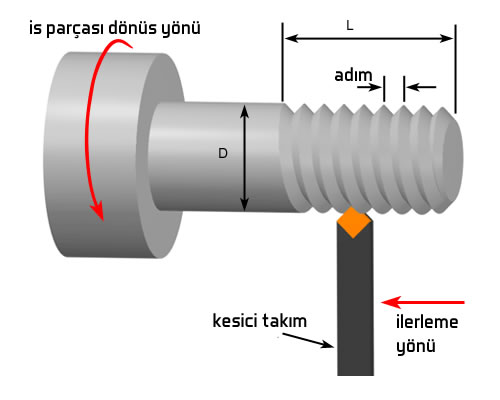
Thread cutting is a turning operation where a cutter shaped to match the thread profile moves along the edge of the workpiece, cutting a helical groove into the outer surface.
A thread is a uniform helical groove with a specified length (L) and pitch. For this operation, the lathe’s feed is set up as shown in the relevant table. The cutting tool is advanced along (L).
To achieve the thread depth, this operation is repeated several times (moving right-left). The cutting tool is advanced a bit further on each repetition.
For detailed information
See: Thread Cutting on a Lathe
Drilling
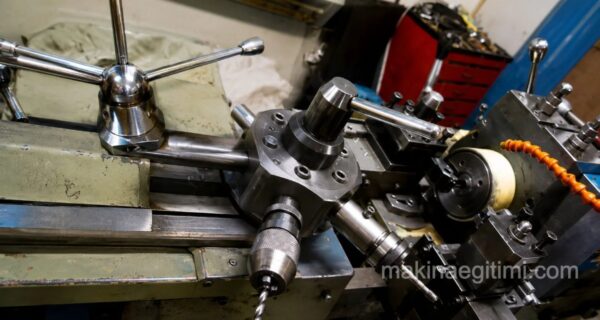
On universal lathes, the drill bit is clamped in a tool holder (chuck) mounted to a part called the “traveling tailstock,” which can move along the lathe’s ways. The drill is fed along the axis of the lathe’s spindle toward the rotating workpiece to perform the drilling operation.
Depending on the hardness of the material being machined and the drill diameter, coolant or cutting oil can be used during drilling.
For detailed information, see: Drilling on a Lathe

On CNC machines, the drill bit is first mounted in a tool holder called a collet. It’s then placed, together with the collet, into a part called the turret. On CNC lathes, the turret does what the traveling tailstock does on universal lathes, and more.
Boring – Enlarging a Hole
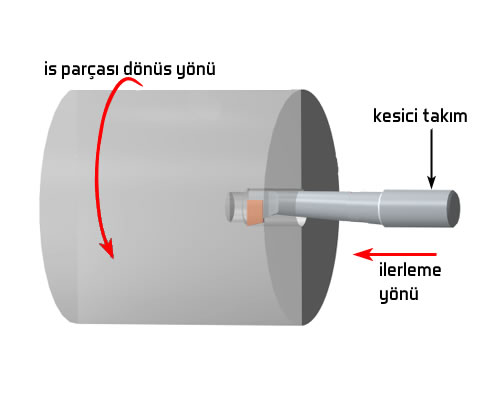
In boring, the cutting tool enters the workpiece axially and removes material (chips) along the internal surface, either to create various shapes (for example, cutting a groove inside a hole) or to enlarge an existing hole.
For detailed information, see: Boring
Reaming
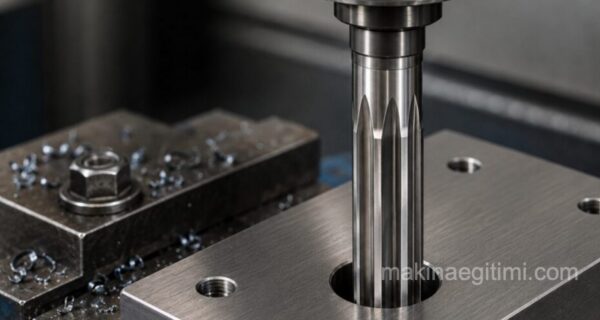
Reaming is a sizing operation that enlarges a hole in the workpiece. In reaming operations, the reamer enters the workpiece axially from the end and enlarges an existing hole to the reamer’s diameter. Reaming removes a minimal amount of material, and is generally performed after drilling to achieve both a more accurate diameter and a smoother internal surface.
For detailed information on this topic:
See: What Is Reaming? How Is It Done?

Tapping (Threading a Hole)
Tapping is the operation where the tapping tool enters the workpiece axially and cuts a thread into an existing hole. Tapping is also the operation used to cut threads into nuts.
The cutting tool, called a tap, is used with tool holders mounted to the traveling tailstock on universal lathes, and to the turret on CNC lathes.
For detailed information on this topic:
See: Tapping on a Lathe

Knurling
Knurling produces a textured pattern on the surface of the part. Knurling is usually applied to the grip areas of hand-held tools. This provides a more secure grip in situations like sweaty or oily hands.
Knurling uses a unique tool made up of one or more cylindrical wheels (knurls) that can spin inside a tool holder.
During knurling, the chuck spins at a low speed, and the knurling wheel is moved across the part at a low feed rate, parallel to the part’s axis, with the wheels applying a light clamping force to the part. Knurling is preferably done using a small amount of cutting oil.

For detailed information on this topic:
See: Knurling on a Lathe
Eccentric Turning
The operation performed is the same as step turning. But thanks to the fixture used, two cylindrical surfaces with different axes are obtained. On a universal lathe, the 3-jaw chuck is replaced with a faceplate for eccentric turning. The workpiece is mounted to this faceplate with the help of a fixture called a “carrier.”
For detailed information
See: Off-Center (Eccentric) Turning

Spring Winding
A spring can be wound on a lathe using low speed and a stepped feed like thread cutting.
For detailed information
See: Spring Winding on a Lathe

Cylindrical Turning
The most common operation performed on a lathe is cylindrical turning, applied to reduce the outer diameter of a rotating part.
Drilling and Enlarging Holes
Lathes can also be used to drill holes, or enlarge existing holes (reaming/boring), by mounting a drill bit.
Thread Cutting Operation
On a lathe, it’s possible to cut threads on internal or external surfaces using special tool bits.
Related Questions
In longitudinal turning, the tool moves parallel to the axis, producing a straight cylindrical surface. In taper turning, since the tool moves at an angle, a sloped transition surface is obtained between two different diameters.
In facing, the tool moves on the end face of the part, perpendicular to the axis, setting the part’s length. In longitudinal turning, the tool moves parallel to the axis, shaping the part’s diameter and outer surface; this different direction of motion is what separates the two operations.
Related Posts