

Hydraulic cylinders convert pressurized fluid energy into linear motion and force in presses, heavy equipment, mold systems, and industrial automation. Knowing how much force a cylinder can produce affects decisions ranging from choosing the right pump and valves to workplace safety. With the interactive calculator below, you can enter the piston diameter and system pressure to instantly calculate extend force, and optionally add rod diameter and flow rate to calculate retract force and piston speed — and watch the piston’s motion with a live animation.
How Does a Hydraulic Cylinder Produce Force?
A hydraulic cylinder works by pressurized oil applying force to one face of the piston. According to Pascal’s principle, pressure applied to a confined fluid is transmitted equally in all directions; when this pressure acts on the piston’s cross-sectional area, it creates a force. The magnitude of the force depends on both the system pressure and the piston’s area — at the same pressure, a larger-diameter piston produces much more force than a smaller one, because force is directly proportional to area.
Hydraulic Cylinder Force Calculator
Enter the piston diameter and system pressure into the tool below to see the extend force instantly. Add a rod diameter to also calculate retract force, or a flow rate to see piston speed. Watch the piston move back and forth with a live animation.
Force is calculated as F = P × A (bar and mm² units are converted automatically). If a rod diameter is entered, the retract force is calculated over the smaller annular area the pressure acts on, and is always lower than the extend force. Values are approximate, for educational reference only; hose/valve losses and efficiency are not included.
How Is Force Calculated?
The basic formula is F = P × A — force equals pressure times the piston’s cross-sectional area. Cross-sectional area is found with A = π × (D/2)² (D: piston diameter). Since pressure is usually worked with in bar and area in mm² in practice, unit conversion is applied automatically to give the result directly in Newtons or kilonewtons (kN).
For example, if a 50 mm diameter piston operates at 160 bar: cross-sectional area A = π × 25² ≈ 1963.5 mm² ≈ 19.6 cm²; force is F = 160 × 1963.5 × 0.0001 ≈ 31.4 kN — a force capable of lifting roughly 3.2 tonnes.
The Difference Between Extend and Retract Force
A hydraulic cylinder’s extend force (piston moving out) differs from its retract force (piston moving in). While extending, pressure acts on the piston’s FULL cross-sectional area. While retracting, pressure acts on a smaller ANNULAR area on the rod side — because the area the rod occupies is “subtracted” from the surface. This is why, at the same pressure, a hydraulic cylinder always produces more force extending than retracting.
What Determines Piston Speed?
Piston speed, independent of force, depends on the flow rate the pump supplies (amount of fluid, L/min) and the piston’s cross-sectional area: at the same flow rate, the smaller the cross-sectional area, the faster the piston moves. This is why applications requiring high speed may favor smaller-diameter pistons (backed by higher pressure).
Applications of Hydraulic Cylinders
- Heavy equipment: excavator arms, forklift forks, bulldozer blades, and other heavy lifting/pushing applications.
- Hydraulic presses: sheet metal forming, molding, and assembly line operations requiring high force.
- Mold opening/closing systems: precise, powerful motion for injection and casting molds.
- Vehicle brake and steering systems: hydraulic applications that work at relatively low force but require precision.
Frequently Asked Questions
While extending, pressure acts on the piston’s full cross-sectional area. While retracting, pressure acts on the rod-side area, which is smaller by the area the rod itself occupies (an annular area). Force acting on a smaller area at the same pressure is smaller, so retract force is always lower than extend force.
It depends on the system design. Increasing pressure is usually a cheaper solution but requires all system components (hoses, valves, seals) to be rated for that pressure. Increasing piston diameter can be a safer route but increases the cylinder’s size and cost, and lowers piston speed at the same flow rate.
Not directly — at the same pump flow rate, increasing force by enlarging the piston diameter lowers speed; increasing speed by shrinking the diameter requires higher pressure to maintain the same force. This is why system design always involves a trade-off between force and speed.
No, this tool performs an ideal (lossless) calculation. In real systems, pressure loss in hoses and valves, seal friction, and hydraulic efficiency all reduce the result. A real application must always account for the manufacturer’s catalog values and safety margins.
Pascal (Pa) is the SI unit of pressure (1 Pa = 1 N/m²). Bar is a more practically sized unit: 1 bar = 100,000 Pa. Hydraulic systems usually express pressure in bar because typical operating pressures (say, 100-350 bar) would be very large numbers in Pascals.
Choosing the right combination of piston diameter and pressure is the foundation of a hydraulic system design that’s both safe and efficient. Use the calculator above to quickly get a reference value for your own project, then compare it against the manufacturer’s catalog data.
Related Posts
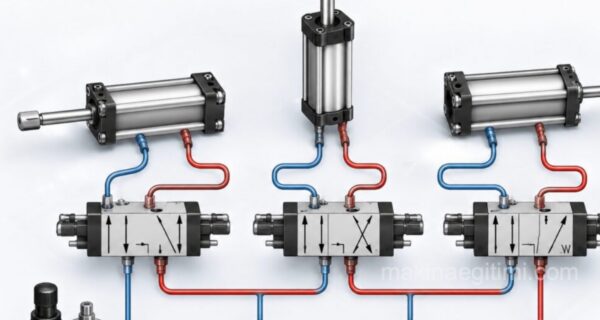 Controlling Multiple Cylinders with Directional Control Valves
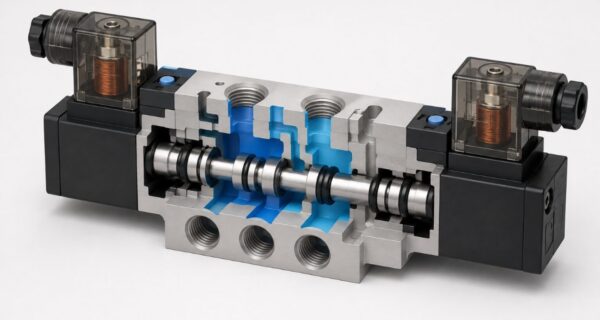 What Is a Solenoid Valve, How Does It Work?
 Advantages of Hydraulic Systems
 Hydraulic Applications – Pressure Reducing Valve
 Pressure Gauges and Types of Pressure Gauges
 Types of Hydraulic Motors
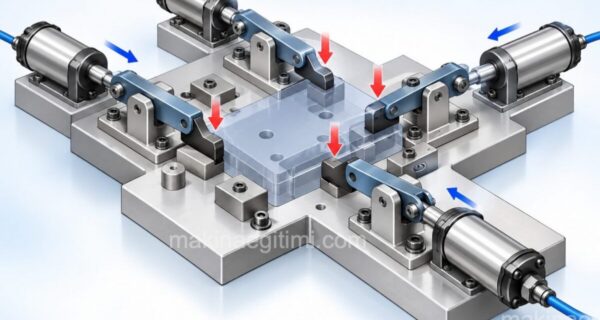 Pneumatic Application Examples, Sample Circuits
 What Is an Orifice in Flow Control Valves?