
If you’re looking for a scanner suitable for industrial applications ranging from reverse engineering, prototyping, and VR to quality control, digital archiving, inspection, and maintenance, these machines are ready for the job and come with exceptionally powerful software to get you started.
Best Industrial 3D Scanners
The machines below, especially the ones further down the list, are used in a range of industries including defense, manufacturing, aerospace, automotive, and consumer products.
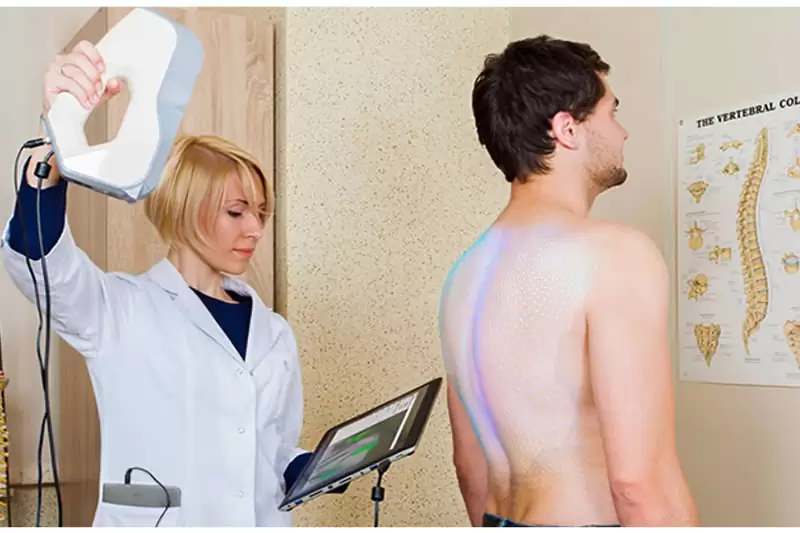
Artec Eva
The Artec Eva is considered by many to be the best-in-class handheld 3D scanner. It’s used in almost every field of work imaginable, from the aerospace industry to orthopedics.
- Accuracy up to 0.1 mm
- Technology Structured Light
- Max. Scan Area 536 × 371 mm
- Market price $16,600
The Artec Eva is particularly well suited to medium-sized objects (including busts), and captures full-color scans quickly and reliably. It’s possible to set up multiple Artec 3D scanners to speed up or improve the scanning process.
That said, its own software isn’t free, and it doesn’t ship with the handheld 3D scanner included. Still, since the data from the 3D scanner can be exported, you can work with any third-party 3D editing software.
Creaform HandyScan 307 Silver Series
- Accuracy up to 0.03 mm
- Technology laser triangulation
- Max. Scan Area 275 x 250 mm
- Market price $18,500
The HandyScan 307 is optimized for dynamic referencing, meaning both the scanner and the part can move freely during scanning while the results remain extremely accurate. Its versatility allows users to scan a variety of objects with the same device, regardless of part size, complexity, material, or color.
The scanner’s plug-and-play technology makes it compatible with a range of software solutions, from Autodesk to 3D Systems.
Artec Space Spider
At the high end of the 3D scanning spectrum is the Artec Space Spider, a high-resolution 3D scanner that uses blue light technology to capture everything from small, intricate objects to large parts in high resolution.
- Accuracy up to 0.05 mm
- Technology Structured Light
- Max. Scan Area 180 × 140 mm
- Market price $23,800
This is an industrial-grade scanner designed for experienced CAD users who need high precision for applications such as reverse engineering, additive manufacturing, quality control, and mass production. It can handle features that frustrate other scanners, such as sharp edges and thin edges.
Artec Leo 2022
The Artec Leo is a step change in the 3D scanning market, offering a larger scan resolution than the company’s already market-leading Eva scanner, while adding full wireless functionality and built-in processing.
- Accuracy up to 0.1 mm
- Technology Structured Light
- Max. Scan Area 838 × 488 mm
- Market price $32,300
With built-in automatic processing and wireless connectivity, the Artec Leo easily captures the widest range of sizes while you move around as freely as if you were filming a video, and a 3D copy is built in real time on the HD screen.
The Leo is a fascinating high-end 3D scanner, well suited to applications ranging from reverse engineering, industrial design, and automotive to VR/AR, heritage preservation, and scientific research.
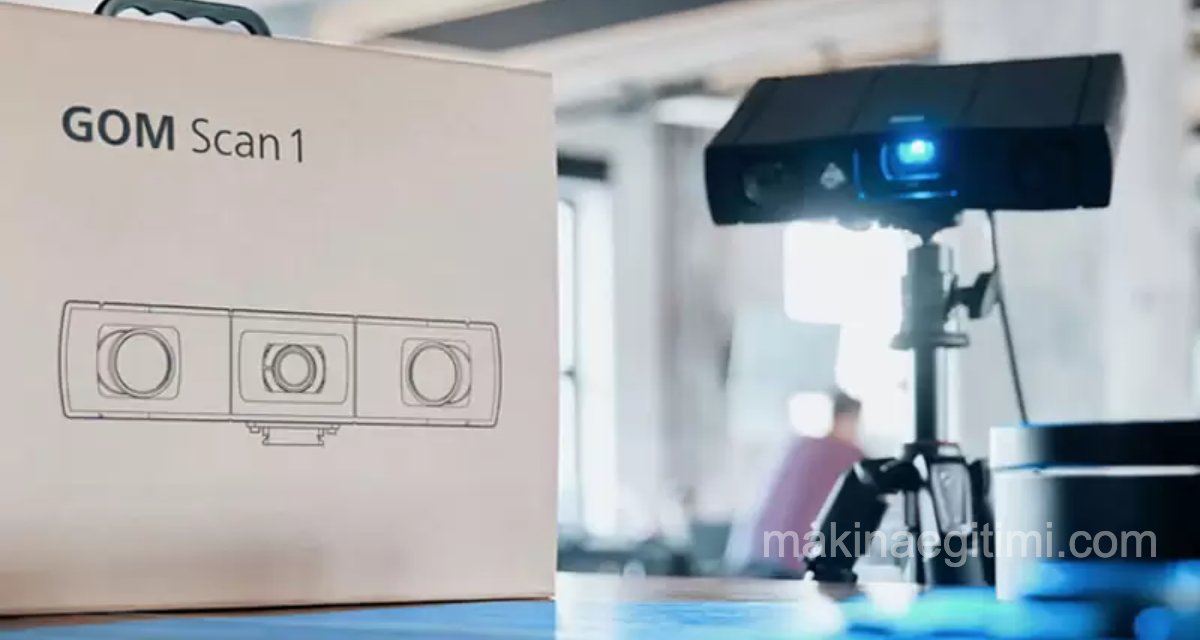
Zeiss GOM Scan 1
Unlike others, the GOM Scan 1 is a professional desktop 3D scanner with blue structured light technology, designed to perform well under changing ambient lighting conditions. Since the sensor operates with narrow-band blue light, interfering ambient light can be filtered out during image capture. Thanks to its powerful light source, short measurement times are possible.

- Accuracy up to 0.037 mm
- Technology: Structured light
- Maximum Scan Area 400 x 250 mm
- Market price $27,000
The GOM Scan 1 is available with three measurement volumes, allowing you to scan small objects up to medium-sized objects (100 x 65 mm to 400 x 65 mm).
Scantech Simscan
The Simscan, from Chinese manufacturer Scantech, is the only scanner on our list that could be called pocket-sized. This one-handed portable 3D scanner weighs just 570 grams and has a metrology-grade measurement system to capture every detail and build 3D models quickly.
Warning: The video has loud music.
- Accuracy up to 0.020 mm
- Technology laser triangulation
- Maximum Scan Area 410 x 400 mm
- Market price $30,000
The Simscan delivers high-quality scans thanks to its high frame rate and fast data capture. Its remarkably compact size allows 3D measurements even in hard-to-reach areas such as engine bays. In 2022, Simscan also released the handheld iReal 2E, which it says is ideal for body scanning.
Creaform Go!Scan Spark
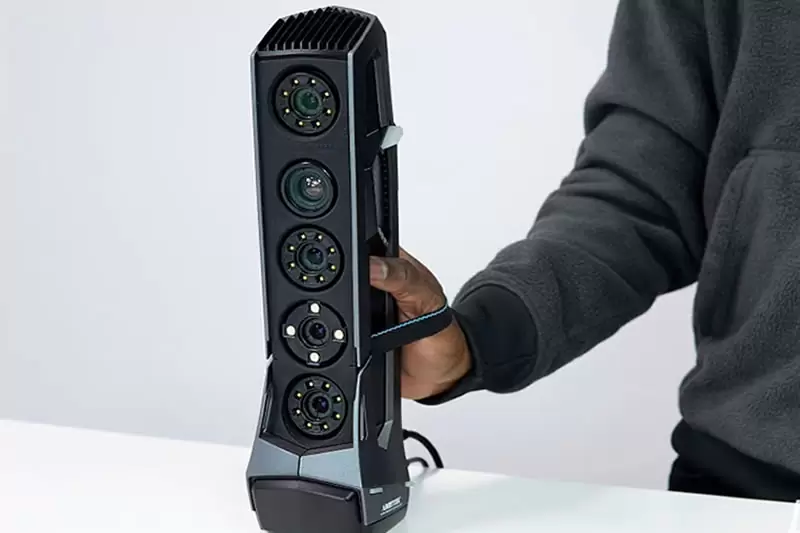
In many ways the most impressive (and expensive) scanner on this list is the Go!Scan Spark.
We found that this white-light 3D scanner packs a lot of power into a portable package. It produces professional-level geometries and textures, and takes 1.5 million measurements per second, while also allowing free movement of both the object and the scanner.
- Accuracy up to 0.05 mm
- Technology Structured Light
- Max. Scan Area 390 x 390 mm
- Market price $37,000
Accurate to within 0.05 mm with a 0.1 mm resolution, the system uses hybrid positioning to allow simple and convenient handheld scanning of larger objects with what could be considered a point-and-shoot workflow.
Zeiss T-Scan Hawk
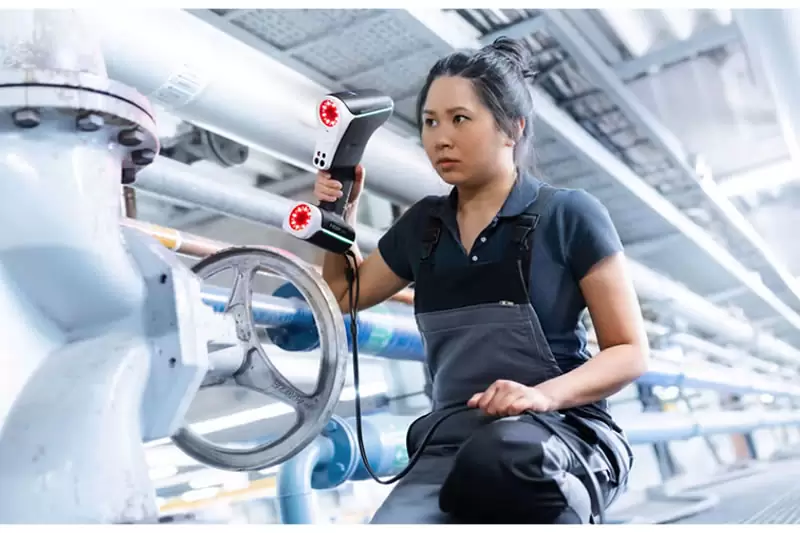
The T-Scan Hawk from German manufacturer Zeiss has three different laser sources and scan modes, including both red and blue lasers. Red lasers are ideal for quickly scanning large objects. A single red laser is used to scan deep interior pockets. Blue lasers, meanwhile, are for scanning closer objects and fine details at higher resolution.
- Accuracy up to 0.02 mm
- Technology laser triangulation
- Max Scan Area 550 x 600 mm
- Market price $40,000
The Hawk can scan ultra-fine details and dark/reflective surfaces, as well as large-sized objects.
Industrial Scanner Accuracy
Industrial 3D scanners can offer micron-level measurement accuracy in manufacturing quality control.
Use in Reverse Engineering
These scanners are commonly used in reverse engineering to build a digital model of old parts or parts with no CAD data.
Structured Light Technology
Many industrial scanners use structured light technology, projecting a patterned light onto the object’s surface to calculate its three-dimensional geometry.
Related Questions
These devices offer much higher accuracy (down to 0.1 mm) and a larger scan area, and are also built to meet the strict accuracy requirements of industries like aerospace and automotive. This high performance also drives up the cost.
A single scanner can only scan one angle of an object, and scanning repeatedly from different angles takes time. Setting up multiple scanners allows different surfaces of the object to be scanned simultaneously, speeding up the process.
Related Posts
 3D Printer Applications Today and in the Future What Is Additive Manufacturing (3D Printing)? Methods and Applications
  What Is Dielectric Fluid, What Does It Do, Where Is It Used?
  Electrical Discharge Machining (EDM) Machines
  What Is Sinker EDM, How Does It Work. Where Is It Used
  Advantages and Disadvantages of Laser Welding
  Types of Lasers – Properties and Applications
  Laser Welding, Its Properties and Working Principle