

Waterjet Cutting
The cutting process that uses water pressurized up to 55,000 PSI to cut materials is called waterjet cutting.
In this process, the water is accelerated to a great degree and further concentrated onto the target workpiece. The water’s speed can reach 762 m/s. Depending on the nature of the material being cut, this high-speed, high-pressure waterjet can use plain water, or it can slice through the material by mixing certain abrasive particles (such as aluminum oxide or garnet) with the water.
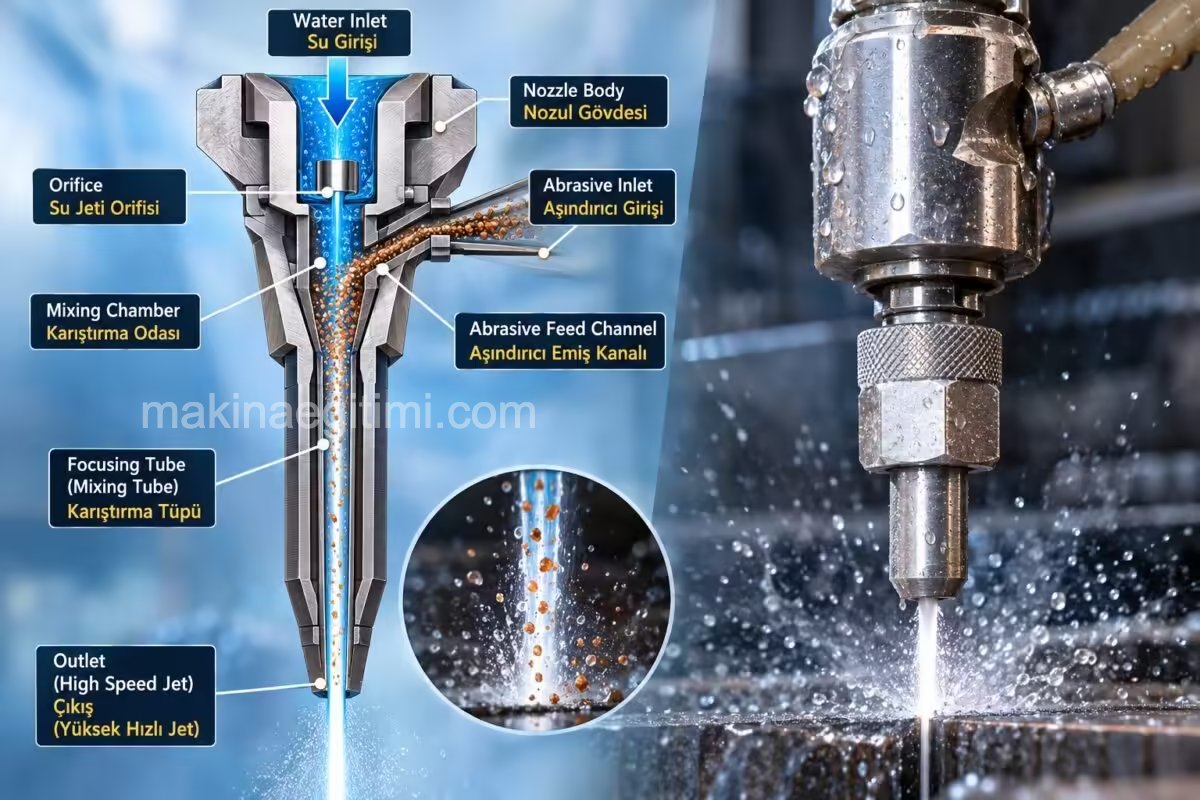
The abrasive is mixed into the stream inside the waterjet cutting head.
Typically, the high-speed water stream creates a vacuum that draws a metered amount of abrasive into a mixing chamber to produce a powerful jet stream. After the abrasive is added, the waterjet exits the focusing tube as a supersonic stream of water carrying the abrasive that erodes materials such as glass, steel, and granite.
The heat generated by this process is carried away by the water stream before it can heat the surrounding material. In addition to this lack of heat, the momentum of the stream keeps the particles moving in a straight line after they exit the nozzle, which provides a super-flat, precise cutting edge for many materials.

The Principle of Waterjet Cutting
The basic principle of waterjet cutting is that the kinetic energy of the waterjet needs to be converted into pressure energy to remove material from the workpiece.
When the kinetic-energy waterjet strikes a workpiece, this kinetic energy converts into pressure energy.
This pressure energy creates stress in the workpiece, and because of this stress, the material begins to separate from the workpiece.
Which Materials Can Be Cut with a Waterjet?
Waterjets offer the ability to cut and machine a wide variety of materials. These include:
- Soft Materials
- Rubber: Silicone, nitrile, sulfur rubber, etc.
- Plastic: PVC, polyethylene, polypropylene, etc.
- Fabric: Cotton, silk, nylon, etc.
- Paper and cardboard: Offset paper, coated paper, box board, etc.
- Hard Materials
- Metal: Aluminum, steel, copper, nickel, etc.
- Glass: Sheet glass, glass mosaic, glass stairs, etc.
- Marble: White marble, travertine, granite, etc.
- Composite materials: Fiberglass, Kevlar, etc.
- Plastic: PVC, polycarbonate, acrylic, etc.
Waterjet cutting is generally not preferred for cutting soft materials. Because soft materials have a lower structural integrity and durability, the waterjet’s cutting efficiency and precision can be lower compared to other materials. For this reason, alternative technologies also exist for cutting soft materials, and the performance of these technologies can differ from that of a waterjet.
In some processes (generally with soft materials), no abrasive is used, and these processes are known as pure waterjet machining. The water pressure used in this machining process is between 200 MPa and 400 MPa.
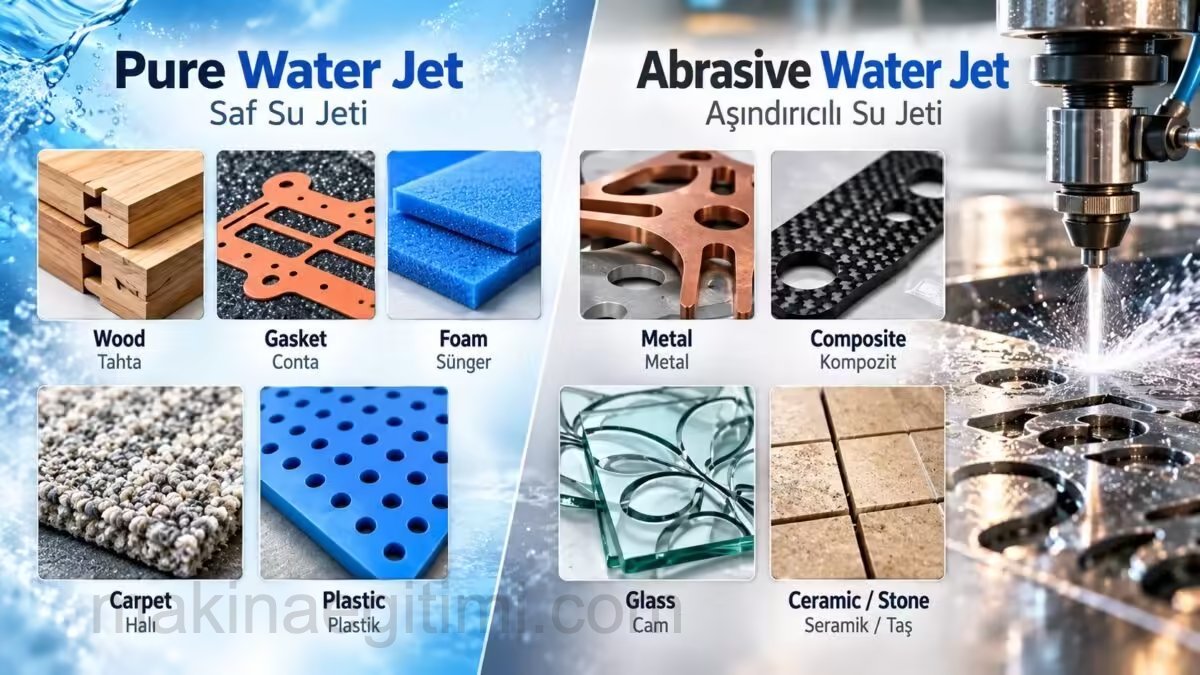
Abrasive waterjet cutting is for hard materials, such as stone, metal, synthetic ceramics, and composites, that can’t be cut using pure water alone.
Some materials can’t be successfully cut using a waterjet. One of these is tempered glass, which shatters at the first attempt to cut it.
How a Waterjet Works
In short, the basic principle of a waterjet is this: using the principle of fluid pressurization, the mechanical energy of the power source (motor) is converted into pressure energy through a specific device (a booster or high-pressure pump), and the high-pressure water passes through a small-diameter nozzle (another energy converter), after which the pressure energy is converted into kinetic energy to form a high-speed jet (WJ).
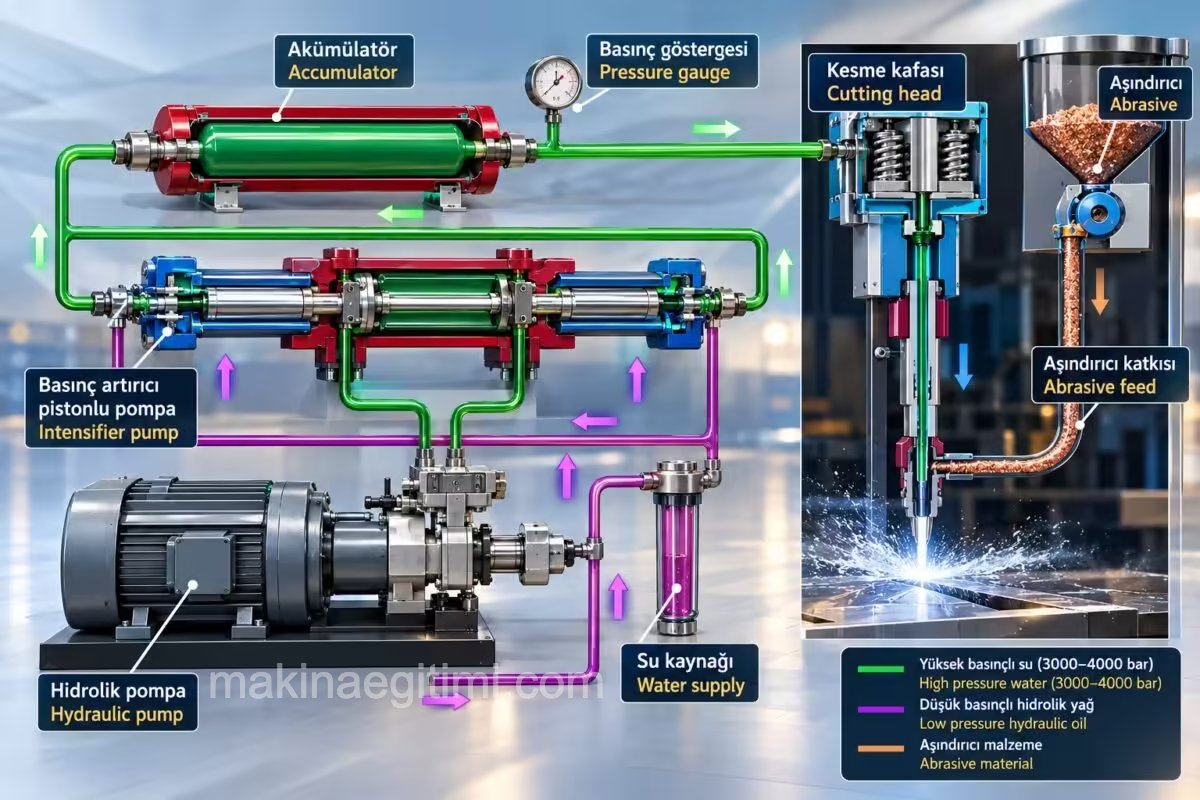
The pressure used in waterjet cutting depends on the workpiece the material is being removed from. The pressure of an abrasive cutter can reach 55,000 PSI, and this high-pressure water is ejected from a small nozzle at a speed of 762 m/s, which is 2.5 times faster than the speed of sound.
Abrasives Used in Waterjet Cutting
The abrasives used in waterjet cutting are quartz sand, garnet, river sand, diamond sand, etc.
The grain size of the abrasives is generally 40-70 mesh; the harder the abrasive, the larger the grain size, and the stronger the cutting ability.

Precision in Waterjet Cutting
The cutting precision of waterjet cutting is between 0.1 mm and 0.25 mm. Cutting precision depends on the precision of the machine, the size range of the workpiece being cut, and the thickness and material of the workpiece being cut.

In general, the positioning precision of the machine’s system is 0.01 mm to 0.03 mm.
Areas Where Waterjets Are Used
Because waterjet machining technology offers many advantages, it’s widely used in the aerospace industry, automotive industry, machine manufacturing industry, construction industry, medical materials industry, electronic power industry, chemical industry, sporting goods industry, military industry, and fields related to new materials.

In the automotive industry, it can be used, thanks to its strong versatility and high flexibility, to cut all kinds of non-metallic and composite materials to meet the requirements of a modern automobile manufacturing mold, such as body outer panels, door frames, fuel tanks, etc.
In the aerospace industry, waterjet technology can be used for cutting and shaping aircraft and helicopter parts. A waterjet is a preferred technology for making precise, clean cuts in the aerospace industry, because it’s a technology that doesn’t expose the material to heat, doesn’t damage the material’s structure, and can make accurate cuts.
In the Military Industry: it can be used for purposes such as the destruction of weapons and the cutting of flammable and explosive facilities, armored plate on combat vehicles, bulletproof glass, turrets, etc.

In Industrial Cleaning: waterjet technology can be used to clean paint booths in the automotive industry, the inner and outer pipes of heat exchangers in the petrochemical industry, rubber deposits on airport runways, industrial rust-removal surface treatment and anti-corrosion engineering, engine parts in the aerospace industry, and radiation contamination in nuclear power plants, as well as for cleaning cars, tall buildings, airport runways, heat exchangers in chemical plants, etc.
Cold-Cutting Method
Because waterjet cutting doesn’t generate heat, it’s a preferred “cold-cutting” method for heat-sensitive, precision materials.
Wide Range of Materials
A waterjet can cut a very wide range of materials, from metal to glass, and stone to fabric.
Minimum Cutting Tolerance
Modern waterjet systems can achieve cutting tolerances of precision up to 0.1 mm.
Related Questions
The water stream instantly absorbs and carries away the heat generated during cutting, so the heat is extinguished before it can spread into the surrounding material. This property allows heat-sensitive materials to be cut without their shape being distorted.
Inside the cutting head, the vacuum effect created by the fast-moving water stream draws the abrasive particles into a mixing chamber. These particles mix into the water stream and increase the jet’s cutting power.
It depends on the size and thickness of the material being cut and the nozzle used. The kerf width with abrasive cutting can be 0.1-1.1 mm for pure water cutting, and 0.8-1.8 mm for abrasive cutting.
The typical width used is 1.0 mm to 1.2 mm.
An ultra-high-pressure waterjet can cut all kinds of thick and hard materials, such as stainless steel, aluminum, copper, steel, marble, alloy metal, glass, plastic, ceramic, tile, and any kind of visible material.
UHP stands for Ultra High Pressure. It’s defined as pressure higher than 30,000 psi. This term is generally used in fields such as hydraulic systems, industrial facilities, or laboratory equipment
ANSWER: The on-site price for a 2-axis CNC abrasive system is somewhere between $100,000 and $200,000 USD, while a water-only CNC waterjet ranges from $50,000 to $100,000 USD.
Related Posts
 Comparing Waterjet Cutting to Other Cutting Methods
 Tips for Reducing 3D Printing Costs
 Laser Welding, Its Properties and Working Principle
 Industrial 3D Scanners
 Properties of Laser Beams and Their Working Principle
 3D Scanning Methods
 What Determines the Color of Laser Beams?
 The Best 3D Scanning Apps