Close Menu
  • MAKİNELER ve İMALAT
    • Tools & Equipment
    • Computer-Aided Drawing
    • CAD/CAM Education
    • CNC Machine Programming
    • Casting Technologies
    • Electrical & Electronics Technologies
    • Hydraulics & Pneumatics
    • Manufacturing Processes
    • Manufacturing Technologies
    • Occupational Safety
    • Mold & Die Design
    • Solid Modeling
    • Welding Technology
    • Machine Elements
    • Mechanical Trade Drawing
    • Materials Science
    • Automotive & Vehicle Technologies
    • Robotics Technologies
    • Health Technologies
    • Defense & Aerospace Technologies
    • Descriptive Geometry
    • Technical Drawing
    • Software & Hardware Technologies
    • Innovative Manufacturing Methods
  • TEKNOLOJİ ve YAŞAM
    • OTOMOBİLLER ve TAŞIT
      • Vehicle & Engine Knowledge
      • Safe Driving
      • Sürüş Destek Sistemleri
    • Genel Kültür
      • Movies & TV Shows
      • Görsel ve Grafik Sanat
      • Books & Literature
      • Music
      • Sports
      • History
      • History of Technology
    • GÜNDELİK YAŞAM TEKNOLOJİLERİ
    • Hobbies & Entertainment
    • Internet Technologies
    • Health
    • Mobile Technologies
Makine Eğitimi
  • Machines & Manufacturing
    Machine Elements
    Hydraulics & Pneumatics
    Technical Drawing
    Computer-Aided Design & Manufacturing
    Basic Manufacturing Processes
    Manufacturing Processes
    Industry Technologies
    Other Technical Courses
    Motion & Power Transmission
    Simple Machines
    Chains & Sprockets
    Shafts & Journals
    Gears
    Cams
    Couplings
    Belts & Pulleys
    Springs
    Bearings
    Keys
    Fastening Joining
    Retaining Rings
    Screws, Bolts & Nuts
    Cotter Pins
    Flanges
    Welding
    Rivets
    Pins & Bolts
    Washers
    Calculators
    Gear Ratio Calculator
    Spring Constant Calculator
    Belt Pulley Ratio Calculator
    Other Machine Elements
    Slides & Linear Guides
    Brakes
    Flywheels
    Clamps
    Shock Absorbers
    Gaskets & O-Rings
    Seals & Sealing Elements
    Hydraulics
    Introduction to Hydraulics & Principles
    Hydraulic Systems & Applications
    Accumulators
    Filters
    Motors
    Pumps
    Valves
    Pneumatics
    Introduction to Pneumatics & Principles
    Pneumatic Systems & Applications
    Pneumatic Circuit Components
    Valves
    Cylinders
    Silencers
    Motors
    Compressors
    Dryers
    Conditioning Units
    Common Topics & Maintenance
    Hydraulic & Pneumatic Maintenance
    Study Notes, Exams & Tests
    Technical Drawing
    Introduction to Technical Drawing
    Geometric Drawings
    Perspective & Projection
    Orthographic Views
    Dimensioning
    Sectioning
    Assembly & Detail Drawings
    Tolerances
    Surface Finish Symbols
    Mechanical Engineering Drawing
    Screws, Bolts & Nuts
    Pulley Drawings
    Gear Drawings
    Shafts & Journals
    Bearing Drawings
    Pins & Bolts
    Spring Drawings
    Welds in Technical Drawing
    Washers
    Cotter Pins
    Technical Drawing Exercises
    Mechanical Drawing Exercises
    Gear Exercises
    View Extraction Exercises
    Pulley Exercises
    Pin & Bolt Exercises
    Threaded Fastening Exercises
    Descriptive Geometry
    Computer-Aided Drawing
    AutoCAD Drawing Lessons
    Computer-Aided Drawing Exams
    Solid Modeling & Animation
    Solid Model Drawing Files
    Solid Model Assembly Examples
    Solid Model Drawing Lessons
    3D CAD Software Reviews
    Solid Modeling Exercises
    CNC Programming
    CAM
    Measurement & Inspection
    Dial Indicators
    Calipers
    Gauges
    Micrometers
    Materials Science
    Steels
    Cast Iron
    Aluminum
    Plastics
    Material Testing & Hardness Measurement
    Occupational Safety
    Workshop Safety
    Safety When Working With Electricity
    Machine Safety Rules
    Hand Operations
    Filing
    Marking
    Cutting Operations
    Reaming
    Tapping
    Threading With a Die
    Drill Bit Sharpening
    Working With Machines
    Basic Turning Operations
    Basic Milling Operations
    Shaper Machine
    Machining
    Turning
    Milling
    Grinding
    Innovative Manufacturing Methods
    EDM (Electrical Discharge Machining)
    Laser Machining
    Waterjet Machining
    3D Printing
    3D Scanners
    Welding
    Rolling
    Casting
    Mold & Die Design
    Mechanical & Hydraulic Presses
    Blanking & Piercing Dies
    Bending Dies
    Drawing Dies
    Plastic Injection Molds
    Extrusion Dies
    Compound Dies
    Progressive Dies
    Blow Molds
    Spinning Dies
    Spray Molds
    Manufacturing of Machine Parts
    Automotive & Vehicle Technologies
    Motor Vehicle Manufacturing
    Raw Material Production
    History of Technology
    Health & Medical Technologies
    Defense & Aerospace
    Robotics Technologies
    Software & Hardware Technologies
    Mechanics - Strength of Materials
    Physics Topics
  • Technology & Life
    Hobbies & Entertainment
    Sports
    Music
    Vehicle & Engine Knowledge
    Vehicle Maintenance & Repair
    Safe Driving
    Driver Assistance Systems
    History
    Movies & TV Shows
    Books & Literature
    Computers & Internet
    Computer Tips
    Software Reviews
    Hardware & Peripherals
    Practical & Safe Internet Use
    Visual & Graphic Art
    Mobile Technologies
    Travel
    Science
    Health
    First Aid Knowledge
    Everyday Technologies
Makine Eğitimi
Home»Machine Elements»Spring Constant Calculator
6 September 2026

Spring Constant Calculator

Spring Constant Calculator

Knowing how much a spring will compress under a given force — or how much force you need to apply to get a desired compression — is a basic calculation in applications ranging from suspension design to a simple latch mechanism. This relationship is described by one of the most fundamental laws in mechanics, Hooke’s Law. With the interactive calculator below, you can enter the spring constant, free length, and compression amount to instantly find the required force, and watch the spring compress and release with a live animation.

  • What Is Hooke’s Law?
  • How Is Force Calculated?
  • What Determines the Spring Constant?
  • Applications of Springs
  • Spring Constant Calculator
  • Frequently Asked Questions

What Is Hooke’s Law?

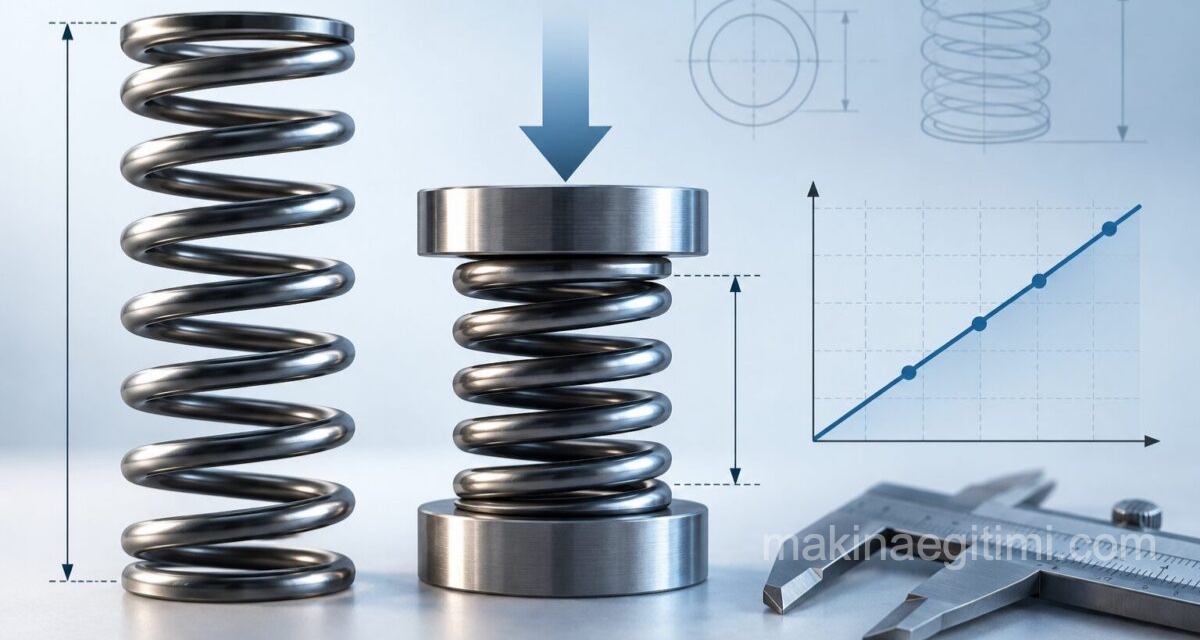
Hooke’s Law states that a spring compresses or stretches DIRECTLY PROPORTIONALLY to the force applied to it (within a certain elastic limit). This relationship is expressed as F = k × x — where F is the applied force, k is the spring constant that describes the spring’s stiffness, and x is the amount the spring compresses or stretches. The larger the spring constant, the more force is required to compress the spring by a given amount — meaning a “stiffer” spring.

How Is Force Calculated?

Once the spring constant (k, N/mm) and compression amount (x, mm) are known, the required force is found directly with F = k × x. For example, compressing a spring with a spring constant of 20 N/mm by 25 mm requires F = 20 × 25 = 500 N of force. If the spring’s free length (L0) is known, the compressed length is easily found with L0 − x — in this example, if the free length is 100 mm, the compressed length is 100 − 25 = 75 mm.

What Determines the Spring Constant?

The spring constant (k) depends on factors like wire thickness, spring diameter, number of coils, and the material’s elastic properties. Two springs that look identical can have very different spring constants if their wire thickness or coil density differs. That’s why, when replacing a spring, you need to pay attention not just to its dimensions but also to the manufacturer-specified spring constant — the wrong spring constant makes a system respond either too stiffly or too softly.

Applications of Springs

  • Vehicle suspensions: the spring constant determines the balance between ride comfort and road grip — soft springs give a comfortable but less controlled ride, while stiff springs give a sportier but less comfortable one.
  • Valve springs: require precise force generation to ensure engine valves open and close with correct timing.
  • Latch and switch mechanisms: use a calculated spring force to give the user a perceptible feedback (a “click” feel).
  • Precision scales and measuring devices: use a known spring constant to convert force into a measurable amount of extension/compression.

Spring Constant Calculator

Enter the spring constant, free length, and compression amount into the tool below — the required force and compressed length are calculated instantly. You can also watch the spring compress and release with a live animation.

Force (F) 0 N
Compressed Length 0 mm

Force is calculated with Hooke's Law, F = k × x. Compressed length is found by subtracting the compression amount from the free length. Values assume an ideal (linear) spring; real springs can have a solid-length limit and nonlinear behavior. The animation is not scaled to real speed.

Frequently Asked Questions

No, Hooke’s Law only holds while the spring stays within its “elastic limit.” If a spring is compressed or stretched too much, it can permanently deform (plastic deformation), and beyond that point the force-compression relationship is no longer linear.

Solid height is the point where the spring’s coils are fully touching each other and it can no longer compress further. Beyond this point, F = k × x no longer applies — the spring suddenly responds much more stiffly because the coils are now bearing directly against each other, rather than flexing.

For springs in parallel, the total spring constant is the SUM of the individual spring constants (k_total = k1 + k2) — the system becomes stiffer. For springs in series, the total spring constant is the reciprocal of the sum of reciprocals (1/k_total = 1/k1 + 1/k2) — the system becomes softer.

Hang (or apply) a known weight on the spring and measure the resulting compression or extension. The spring constant is found by dividing the applied force by the measured compression/extension (k = F / x). For a more accurate result, it’s recommended to measure with several different weights and average the results.

Understanding the relationship between spring constant and compression is fundamental knowledge you’ll encounter across many areas of mechanical design. Use the calculator above to experiment with different spring constants and force values and reinforce the logic of Hooke’s Law.

Related Posts

What is a washer. What does it do What Is a Washer. What Does It Do Areas Where the Worm Is Used Where the Worm and Worm Wheel Are Used Muylular ve Çeşitleri Journals and Their Types Information About Pipe Threads Information About Pipe Threads Securing Bolts and Nuts Securing Bolts and Nuts Dimensional Tolerances Annotated Example Drawings Dimensional Tolerances – Annotated Example Drawings Number of Starts on Screws and What It Means Number of Starts on Screws and What It Means Gear Terminology and Elements Gear Terminology – Gear Elements
Springs
Share. Facebook Twitter WhatsApp Tumblr Email Telegram Copy Link

Leave A Reply Cancel Reply


Lionel Messi’s Legendary Body Feints
Main Components and Advantages of Electric Vehicles
  • Contact
  • Terms of Service
  • Privacy & Cookie Policy

Type above and press Enter to search. Press Esc to cancel.