
In the Machine Technology Manufacturing Operations / Machining / Turning category, this article will cover what a turret lathe is, how a turret lathe works, and how the workpiece is mounted on a turret lathe.
Turret Lathe

Turret lathes are a type of lathe used when parts need to be manufactured in a production run. Parts made this way are machined rapidly within a certain tolerance limit, so that their dimensions and shapes are identical to one another; these are called identical parts. By setting up a system that allows the turner to perform various operations using different tools on the same workpiece, the same results are obtained on every part.
Structure of the Turret Lathe
The turret lathe’s headstock carries the spindle and the gears that drive it. It generally has spindle speeds ranging from 6 to 12, which can be reversed whenever needed. The levers that control the gear arrangement for the desired speed are placed at the front of the headstock, just as on a regular lathe. Spindle speeds differ across turret lathes of various sizes. Those used for light work have high speeds approaching 4000 rpm; heavier turret lathes have lower speeds but greater power.

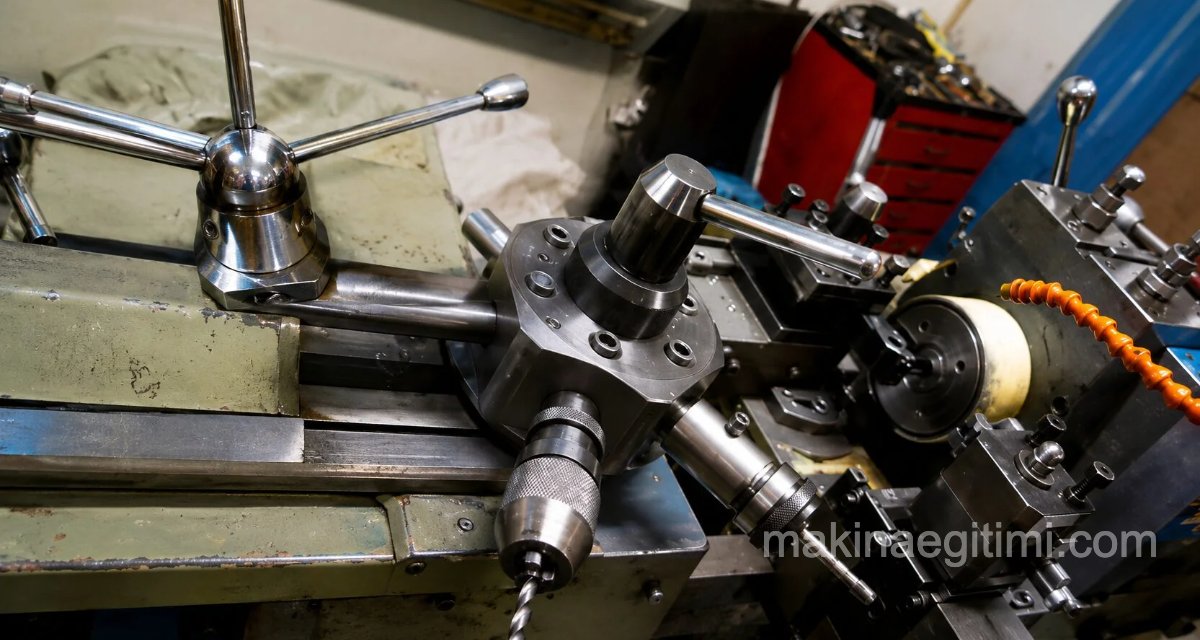
The cross-sliding tool holder of a turret lathe differs from that of a regular lathe in many respects. Here there’s a square tool post to which 4 tools can be mounted. This tool post can be rotated to bring it to the desired working position. To prevent excessive vibration and noise during operation, the tool post locks into place.

By limiting the cross and longitudinal movements with adjustable stop rods, operations automatically follow one another, providing production-run capability. Tools can be mounted on the cross-sliding tool holder on both the front and back of the workpiece. This way, tools generally take specific positions for facing corners, cutting grooves, or parting off the piece once the final operation is done. Instead of a tailstock body, a hexagonal turret head that carries tools for various operations is used on the turret lathe. Tools are mounted in the order the workpiece requires, and the turret is rotated (indexed) at the end of each operation.

The spindles of turret lathes can be horizontal or vertical. Vertical turret lathes resemble a vertical boring mill; their main differences are how the tools are indexed and their positions on the turret head. The workpiece is mounted on a rotating table or chuck, while the tools are held by the turret head, supported on top of the cross tool carriage. Tools can also be held in a square tool post at the edge of the table. If the nature of the work requires it, more than one tool post can be used on this machine.
Types of Turret Lathes
Horizontal Turret Lathe
Operating at high speed, it removes rough stock with the deepest and highest feed rate. Cutting fluid is generally used, and during machining it can look as if the machine is smoking as if it were on fire. The turret lathe operator must be able to set up the tools, gauges, and stop settings themselves so that operations can be carried out in sequence without excessive tool adjustment.

turret head
The turret lathe takes its name from a turret head that carries many cutting tools. This head is rotated (indexed) to bring each cutting tool into position to be used on the work. The turret head carrying multiple cutting tools was first used on ordinary lathes. Initially, this was a single block holding more than one tool, and it later took the form of a turret head mounted to the lathe’s tailstock body. Later still, an entirely new machine was created, resembling a regular lathe in many respects but differing in some important features.
Horizontal turret lathes come in two types: light (ram) type and heavy (saddle) type. These are made for various jobs and get their names from how the turret head is mounted to the lathe.
Light-Type (Ram) Turret Lathe
On the light (ram) type, the turret head is mounted onto a sliding part that moves back and forth in a way mounted onto the lathe’s bed. This machine is mainly used for bar work (with a collet chuck) and light work.

light-type turret lathe
Heavy-Type (Saddle) Turret Lathe
On the heavy (saddle) type machine, the turret head is mounted onto a carriage that moves back and forth on the lathe’s ways. This type of lathe is suitable for heavy chuck work and is built to provide a sturdy support for the tools. The stroke length or tool travel can be made longer to suit long turning and boring operations.

Heavy-type turret lathe
Mounting the Workpiece on a Turret Lathe
This is done with a wide variety of methods. Standard 6, 4, 3, and 2-jaw chucks are used as often as special two-flat-jaw and rotating-jaw chucks. Chucking can be pneumatically, hydraulically, or electrically actuated. When the diameter or width of round or polygonal bar stock to be mounted on the lathe is smaller than 60 mm, collet chucks are generally used. Collet chucks are expandable and come in various sizes. They’re shaped to hold round, hexagonal, or square-section bars.

Turret lathes are equipped with steady rests to support long and slender workpieces. These come in many types and sizes. The equipment and methods used to support the tool on a turret lathe are quite varied. These are generally chosen based on the nature of the workpiece.
A very wide range of operations can be performed on a turret lathe: cylindrical turning, boring, reaming, taper turning, and internal and external thread cutting can be included among these. An experienced turner, once informed about the machine’s control levers, won’t have difficulty operating a turret lathe. Learning to use and position the tool-mounting equipment in the best way should be a priority.
How Is a Turret Lathe Used
A video prepared about how a turret lathe is used
Multi-Tool Setup
A turret lathe holds multiple cutting tools on a rotating turret, allowing for fast tool changes.
Mass Production Advantage
Turret lathes speed up mass production by reducing tool-change time on repeated operations of the same part.
Evolution Toward the CNC Lathe
Turret lathe technology is considered the ancestor of today’s CNC lathes with automatic tool changers.
Related Questions
On this machine, several tools can be set up in advance and brought into use in sequence, allowing the same operation sequence to be quickly repeated on every part. This repeatability makes it possible to produce identical parts quickly and consistently.
Different parts and different operations require different optimal cutting speeds. A wide speed range allows the same machine to be used efficiently for both light and heavier jobs.
Related Posts
 The Best 3D Scanners of 2022 – Buying Guide
 What Is Rolling? How Is It Done? Rolled Products in Our Lives
 Broaching. What Is It. How Is It Done
 How Is a Zippo Lighter Made? Zippo Manufacturing and Assembly
 How Are Washers Made
 Progressive Dies
 What Is Honing? How Is It Done? Where Is It Used?
 What Is Reaming? How Is It Done?