Close Menu
  • MAKİNELER ve İMALAT
    • Tools & Equipment
    • Computer-Aided Drawing
    • CAD/CAM Education
    • CNC Machine Programming
    • Casting Technologies
    • Electrical & Electronics Technologies
    • Hydraulics & Pneumatics
    • Manufacturing Processes
    • Manufacturing Technologies
    • Occupational Safety
    • Mold & Die Design
    • Solid Modeling
    • Welding Technology
    • Machine Elements
    • Mechanical Trade Drawing
    • Materials Science
    • Automotive & Vehicle Technologies
    • Robotics Technologies
    • Health Technologies
    • Defense & Aerospace Technologies
    • Descriptive Geometry
    • Technical Drawing
    • Software & Hardware Technologies
    • Innovative Manufacturing Methods
  • TEKNOLOJİ ve YAŞAM
    • OTOMOBİLLER ve TAŞIT
      • Vehicle & Engine Knowledge
      • Safe Driving
      • Sürüş Destek Sistemleri
    • Genel Kültür
      • Movies & TV Shows
      • Görsel ve Grafik Sanat
      • Books & Literature
      • Music
      • Sports
      • History
      • History of Technology
    • GÜNDELİK YAŞAM TEKNOLOJİLERİ
    • Hobbies & Entertainment
    • Internet Technologies
    • Health
    • Mobile Technologies
Makine Eğitimi
  • Machines & Manufacturing
    Machine Elements
    Hydraulics & Pneumatics
    Technical Drawing
    Computer-Aided Design & Manufacturing
    Basic Manufacturing Processes
    Manufacturing Processes
    Industry Technologies
    Other Technical Courses
    Motion & Power Transmission
    Simple Machines
    Chains & Sprockets
    Shafts & Journals
    Gears
    Cams
    Couplings
    Belts & Pulleys
    Springs
    Bearings
    Keys
    Fastening Joining
    Retaining Rings
    Screws, Bolts & Nuts
    Cotter Pins
    Flanges
    Welding
    Rivets
    Pins & Bolts
    Washers
    Calculators
    Gear Ratio Calculator
    Spring Constant Calculator
    Belt Pulley Ratio Calculator
    Other Machine Elements
    Slides & Linear Guides
    Brakes
    Flywheels
    Clamps
    Shock Absorbers
    Gaskets & O-Rings
    Seals & Sealing Elements
    Hydraulics
    Introduction to Hydraulics & Principles
    Hydraulic Systems & Applications
    Accumulators
    Filters
    Motors
    Pumps
    Valves
    Pneumatics
    Introduction to Pneumatics & Principles
    Pneumatic Systems & Applications
    Pneumatic Circuit Components
    Valves
    Cylinders
    Silencers
    Motors
    Compressors
    Dryers
    Conditioning Units
    Common Topics & Maintenance
    Hydraulic & Pneumatic Maintenance
    Study Notes, Exams & Tests
    Technical Drawing
    Introduction to Technical Drawing
    Geometric Drawings
    Perspective & Projection
    Orthographic Views
    Dimensioning
    Sectioning
    Assembly & Detail Drawings
    Tolerances
    Surface Finish Symbols
    Mechanical Engineering Drawing
    Screws, Bolts & Nuts
    Pulley Drawings
    Gear Drawings
    Shafts & Journals
    Bearing Drawings
    Pins & Bolts
    Spring Drawings
    Welds in Technical Drawing
    Washers
    Cotter Pins
    Technical Drawing Exercises
    Mechanical Drawing Exercises
    Gear Exercises
    View Extraction Exercises
    Pulley Exercises
    Pin & Bolt Exercises
    Threaded Fastening Exercises
    Descriptive Geometry
    Computer-Aided Drawing
    AutoCAD Drawing Lessons
    Solid Modeling & Animation
    Solid Model Drawing Files
    Solid Model Assembly Examples
    Solid Model Drawing Lessons
    3D CAD Software Reviews
    Solid Modeling Exercises
    CNC Programming
    CAM
    Measurement & Inspection
    Dial Indicators
    Calipers
    Gauges
    Micrometers
    Materials Science
    Steels
    Cast Iron
    Aluminum
    Plastics
    Material Testing & Hardness Measurement
    Occupational Safety
    Workshop Safety
    Safety When Working With Electricity
    Machine Safety Rules
    Hand Operations
    Filing
    Marking
    Cutting Operations
    Reaming
    Tapping
    Threading With a Die
    Drill Bit Sharpening
    Working With Machines
    Basic Turning Operations
    Basic Milling Operations
    Shaper Machine
    Machining
    Turning
    Milling
    Grinding
    Innovative Manufacturing Methods
    EDM (Electrical Discharge Machining)
    Laser Machining
    Waterjet Machining
    3D Printing
    3D Scanners
    Welding
    Rolling
    Casting
    Mold & Die Design
    Mechanical & Hydraulic Presses
    Blanking & Piercing Dies
    Bending Dies
    Drawing Dies
    Plastic Injection Molds
    Extrusion Dies
    Compound Dies
    Progressive Dies
    Blow Molds
    Spinning Dies
    Spray Molds
    Manufacturing of Machine Parts
    Automotive & Vehicle Technologies
    Motor Vehicle Manufacturing
    Raw Material Production
    History of Technology
    Health & Medical Technologies
    Defense & Aerospace
    Robotics Technologies
    Software & Hardware Technologies
    Mechanics - Strength of Materials
    Physics Topics
  • Technology & Life
    Hobbies & Entertainment
    Sports
    Music
    Vehicle & Engine Knowledge
    Vehicle Maintenance & Repair
    Safe Driving
    Driver Assistance Systems
    History
    Movies & TV Shows
    Books & Literature
    Computers & Internet
    Computer Tips
    Software Reviews
    Hardware & Peripherals
    Practical & Safe Internet Use
    Visual & Graphic Art
    Mobile Technologies
    Travel
    Science
    Health
    First Aid Knowledge
    Everyday Technologies
Makine Eğitimi
Home»Manufacturing Processes»Operations Performed on a Lathe
29 August 2026

Operations Performed on a Lathe

Operations Performed on a Lathe

In this article we’ll cover what turning methods there are. We’ll look at what jobs are done on a lathe. The operations performed on a lathe are varied. These are called lathe operations.
The lathe operations are as follows:

    • Facing
    • Longitudinal – Step Turning
    • Taper Turning
    • Chamfer Turning (Chamfering)
    • Profile (Contour) Turning
    • Grooving
    • Parting Off
    • Thread Cutting
    • Drilling
    • Boring – Enlarging a Hole
    • Reaming
    • Tapping (Threading a Hole)
    • Knurling
    • Eccentric Turning
    • Spring Winding
  • Related Questions

Facing
Longitudinal/step turning
Taper turning
Chamfer turning
Profile (contour) turning

Grooving
Parting off
Thread cutting
Drilling
Boring

Reaming
Tapping
Knurling
Eccentric turning
Spring winding

Facing

During machining, the length of workpieces is a bit longer than what the final part needs to be. During facing, the tool moves along the radius of the workpiece’s circular surface, which we call the face. This shortens the length of the part and clears the face surface of roughness.

For detailed information on this topic, see:
See: Facing

facing

Longitudinal – Step Turning

Step turning creates two surfaces with a sudden change in diameter between them.

longitudinal turning

Taper Turning

Taper turning creates a ramped transition between two surfaces of different diameters, through the cutting tool’s angled motion.

For detailed information on this topic:
See: Taper Turning Methods

taper turning

Chamfer Turning (Chamfering)

Similar to taper turning, chamfer turning creates an angled transition between two turned surfaces of different diameters. The chamfer angle is usually 45o.

chamfer turning chamfering

Profile (Contour) Turning

In contour turning, the cutting tool is moved axially along a predefined path geometry. Producing the desired contours on the workpiece requires multiple passes of a contouring tool. However, the same contour shape can be produced in a single pass using form tools.

profile contour turning

Grooving

Grooving is a turning operation that creates a narrow cut, a “groove,” in the workpiece. The width of the cut (w) depends on the width of the cutting tool. Multiple tool passes are required to machine wider grooves.

For detailed information
See: Groove Turning

grooving groove turning

Parting Off

Parting off is a machining operation that ends with the part being cut and separated at the end of the machining cycle. The operation is done with a specially shaped cutting tool, feeding perpendicular to the axis of the rotating workpiece and making a gradual cut as the workpiece rotates. Once the cutting tool’s edge reaches the center of the workpiece, the part drops off.

lathe parting off

Thread Cutting

Thread cutting is a turning operation where a cutter shaped to match the thread profile moves along the edge of the workpiece, cutting a helical groove into the outer surface.

A thread is a uniform helical groove with a specified length (L) and pitch. For this operation, the lathe’s feed is set up as shown in the relevant table. The cutting tool is advanced along (L).

To achieve the thread depth, this operation is repeated several times (moving right-left). The cutting tool is advanced a bit further on each repetition.
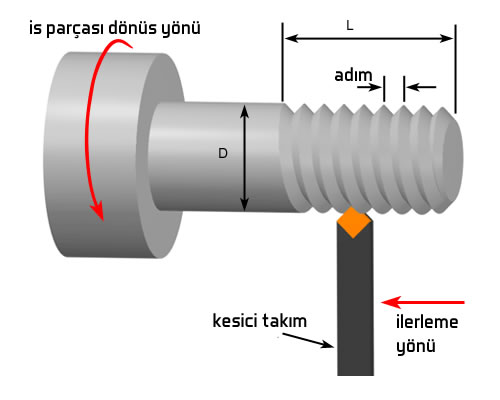
thread cutting on a lathe

For detailed information
See: Thread Cutting on a Lathe

Drilling

On universal lathes, the drill bit is clamped in a tool holder (chuck) mounted to a part called the “traveling tailstock,” which can move along the lathe’s ways. The drill is fed along the axis of the lathe’s spindle toward the rotating workpiece to perform the drilling operation.

Depending on the hardness of the material being machined and the drill diameter, coolant or cutting oil can be used during drilling.

For detailed information, see: Drilling on a Lathe

drilling on a lathe

On CNC machines, the drill bit is first mounted in a tool holder called a collet. It’s then placed, together with the collet, into a part called the turret. On CNC lathes, the turret does what the traveling tailstock does on universal lathes, and more.

Boring – Enlarging a Hole

In boring, the cutting tool enters the workpiece axially and removes material (chips) along the internal surface, either to create various shapes (for example, cutting a groove inside a hole) or to enlarge an existing hole.

For detailed information, see: Boring
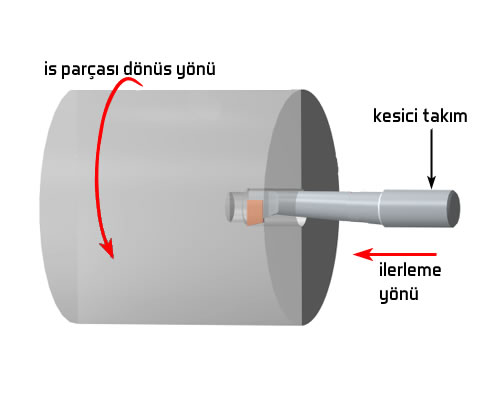
enlarging a hole on a lathe

Reaming

Reaming is a sizing operation that enlarges a hole in the workpiece. In reaming operations, the reamer enters the workpiece axially from the end and enlarges an existing hole to the reamer’s diameter. Reaming removes a minimal amount of material, and is generally performed after drilling to achieve both a more accurate diameter and a smoother internal surface.

For detailed information on this topic:
See: What Is Reaming? How Is It Done?

reaming on a lathe, using a reamer on a lathe

Tapping (Threading a Hole)

Tapping is the operation where the tapping tool enters the workpiece axially and cuts a thread into an existing hole. Tapping is also the operation used to cut threads into nuts.

The cutting tool, called a tap, is used with tool holders mounted to the traveling tailstock on universal lathes, and to the turret on CNC lathes.

For detailed information on this topic:
See: Tapping on a Lathe

tapping on a lathe

Knurling

Knurling produces a textured pattern on the surface of the part. Knurling is usually applied to the grip areas of hand-held tools. This provides a more secure grip in situations like sweaty or oily hands.

Knurling uses a unique tool made up of one or more cylindrical wheels (knurls) that can spin inside a tool holder.

During knurling, the chuck spins at a low speed, and the knurling wheel is moved across the part at a low feed rate, parallel to the part’s axis, with the wheels applying a light clamping force to the part. Knurling is preferably done using a small amount of cutting oil.

knurling operation on a lathe

For detailed information on this topic:
See: Knurling on a Lathe

Eccentric Turning

The operation performed is the same as step turning. But thanks to the fixture used, two cylindrical surfaces with different axes are obtained. On a universal lathe, the 3-jaw chuck is replaced with a faceplate for eccentric turning. The workpiece is mounted to this faceplate with the help of a fixture called a “carrier.”

For detailed information
See: Off-Center (Eccentric) Turning

eccentric turning

Spring Winding

A spring can be wound on a lathe using low speed and a stepped feed like thread cutting.

For detailed information
See: Spring Winding on a Lathe

spring winding on a lathe

Cylindrical Turning


The most common operation performed on a lathe is cylindrical turning, applied to reduce the outer diameter of a rotating part.

Drilling and Enlarging Holes


Lathes can also be used to drill holes, or enlarge existing holes (reaming/boring), by mounting a drill bit.

Thread Cutting Operation


On a lathe, it’s possible to cut threads on internal or external surfaces using special tool bits.

Related Questions

In longitudinal turning, the tool moves parallel to the axis, producing a straight cylindrical surface. In taper turning, since the tool moves at an angle, a sloped transition surface is obtained between two different diameters.

In facing, the tool moves on the end face of the part, perpendicular to the axis, setting the part’s length. In longitudinal turning, the tool moves parallel to the axis, shaping the part’s diameter and outer surface; this different direction of motion is what separates the two operations.

Related Posts

Waterjet Cutting Basics Waterjet Cutting Basics Heat Treatments Applied to Cast Iron Heat Treatments Applied to Cast Iron What Is Reaming? How Is It Done? What Is Reaming? How Is It Done? Dişli Çark Üretim Yöntemleri Gear Manufacturing Methods modern factory manufacturing processes Surprising Manufacturing Processes in Modern Factories Industrial 3D Scanners Industrial 3D Scanners What Is a Turret Lathe, How Is It Used What Is a Turret Lathe. How Is It Used Broaching. What is it. Title image Broaching. What Is It. How Is It Done
Manufacturing of Machine Parts Basic Turning Operations Turning
Share. Facebook Twitter WhatsApp Tumblr Email Telegram Copy Link

Leave A Reply Cancel Reply

What Are Fuel Additives For? Benefits of Fuel Additives
Seasonal Vehicle Battery Maintenance: Why and How
  • Contact
  • Terms of Service
  • Privacy & Cookie Policy

Type above and press Enter to search. Press Esc to cancel.