

In the vehicle maintenance section, this article covers engine noises and what they mean. When diagnosing vehicle problems, different sounds coming from the engine can give us clues. Knocking, ticking, rattling, whistling, and roaring sounds can all help diagnose issues with engine parts like the main bearings, pistons and rings, valves, and alternator, as well as things like axle problems.
Knocking Sound From the Engine
If you hear a strong, dull thud under load, this could indicate main bearing knock. There may be more clearance than there should be in the main bearing. In this case, abnormal noises will come from the engine. This is a sound that comes regularly while the engine is running.
To locate where the sound is coming from, you can short out the spark plug wires one at a time. If the bearing noise stops or decreases when a particular plug is shorted, the bearing clearance for that cylinder is excessive.
This test can be done at a high idle speed corresponding to about 25 km/h in top gear, or on the road. In this case, the main bearing noise will increase if the vehicle is put under load.
In some cases, even if there’s no clearance in the bearing that would cause knocking, oil that’s too thin can also cause bearing knock, since it thins out the bearing’s oil film.
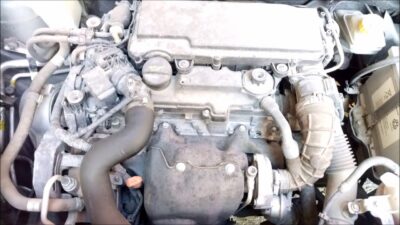
A video about engine noises and their meanings (above)
Knocking sound when closing the throttle on a straight road
If you hear a metallic knock when closing the throttle while driving straight at around 45 km/h, this strongly suggests excessive bearing clearance in the connecting rods.
While the vehicle is stationary, if you open the throttle enough to raise engine speed and then close it immediately, you’ll hear the noise of connecting rod bearings with excessive clearance. Engine oil that’s thinner than it should be can also cause the same sound.

If lubrication is normal but noise is still coming from the main or connecting rod bearings, the bearings should be replaced or the clearance reduced at the first opportunity. Otherwise, costly engine damage can result.
Double-knock sound while the engine is idling
If you always hear a sharp double-knock while the engine idles, suspect the piston pin. Shorting out the spark plug of the suspected cylinder with a plastic-handled screwdriver will increase the pin’s knocking noise if that’s the cause. Piston pins can also rub against the cylinder wall if their retaining pins or clips have failed or broken.
Dull knock when pressing and releasing the throttle
When engine mounts are loose, a dull knocking sound is heard, especially while the vehicle is moving, when the throttle is pressed and released.
For our detailed article on engine knocking sounds,
SEE: Engine Knocking Sound
A Mallet-Like Sound Hitting a Hard Object, From the Engine
This is a dull, resonant sound, similar to a wooden mallet striking a hard object in an enclosed space. The main cause of this sound is excessive clearance between the piston and cylinder.
If the sound comes when the engine is cold but disappears once the engine warms up, it can be said there’s nothing seriously wrong. However, if left unaddressed, the clearance between the piston and cylinder will increase over time and reduce the engine’s power.
Knocking Sound at Idle or High RPM
Generally, if you hear a sharp knocking sound while the engine idles, sometimes also at high RPM, which stops when the clutch is pressed, this is usually caused by excessive crankshaft end-play (axial clearance).
Cause of Knocking
Engine knock is usually caused by the fuel-air mixture igniting on its own before it’s supposed to.
Source of Rattling
Metallic rattling sounds often come from worn hydraulic lifters or loose exhaust components.
Sign of a Roaring Sound
A roaring sound that increases with throttle input often points to a leak in the turbocharger or intake system.
Rattling Sound From the Engine
If there’s clearance in the flywheel mounting, you’ll regularly hear a knocking or rattling sound from the engine. To tell if the sound is caused by a loose flywheel, turn the ignition off while the transmission is in neutral and the engine is at a fast idle. If you hear a knocking sound from the engine when you turn off the ignition, the flywheel mounting most likely has clearance.
Rattling that increases with throttle
This sound is very similar to valve noise. However, valve noise decreases when you press the throttle, while noise from the piston rings increases.
The top of the cylinders may be worn, and the piston rings may be striking the edges of that wear. Carbon buildup on top of the piston may be contacting the cylinder head. The piston may be rubbing against the head gasket. A piston ring may be broken. The side clearance in the ring grooves may be excessive. The piston ring lands may be cracked. For our article on ring wear, SEE: Piston ring wear in the engine
Rattling that stops when you press the clutch
If you hear a “chik-chik-chik” rubbing sound while the vehicle is in neutral or in gear, and it stops when you press the clutch, this may indicate a transmission problem.
Roaring Sound That Increases With Throttle
If a noise comes from the engine when you press the throttle, this indicates a problem with a rotating part. It may specifically point to an alternator fault. If left unresolved, the bearings inside the alternator can break apart and lock up, and once the alternator locks, the V-belt (alternator belt) will stop turning. Because this disrupts the transfer of drive from the engine, the V-belt can snap. Once the V-belt breaks, the water pump will stop working and there will be no water circulation inside the engine. As a result, your vehicle will overheat.
Noise from the water pump:
1- The water pump drive pulley is loose
2- The pump’s rotor has loosened on its shaft
3- The pump shaft’s end-play (axial clearance) is excessive
4- The pump shaft’s bushing (bearing) clearances are excessive
5- The pump rotor’s vanes are rubbing against its housing.
If noise is coming from the camshaft
There may be excessive clearance between the camshaft gear teeth or shafts. The gears may not be in the same plane (tilted relative to each other). The gears may be too tight (insufficient backlash). The camshaft gear’s key may be too thick, causing the gear to run off-center. There may be end-play in the camshaft or crankshaft. The camshaft gear teeth may be bent or broken.
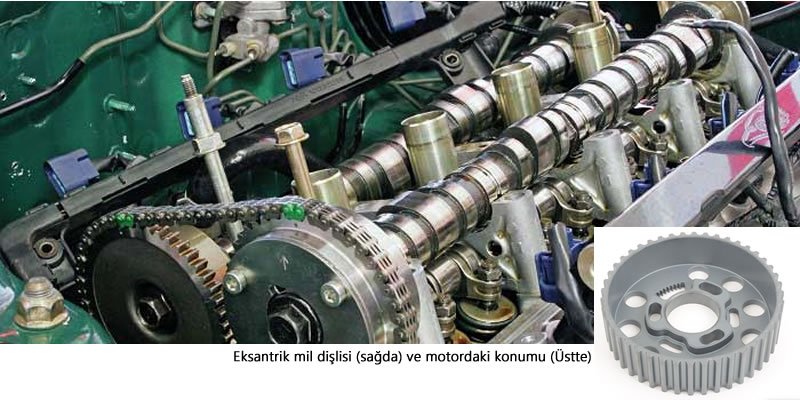
If noise is coming from the camshaft’s timing chain
The chain may have loosened due to wear. The chain links may be worn. The chain link pins may be worn. The chain links may be off-center. The front main bearing clearance may be excessive. The front camshaft bearing clearance may be excessive. The damper or pulley may have loosened.
In this article, we covered engine noises. See you in the next one.
Related Questions
When a cylinder’s spark plug is shorted out, that cylinder temporarily stops producing power. If the bearing knock decreases while doing this, it tells you the noise is coming from the bearing associated with that cylinder.
A continuous, regular noise usually points to a rubbing or worn part, while an intermittent noise tied to a specific event (like a certain RPM) can point to a different kind of problem. This distinction is an important clue for narrowing down the source of the fault.
Related Posts
 What Is a Starter Motor, What Does It Do?
  What Does the Noise from the Valves Mean?
  10 Basic Things Every Driver Should Know
  Is It Harmful to Drive Off Without Warming Up the Engine?
  Why Does an Engine Misfire? Engine Misfire Problem
  What the Markings on a Car Tire Mean
  If the Engine Won’t Start, the Reason. Reasons the Engine Won’t Start
  What Is a Diesel Particulate Filter (DPF)? What Does It Do?