Close Menu
  • MAKİNELER ve İMALAT
    • Tools & Equipment
    • Computer-Aided Drawing
    • CAD/CAM Education
    • CNC Machine Programming
    • Casting Technologies
    • Electrical & Electronics Technologies
    • Hydraulics & Pneumatics
    • Manufacturing Processes
    • Manufacturing Technologies
    • Occupational Safety
    • Mold & Die Design
    • Solid Modeling
    • Welding Technology
    • Machine Elements
    • Mechanical Trade Drawing
    • Materials Science
    • Automotive & Vehicle Technologies
    • Robotics Technologies
    • Health Technologies
    • Defense & Aerospace Technologies
    • Descriptive Geometry
    • Technical Drawing
    • Software & Hardware Technologies
    • Innovative Manufacturing Methods
  • TEKNOLOJİ ve YAŞAM
    • OTOMOBİLLER ve TAŞIT
      • Vehicle & Engine Knowledge
      • Safe Driving
      • Sürüş Destek Sistemleri
    • Genel Kültür
      • Movies & TV Shows
      • Görsel ve Grafik Sanat
      • Books & Literature
      • Music
      • Sports
      • History
      • History of Technology
    • GÜNDELİK YAŞAM TEKNOLOJİLERİ
    • Hobbies & Entertainment
    • Internet Technologies
    • Health
    • Mobile Technologies
Makine Eğitimi
  • Machines & Manufacturing
    Machine Elements
    Hydraulics & Pneumatics
    Technical Drawing
    Computer-Aided Design & Manufacturing
    Basic Manufacturing Processes
    Manufacturing Processes
    Industry Technologies
    Other Technical Courses
    Motion & Power Transmission
    Simple Machines
    Chains & Sprockets
    Shafts & Journals
    Gears
    Cams
    Couplings
    Belts & Pulleys
    Springs
    Bearings
    Keys
    Fastening Joining
    Retaining Rings
    Screws, Bolts & Nuts
    Cotter Pins
    Flanges
    Welding
    Rivets
    Pins & Bolts
    Washers
    Calculators
    Gear Ratio Calculator
    Spring Constant Calculator
    Belt Pulley Ratio Calculator
    Other Machine Elements
    Slides & Linear Guides
    Brakes
    Flywheels
    Clamps
    Shock Absorbers
    Gaskets & O-Rings
    Seals & Sealing Elements
    Hydraulics
    Introduction to Hydraulics & Principles
    Hydraulic Systems & Applications
    Accumulators
    Filters
    Motors
    Pumps
    Valves
    Pneumatics
    Introduction to Pneumatics & Principles
    Pneumatic Systems & Applications
    Pneumatic Circuit Components
    Valves
    Cylinders
    Silencers
    Motors
    Compressors
    Dryers
    Conditioning Units
    Common Topics & Maintenance
    Hydraulic & Pneumatic Maintenance
    Study Notes, Exams & Tests
    Technical Drawing
    Introduction to Technical Drawing
    Geometric Drawings
    Perspective & Projection
    Orthographic Views
    Dimensioning
    Sectioning
    Assembly & Detail Drawings
    Tolerances
    Surface Finish Symbols
    Mechanical Engineering Drawing
    Screws, Bolts & Nuts
    Pulley Drawings
    Gear Drawings
    Shafts & Journals
    Bearing Drawings
    Pins & Bolts
    Spring Drawings
    Welds in Technical Drawing
    Washers
    Cotter Pins
    Technical Drawing Exercises
    Mechanical Drawing Exercises
    Gear Exercises
    View Extraction Exercises
    Pulley Exercises
    Pin & Bolt Exercises
    Threaded Fastening Exercises
    Descriptive Geometry
    Computer-Aided Drawing
    AutoCAD Drawing Lessons
    Computer-Aided Drawing Exams
    Solid Modeling & Animation
    Solid Model Drawing Files
    Solid Model Assembly Examples
    Solid Model Drawing Lessons
    3D CAD Software Reviews
    Solid Modeling Exercises
    CNC Programming
    CAM
    Measurement & Inspection
    Dial Indicators
    Calipers
    Gauges
    Micrometers
    Materials Science
    Steels
    Cast Iron
    Aluminum
    Plastics
    Material Testing & Hardness Measurement
    Occupational Safety
    Workshop Safety
    Safety When Working With Electricity
    Machine Safety Rules
    Hand Operations
    Filing
    Marking
    Cutting Operations
    Reaming
    Tapping
    Threading With a Die
    Drill Bit Sharpening
    Working With Machines
    Basic Turning Operations
    Basic Milling Operations
    Shaper Machine
    Machining
    Turning
    Milling
    Grinding
    Innovative Manufacturing Methods
    EDM (Electrical Discharge Machining)
    Laser Machining
    Waterjet Machining
    3D Printing
    3D Scanners
    Welding
    Rolling
    Casting
    Mold & Die Design
    Mechanical & Hydraulic Presses
    Blanking & Piercing Dies
    Bending Dies
    Drawing Dies
    Plastic Injection Molds
    Extrusion Dies
    Compound Dies
    Progressive Dies
    Blow Molds
    Spinning Dies
    Spray Molds
    Manufacturing of Machine Parts
    Automotive & Vehicle Technologies
    Motor Vehicle Manufacturing
    Raw Material Production
    History of Technology
    Health & Medical Technologies
    Defense & Aerospace
    Robotics Technologies
    Software & Hardware Technologies
    Mechanics - Strength of Materials
    Physics Topics
  • Technology & Life
    Hobbies & Entertainment
    Sports
    Music
    Vehicle & Engine Knowledge
    Vehicle Maintenance & Repair
    Safe Driving
    Driver Assistance Systems
    History
    Movies & TV Shows
    Books & Literature
    Computers & Internet
    Computer Tips
    Software Reviews
    Hardware & Peripherals
    Practical & Safe Internet Use
    Visual & Graphic Art
    Mobile Technologies
    Travel
    Science
    Health
    First Aid Knowledge
    Everyday Technologies
Makine Eğitimi
Home»Vehicle & Engine Knowledge»What Is ESP in Vehicles? What Does It Do? How Does It Work?
30 August 2026Updated:20 September 2026

What Is ESP in Vehicles? What Does It Do? How Does It Work?

what is ESP in vehicles, what does it stand for. ESP abbreviation

This article answers questions like: what is ESP in vehicles, what does it stand for, what does the ESP abbreviation mean, and what does ESP do. If you’re wondering how ESP works and what its function is, keep reading.

  • What Is ESP in Vehicles?
  • What Does ESP Do
  • How Does ESP Work?
    • Watch Electronic Stability Control in Action
  • Related Questions

What Is ESP in Vehicles?

ESP stands for the initial letters of the phrase “Electronic Stability Program”. To explain what ESP is: in modern vehicles, it’s one of the safety systems designed to help the driver avoid losing control of the vehicle during sudden high-speed braking or sharp turns.

what is ESP in vehicles, what does it stand for. ESP abbreviation

Electronic Stability Control was introduced in the 1990s by Bosch, one of the leading automotive parts manufacturers, and was first used in a Mercedes-Benz vehicle. ESC was available as an optional feature on vehicles produced in the 2000s. About 50% of vehicles released in 2007 had ESC.

Preventing Skids


ESP detects the vehicle’s skidding (fishtailing) motion and tries to prevent unwanted rotation.

Individual Wheel Braking


The system can selectively apply the brake to a single wheel when needed to correct a skid.

Mandatory Safety Equipment


ESP has been legally mandatory on all new vehicles produced in the EU since 2014.

What Does ESP Do

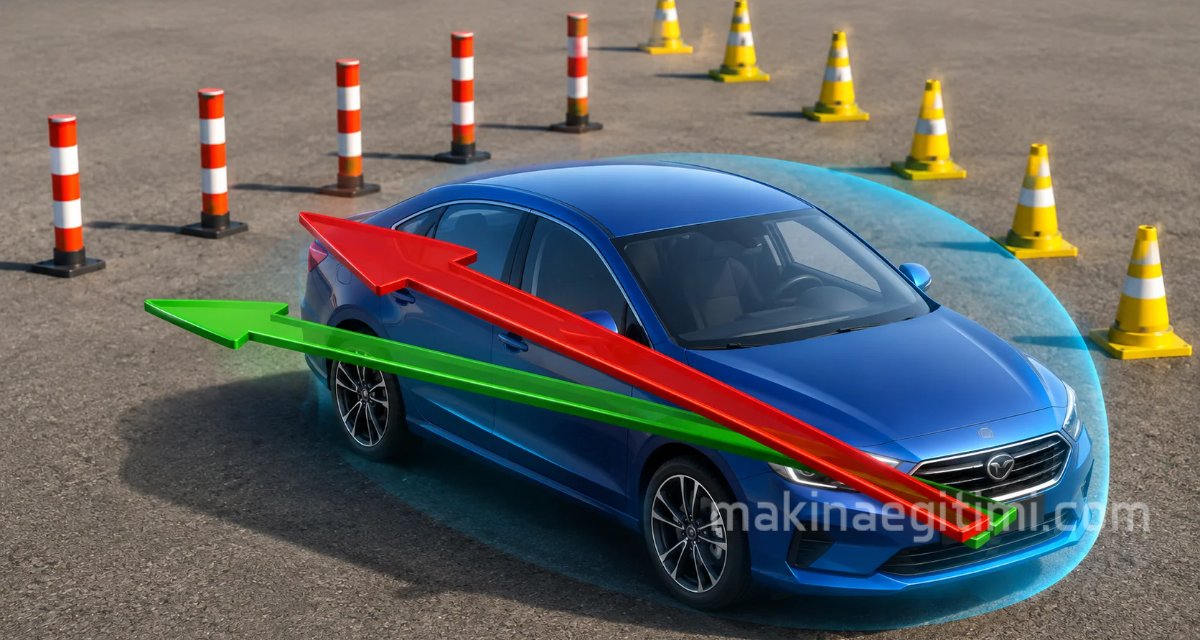
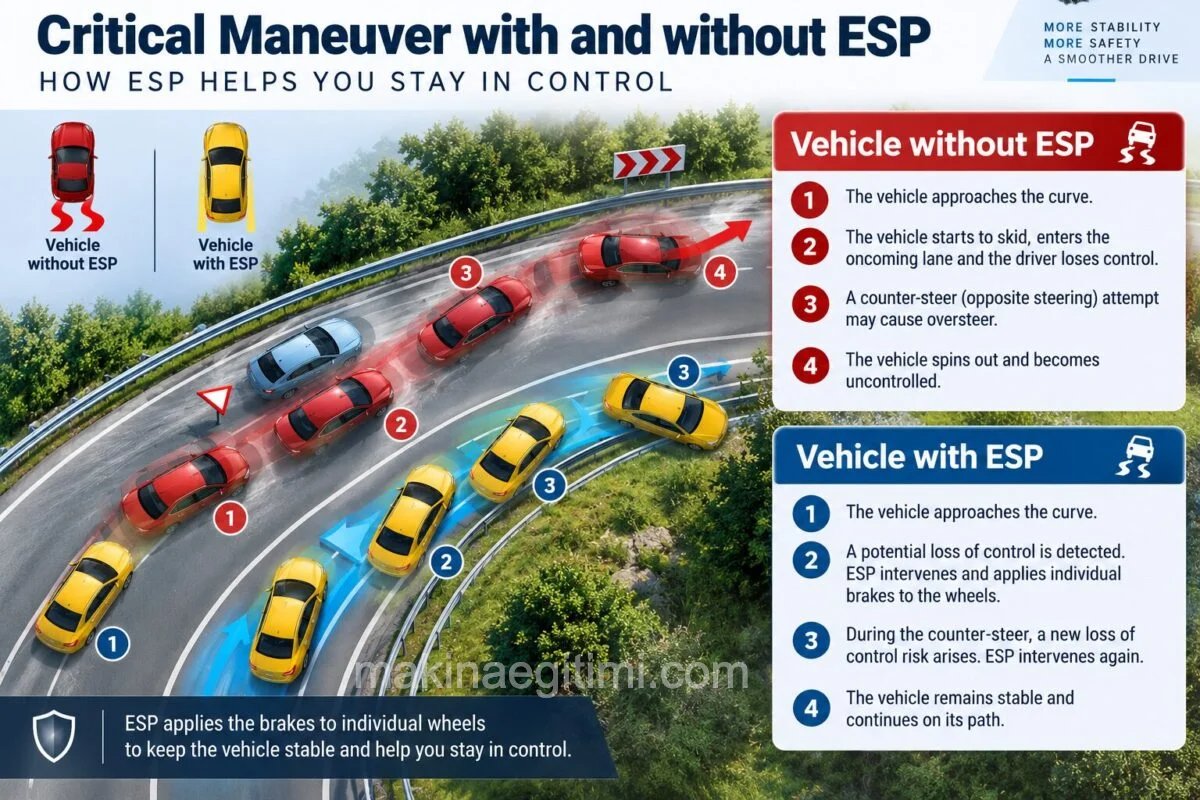
Imagine you’re driving a car at high speed and suddenly encounter an obstacle. A scenario like this forces you to make a sharp turn or brake to avoid a possible collision. However, while doing this, you could lose control and go off the road, which could lead to an undesired event like an accident. The vehicle you’re driving could also roll over. To prevent this situation, manufacturers use the Electronic Stability Program (ESP), or Electronic Stability Control system (ESC).
critical-maneuver with and without esp

ESP is a smart safety system that can anticipate driving intent. So, what does ESP do?
First, ESP helps the driver maintain the wheel’s intended path. It does this by applying the brake to individual wheels. Second, it can also adjust engine performance during critical maneuvers. However, ESP’s ultimate purpose is to increase vehicle stability. This way, ESP increases stability by preventing the vehicle from skidding out.

How Does ESP Work?

The Electronic Stability Program (ESP) consists of the following components:

  1. Hydraulic unit
  2. Wheel speed sensors
  3. Steering angle sensor
  4. Yaw rate and lateral acceleration sensor
  5. Engine control unit

So, how does ESP work?
While driving, ESP continuously monitors steering wheel movement and speed changes at the wheels via its sensors. In addition, the yaw rate and lateral acceleration sensors determine the vehicle’s exact orientation.

This data is sent to the ECU (electronic brain). ESP engages when it detects a mismatch between the movement of the steering wheel and the actual movement of the car’s wheels.

how does esp work

This way, the system can detect an obstacle on the road or an overly sharp turn. In such situations, the system applies the required braking force only to the wheels that need it. And this way, it restores the driver’s control over the vehicle.

This system also has an advantage over ABS and TCS systems. This is because it can actually anticipate the vehicle’s driving behavior. When the Electronic Stability Program engages, it lights up an indicator icon on the dashboard. In most cases, the driver doesn’t feel any difference in the vehicle when ESP activates, other than improved control.

When referring to the Electronic Stability Program or Electronic Stability Control, most vehicle manufacturers use the term ESP. However, some manufacturers use the following brand-specific abbreviations.

AbbreviationFull NameBrand
DSCDynamic Stability ControlBMW
VSAVehicle Stability AssistHonda
VSCVehicle Stability ControlToyota

Watch Electronic Stability Control in Action

In this article, we covered topics like what ESP is in vehicles, what it stands for, what ESP does, and how ESP works. We discussed the ESP system’s components, parts, and how it operates. See you in our next articles. Have a great day, and safe driving.

Related Questions

The system continuously compares the angle the steering wheel is pointed toward with the direction the vehicle is actually traveling. When an unwanted difference forms between the two, this is interpreted as a sign of a skid.

Applying the brake to a specific wheel of the vehicle slows that side down, creating a rotational force (moment) around the vehicle. This controlled force helps reverse and correct the vehicle’s unwanted skidding direction.


Related Posts

What is the TCS light? Why does it come on? Why Does the Traction Control System Light (TCS Light) Come On? How to engine brake by downshifting What Is Engine Braking? Does It Damage the Vehicle? rear-wheel-drive vehicle drivetrain Characteristics and Advantages of Rear-Wheel-Drive Vehicles Vehicle charging system components and operation diagram How Does a Vehicle’s Charging System Work? Components, Jobs, and Failures Diesel engine versus gasoline engine performance comparison Diesel Engine vs. Gasoline Engine: Which Is More Powerful? what is a catalytic converter in the vehicle exhaust system What Is a Catalytic Converter, What Is It For? Mercedes-Benz V8 engine production Mercedes-Benz AMG 63 V8 Engine Manufacturing Motor Yakıt Sistemi ve Bileşenleri Vehicle Fuel System Components and Their Functions
Share. Facebook Twitter WhatsApp Tumblr Email Telegram Copy Link

Leave A Reply Cancel Reply


The Financial Origins of the French Revolution: How a Kingdom Collapsed Into Bankruptcy
When Should the Timing Belt Be Replaced
  • Contact
  • Terms of Service
  • Privacy & Cookie Policy

Type above and press Enter to search. Press Esc to cancel.