
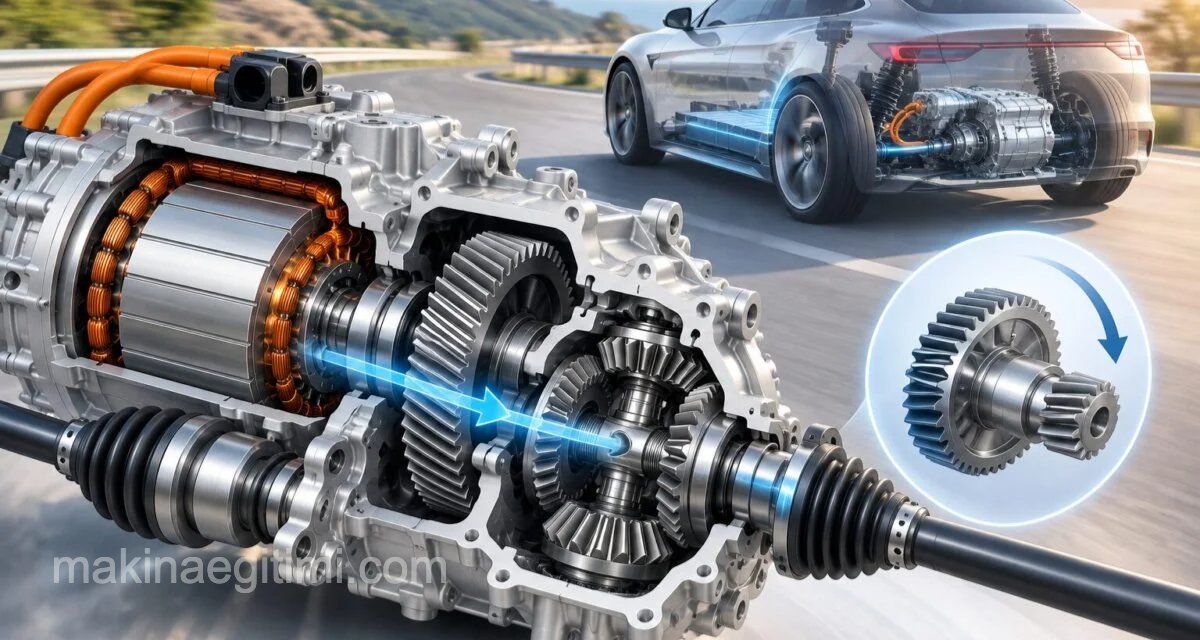
There is one thing everyone notices the first time they get behind the wheel of an electric car: there are no gears. No clutch pedal, no gear lever, and none of that familiar jolt as the car shifts while accelerating. From the Tesla Model 3 to the Hyundai Kona Electric, from the Renault Zoe to the BYD Atto 3, almost every electric car on the market runs on a single fixed gear ratio.

This is not a shortcoming. It is a deliberate engineering choice that follows from the nature of the electric motor itself. In this article we explain in plain language why electric cars do not use multi-speed gearboxes, how the single-speed system works, and why exceptions such as the Porsche Taycan exist.
Why Do Petrol Engines Need Gears?
To understand this, you first have to look at why petrol and diesel engines need so many gears. An internal combustion engine only produces its power efficiently within a certain rev range, typically between 2,000 and 4,500 rpm.
Outside that band, power and efficiency fall away sharply. That is why a car needs five, six, or even eight to ten gears to keep the engine in its efficient rev band at every road speed. Changing gear is really an effort to keep the engine permanently in the rev range where it works best.
Why Do Electric Motors Behave Differently?
Electric motors work to a completely different rule of physics. An electric motor can produce its maximum torque while standing still — that is, at zero rpm. The reason is that torque is proportional not to engine speed but to the current flowing through the motor windings. In other words, an electric motor can reach full power instantly, rather like a lamp that lights the moment you flick the switch.

The chart above is a simplified comparison prepared to show the typical characteristics; real figures vary from motor to motor. What it makes clear is the fundamental difference: an electric motor produces high torque from low revs and can hold it across a wide rev range, whereas a petrol engine builds its torque higher up the rev range and lets it fall away beyond a certain point.
An electric motor typically produces constant, maximum torque from 0 rpm up to somewhere between 4,000 and 6,000 rpm. This is called the constant torque region. Beyond that point the motor moves into the constant power region, where torque falls as revs rise but power stays constant.
This allows the motor to keep working efficiently up to 15,000 or even 20,000 rpm. The rear motor of the Tesla Model 3 Performance, for instance, can spin to around 18,000 rpm — nearly three times the red line of an average petrol engine.
The Advantages of a Single Gear
Thanks to this wide, efficient rev range, a single fixed gear ratio can deliver both a strong pull away at low city speeds and adequate top speed at motorway pace. That simplicity brings the concrete advantages below.
Fewer moving parts: There is no need for complex components such as selector forks, synchroniser rings or clutch packs.
Lower weight: A conventional six-speed automatic gearbox weighs between 70 and 90 kilograms, while a single-ratio reduction gear for an electric car generally weighs between 25 and 40 kilograms.
Higher reliability: The gear-change mechanism is among the most failure-prone parts of a conventional car. In an electric car that risk largely disappears.
Uninterrupted acceleration: Because there is no break in power during a gear change, acceleration feels completely smooth and seamless.
Lower production and maintenance costs: Fewer parts means less labour and less servicing.
The difference is clear in efficiency terms too. The mechanical efficiency of a single-speed reduction gear in an electric car is between 96 and 98 per cent. A multi-ratio automatic gearbox, by contrast, works at between 85 and 92 per cent because of losses in the torque converter and the hydraulic controls.
How Does the Reduction Gear Actually Work?

The part referred to as a “single-speed gearbox” in electric cars is not really a gearbox in the classic sense. It is a fixed-ratio reduction gear set, usually made up of two or three stages of helical gear pairs. Its job is simple: to bring the motor’s high rotational speed down to a speed the wheels can turn at. As the speed falls in this process, torque is multiplied. The differential is mostly built into the same housing, which gives a further packaging advantage.
The reduction gear in the Nissan Leaf, for example, works at a ratio of about 7.94:1, while in high-torque performance cars that ratio can rise to between 9:1 and 10:1.
Does Every Electric Car Have a Single Gear?
There are exceptions to the rule. The Porsche Taycan is one of the few production electric cars to use a two-speed gearbox on its rear axle. First gear provides a strong launch and rapid acceleration at low speed, while second gear lowers motor revs at motorway speeds and so improves energy efficiency and top speed. In the same way, some heavy commercial electric trucks use gearboxes with between two and four speeds so that they can reach different operating points under load.

So why do most manufacturers not go down this road? The Taycan showed that developing a multi-speed gearbox for an electric car is decidedly difficult. Matching the gear change to the millisecond-level response of an electric motor is a serious engineering challenge and adds considerably to the cost. The gain, meanwhile, is usually limited: in the Taycan’s case the estimated increase in range is between 1 and 3 per cent. For most manufacturers a gain that small is not enough to justify the extra complexity, weight and cost.
Torque Distribution in Single- and Dual-Motor Systems
The simplicity of the single-speed reduction gear also makes it easier to apply different drivetrain architectures economically. In single-motor rear-wheel-drive cars the reduction gear is integrated directly into the rear axle, while in dual-motor four-wheel-drive systems an independent motor and reduction gear unit is placed on each of the front and rear axles.
This means torque distribution can be adjusted electronically, in a fraction of a second, with no need for a mechanical propshaft. In the Tesla Model Y Performance, for instance, the two separate motors on the front and rear axles work through their own single-ratio reduction gears and can distribute torque instantly.
The Link with Regenerative Braking
The fixed ratio of the single-speed reduction gear is also an advantage during regenerative braking. When the motor switches to generator mode, the relationship between wheel speed and motor speed always stays at the same fixed ratio. That makes life easier for the energy recovery algorithm.
In a multi-speed system, by contrast, regenerative braking torque can be interrupted briefly during gear changes, which can affect both ride comfort and the efficiency of energy recovery.
Will This Change in the Future?
Some manufacturers and suppliers continue to explore multi-speed solutions, particularly in the high-performance electric sports car segment. In mainstream, mass-produced electric cars, however, advances in motor and power electronics technology — motors capable of higher revs and wider efficient operating ranges — suggest that the single-speed architecture will remain the dominant standard for some time to come.
Conclusion
The use of a single gear in electric cars is not a shortcoming but a smart engineering solution arising from the physical characteristics of the electric motor.
Because an electric motor can produce maximum torque at zero rpm and work efficiently across a very wide rev range, the need for complex multi-speed gearboxes disappears. That simplicity delivers a drivetrain that is lighter, more reliable, quieter and needs less maintenance. Exceptions such as the Porsche Taycan remain rare examples that prove the rule.
Related Videos

Why Do Electric Cars Only Have 1 Gear?

Porsche Taycan: 800‑volt architecture, two‑speed gearbox and EV track tech

Porsche Taycan's SECRET 2-Speed Transmission Explained! #shorts
Frequently Asked Questions
No. Because there are no gear changes in a single-speed system, acceleration feels seamless and smooth, with no interruption in torque.
Not necessarily. A well-designed single-speed system offers ample performance across a wide speed range. Multiple gears are generally chosen for top speed and motorway efficiency, as in the Porsche Taycan.
The electric motor’s maximum torque from 0 rpm and its wide efficient operating range, stretching to 15,000–20,000 rpm, remove the need for a complex gear-changing mechanism.
It needs far less maintenance than a conventional multi-speed gearbox; periodic checking and changing of the gear oil is generally enough, and there is no clutch or synchroniser ring wear to worry about.
It varies from model to model, but the typical ratio is between 7:1 and 10:1. The Nissan Leaf uses about 7.94:1, while in high-torque performance cars the ratio can rise to 9:1–10:1.
Electric cars have no gears for the driver to change, but they do have a fixed-ratio reduction gear that brings motor speed down to wheel speed. Because it works with a single gear ratio, it is described as “single-speed”.
Technically it is possible, but it would largely undo the efficiency and simplicity that electric cars offer. That is why manufacturers do not go down this route.
The two-speed gearbox on the Taycan’s rear axle is designed to deliver both a strong launch at low speed and high efficiency at motorway speeds. It is an important part of the Taycan’s repeatable, consistent acceleration performance.
Yes, but far less than a multi-speed gearbox. Periodically checking the gear oil is usually enough, because the system contains no wearing parts such as clutch packs or synchroniser rings.
Electric motors have no pistons, valves or combustion chamber as internal combustion engines do. Without those mechanical constraints, electric motors can spin smoothly up to 15,000–20,000 rpm.
Related Posts
 Characteristics and Advantages of Rear-Wheel-Drive Vehicles
 Diesel Engine vs. Gasoline Engine: Which Is More Powerful?
 What Is an Intake Manifold? Its Job, and Diagnosing a Fault
 What Is AdBlue, What Does It Do?
 What Is Engine Braking? Does It Damage the Vehicle?
 Vehicle Drivetrain: Components, How It Works, and Common Failures
 The Importance of Using Original Parts on a Motorcycle
 Why Does the Traction Control System Light (TCS Light) Come On?