
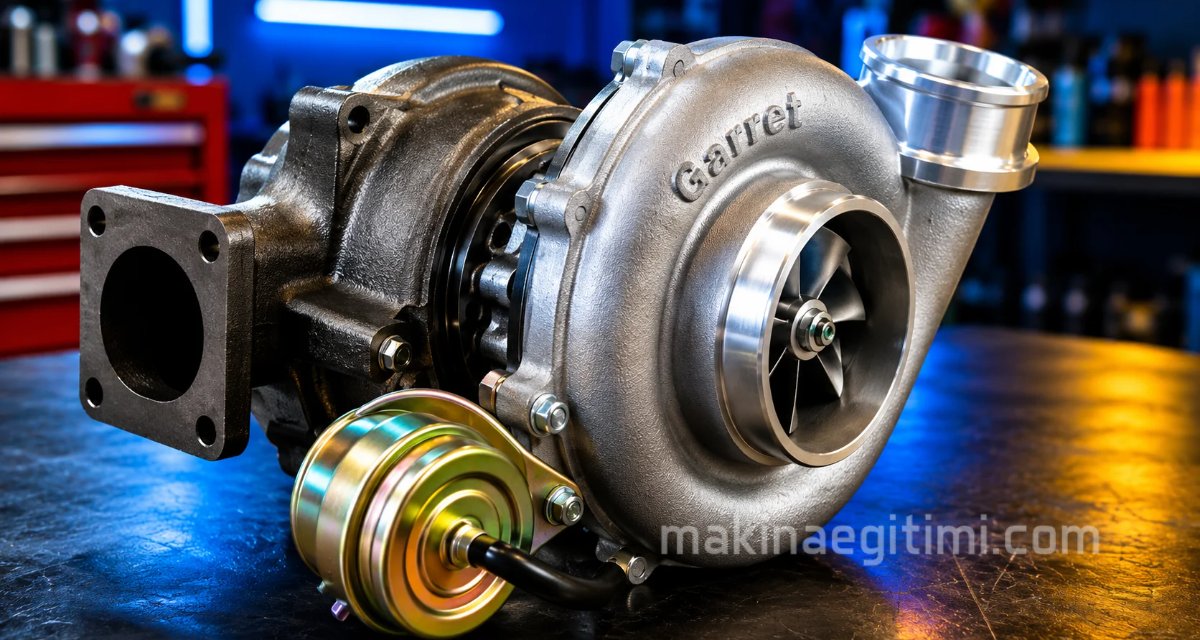
One term that comes up often when looking at a car’s technical specifications is turbocharger, or simply turbo for short. Today, turbo systems are used in a large share of both gasoline and diesel engines. So what does a turbo actually do, how does it add power to the engine, and does it really save fuel?
In this article, we cover the turbocharger system in plain language anyone can understand.
What Is a Turbocharger?
A turbocharger is a system that lets the engine take in more air, allowing more power to be extracted from the same engine displacement.

Under normal conditions, engines draw air into the cylinders using atmospheric pressure alone. A turbo, on the other hand, uses the energy from exhaust gases to push more air into the engine. When more air enters the cylinder, more fuel can be burned, and as a result, the engine produces more power.
In short, a turbo boosts engine performance without increasing engine displacement.
Bosch, Mahle, and Honeywell are some of the world’s popular turbo manufacturers.
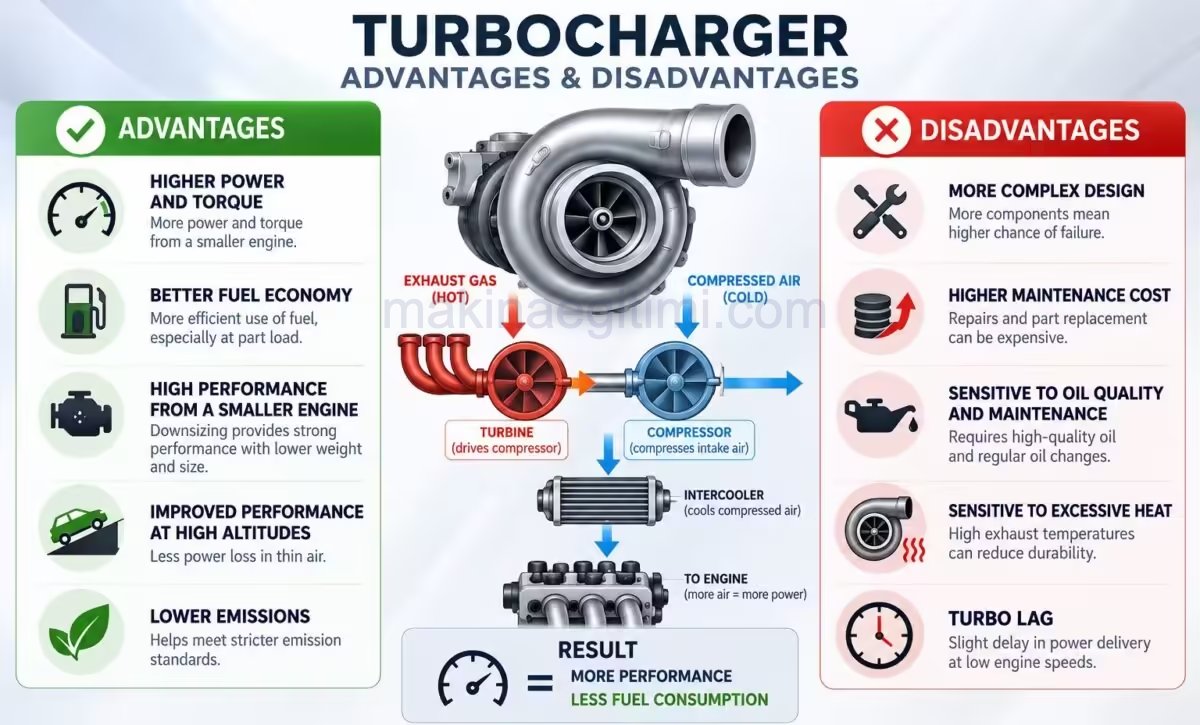
Advantages of a Turbocharger
Turbo systems have several important advantages.
- Higher power is achieved from the same engine displacement.
- High performance can be achieved with smaller-displacement engines.
- It can contribute to fuel economy.
- It produces higher torque.
- Mid-range acceleration is stronger.
- Hill-climbing performance improves.
- The engine runs more comfortably while carrying a load.
For this reason, small-displacement turbo engines have become quite widespread today.
Disadvantages of a Turbocharger
Turbo systems also have some disadvantages.
- Their design is more complex than naturally aspirated engines.
- Maintenance costs can be higher.
- Oil changes need to be done on time.
- Low-quality engine oil can shorten the turbo’s lifespan.
- Repair costs can be high in the event of a failure.
That said, on vehicles that receive regular maintenance, a turbo can run trouble-free for many years.
How Does a Turbocharger Work?
A turbocharger is turbine-driven. Forced induction is a mechanical process. First, it compresses incoming air. It then pumps that air into the engine cylinder at high pressure. This increases the engine’s efficiency and power output. It’s roughly 30% to 40% more efficient than naturally aspirated engines.
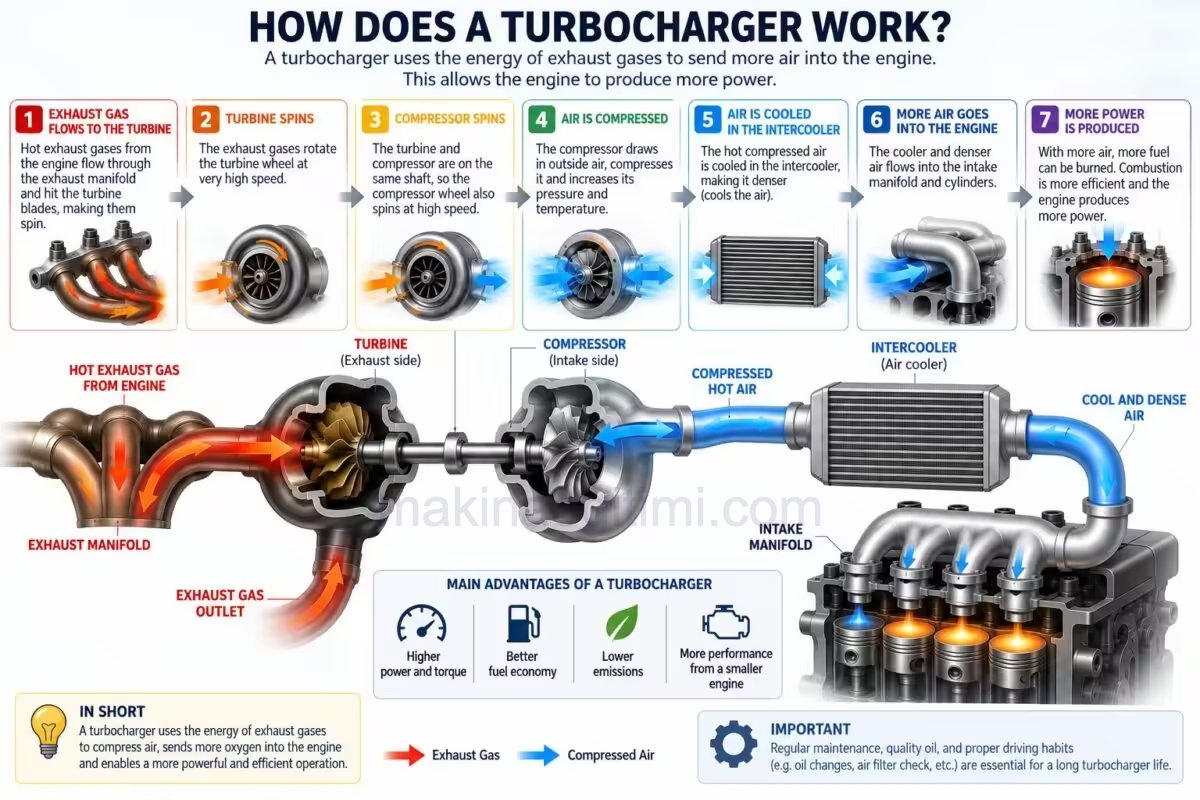
A turbo system is made up of two basic sections: the turbine and the compressor.
The operating principle is quite simple.
- The exhaust gases generated as the engine runs are directed to the turbine.
- The pressure of the exhaust gases spins the turbine blades.
- The turbine also spins the compressor, which is connected to the same shaft.
- The compressor compresses the air it draws in from outside.
- The pressurized air is sent to the intake manifold.
- More oxygen enters the cylinders.
- The engine achieves more powerful combustion.
This entire process happens thanks to a turbo that spins hundreds of thousands of times per minute.
What Components Make Up a Turbo System?
A turbocharger system is basically made up of the following components:
- Turbine
- Compressor
- Shared shaft
- Wastegate
- Intercooler
- Lubrication system
- Air piping
These components working together make the engine more efficient.
Watch a Turbocharger in Action:
What Does an Intercooler Do?
The air compressed by the turbo heats up. Hot air carries less oxygen to the engine because its density is lower. An intercooler cools the compressed air, increasing its density. This lets more oxygen reach the cylinders, and the engine runs more efficiently.
What Is Turbo Lag?
On older-generation turbo engines, it could take a brief moment for turbo boost to build after pressing the throttle. This delay is called turbo lag.
Today, thanks to variable-geometry turbos (VGT/VNT), twin-turbo setups, and electronic control systems, this lag has been reduced considerably.
Turbo RPM
Turbochargers can spin up to 150,000-250,000 RPM; this extreme speed requires precise lubrication.
Turbo Lag
Turbo lag is the brief delay after pressing the throttle for the exhaust gas to spin the turbine up to speed.
Twin-Turbo Systems
Some engines use two differently sized turbos (twin-turbo) to balance performance across low and high RPM.
How Should a Turbo Engine Be Maintained?
For a turbo system to have a long lifespan, some rules should be followed.
- Change the engine oil and oil filter on time.
- Use the engine oil recommended by the manufacturer.
- Replace the air filter regularly.
- Avoid excessively straining the engine.
- Don’t delay periodic maintenance.
A turbo system that receives regular maintenance can run trouble-free for hundreds of thousands of kilometers.
Should the Engine Be Shut Off Immediately After a Long Drive?
Drivers of turbo vehicles used to be advised not to shut off the engine right after a long, fast drive. This was to allow the turbo, which reaches very high temperatures, to keep receiving lubrication for a bit longer.
Today, lubrication and cooling systems on many modern vehicles are far more advanced in this regard. Still, after prolonged driving at high speed or under heavy load, letting the engine idle for about 30-60 seconds before shutting it off can positively contribute to the turbo’s lifespan.
Symptoms of a Turbo Failure
A failure in the turbo system can present with the following symptoms:
- A noticeable drop in traction
- A delayed response to the throttle
- Black or blue smoke from the exhaust
- A whistling or whining sound from the turbo area
- The check engine light coming on
- Increased fuel consumption
If you notice one or more of these symptoms, it’s recommended to have the vehicle checked at a specialized service center.
Does a Turbo Increase Fuel Consumption?
The answer to this question depends on how the vehicle is driven.
Under normal, calm driving, turbo engines can have lower fuel consumption, since they can produce the same performance from a smaller engine displacement. However, when driven continuously at high RPM and full throttle, the turbo pushes more air in, and as a result, more fuel will be burned too.
In other words, a turbo isn’t a system that increases fuel consumption on its own — driving style is the most important factor in determining consumption.
In this article, we covered the advantages and disadvantages of turbo vehicles. We explained how the turbo system works and what components it’s made of. We also touched on subjects like the symptoms of a turbo failure and how to maintain a turbo engine. We answered the question: does a turbo increase fuel consumption?
To sum up, a turbocharger
is an advanced system that uses the energy of exhaust gases to push more air into the engine, allowing more power to be extracted from the same engine displacement. It’s widely used today in both diesel and gasoline engines. A turbo system that receives regular maintenance, uses quality engine oil, and is used with correct driving habits can run efficiently for many years. For this reason, the turbo is regarded as one of the most important technologies bringing performance and fuel economy together in modern automobiles.
Frequently Asked Questions
A turbo uses the energy from exhaust gas to force more air into the cylinder than normal. When more air enters, more fuel can be burned, which means more power from the same engine displacement.
A small turbocharged engine can produce power similar to a larger engine without a turbo. Since the small engine burns less fuel while idling or under light load, average consumption during everyday driving drops.
Related Posts
 Properties and Advantages of Scooters
  Properties of Ethanol (Ethyl Alcohol) Blended Gasoline
  The Biggest and Craziest Engines of All Time
  Front-Wheel-Drive Vehicles: Advantages and Disadvantages
  If the Engine Won’t Start, the Reason. Reasons the Engine Won’t Start
  What Is a Clutch? How Does It Work? Failures and What Drivers Should Know
  Properties and Advantages of Alloy Wheels
  Engine Noises and What They Mean