

There’s a lot of writing on a vehicle’s tires that gives information about the tire. In this article, we’ll focus on what the letters and numbers on the side of a car tire mean.
A lot of information, such as the tire’s manufacturing date, tread width, aspect ratio, rim width, and load and speed index, is written on the tire’s sidewall using various letters and numbers.
What Do the Markings on a Tire Mean?
Speaking of car tires, a vehicle’s tire has the manufacturing date, country of manufacture, tire size, and load and speed index on it. Seasonal characteristics are also written on the tire’s sidewall (on winter and all-season tires).

Now, based on the example above, let’s try to explain what the letters and numbers on a car tire mean:
The “205/55 R16” part: This reads as your tire’s tread width is 205 mm, the sidewall’s ratio to the tread is 55%, and the rim the tire fits is a 16.
The “91 V” part: The number 91 indicates the tire’s load-carrying capacity, meaning that 1 tire can withstand a maximum weight of 615 kg. You can see this in the tire load index table given below. V, on the other hand, is the tire’s speed index, meaning the maximum speed it can be used at. Tires in the V class can be used up to 240 km/h. For details, SEE: tire speed index table
The part on a car tire starting with DOT and followed by 4 digits: This indicates the tire’s manufacturing date. A tire with DOT 0204 means it was manufactured in the 4th week of 2004.
The M/S symbol: Found on winter tires, it indicates the climate conditions it’s suitable for. This value, short for Mud/Snow, indicates the tire is suitable for traveling in mud and snow.
An arrow indicating a specific direction: Found on some tires. It indicates which way the tread pattern should face forward, especially on directional-tread tires. Symmetrical and summer tires generally don’t have a direction.
Tire Dimensions Written on the Tire
The numbers on a car tire also indicate the tire dimensions to us. For example, let’s say the tires on your vehicle are 245/45/17. What these numbers tell us is: your tires’ tread width touching the ground is 24.5 cm, the distance between the rim and the tire tread (the tire’s sidewall) is 45% of the tire’s tread width, and your rim’s size is 17 inches (1 inch=25.4 mm).
If you want to fit your vehicle with tires of a different size than what’s currently on it, you first need to check the sizes approved by the manufacturer, found on the labels on the door pillar or on the fuel filler flap. If you use a tire size not approved by the manufacturer, unfortunately you’ll be assessed as having a major fault at the vehicle inspection.
What Is the Tire Load Index?
Car tires have values like 88T, 91V on them. The numbers in this value indicate how much weight a single tire can withstand. You can see the tire load indices in the table below.

Is the Tire Load Index Important?
There are wires in the tire’s sidewalls that allow it to carry weight. These wires are reinforced according to the tire’s load index. If your vehicle is constantly traveling at full capacity or carrying loads, the likelihood of your tire splitting increases, especially over potholes, etc., and cracks can occur on the tire’s sidewalls even before the tread depth decreases.
What Is the Tire Speed Index?
Car tires have different strength ratings depending on their size. For example, if a 175/70/13 tire provides safe driving up to 160 km/h, a 245/35/19 tire can provide safe driving up to 280 km/h. This value is indicated on the tire’s sidewalls with letters such as 85V, 88T. You can see the tire speed indices in the table below.
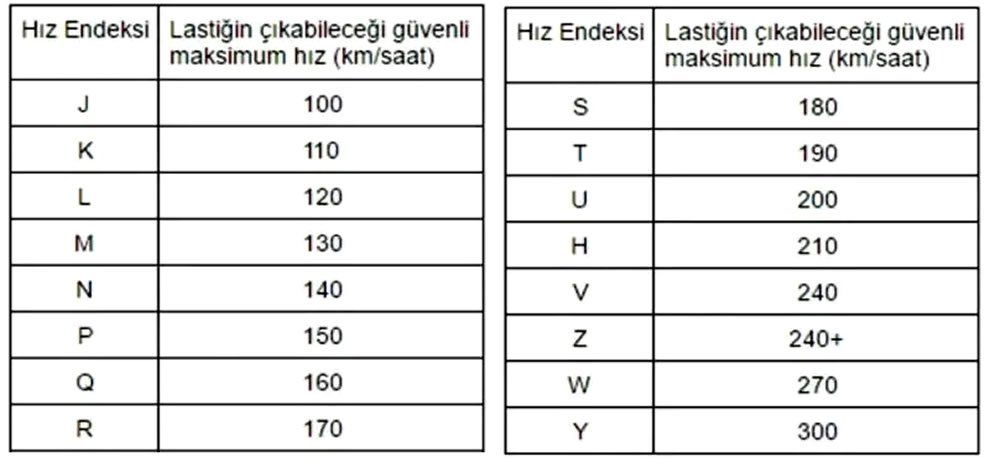
As for whether the tire speed index matters, we can answer that it certainly does. If you fit your vehicle with a tire rated lower than your engine’s performance, you may encounter problems such as rapid wear and splitting at high speeds.
Tire Wear Indicator
Tires have an average lifespan of 5 years or 50,000 km. During this time, either the tread depth decreases significantly, or the tire’s rubber compound hardens and starts to lose grip on the road. You can easily tell a tire has hardened by how frequently the ABS kicks in when you brake, while you can tell the tread depth from the markers on the tire’s tread.
For detailed information about ABS, SEE: What Is the ABS Brake System? What Is It For
Every vehicle has a tire wear indicator like the one in the image above. For safe driving, it’s critically important to replace tires before they reach this limit.
In this article, we tried to explain the meanings of the letters and numbers on a car tire with examples. See you in new articles, we wish you safe, accident-free, and enjoyable drives.
DOT Code
The DOT code on a tire shows the manufacturing week and year as 4 digits (e.g., 2324 = week 23 of 2024).
Load and Speed Index
The number and letter in the tire size code indicate, respectively, the maximum load capacity and the safe maximum speed.
Tread Depth Limit
The legal minimum tire tread depth in Turkey is 1.6 mm; below this level creates a safety risk.
Related Questions
205 indicates the tire’s tread width in millimeters; 55 indicates the sidewall’s ratio to the tread as a percentage. 16 indicates the rim diameter the tire fits.
This letter indicates the maximum speed the tire can safely withstand. Fitting a tire with a lower speed index than the vehicle’s actual performance can create a safety risk at high speed.
Related Posts
 What Is a Starter Motor, What Does It Do?
  What Is an Alternator? What Does It Do?
  What Is a Clutch? How Does It Work? Failures and What Drivers Should Know
  What Is the ABS Braking System, What Does It Do, How Does It Work
  Why Doesn’t the Engine Start? Reasons the Engine Fails to Start.
  What Is a Drum Brake System, How Does It Work
  Why Does an Engine Misfire? Engine Misfire Problem
  The Biggest and Craziest Engines of All Time