

In this lecture-notes-style article, we’ll cover what welding methods exist, what welding types there are and where they’re used, and the strengths and weaknesses of well-known welding methods.
Table of contents
- Welding methods using electric current
- Welding Methods Using Gas
- Welding Methods Using Gas and Electric Current
Welding Methods Using Electric Current
These are welding methods where the welding process is performed using electric current. These are: electric arc welding, submerged arc welding, spot welding, pressure (upset) welding, and seam (roller electrode) welding.
ARC WELDING
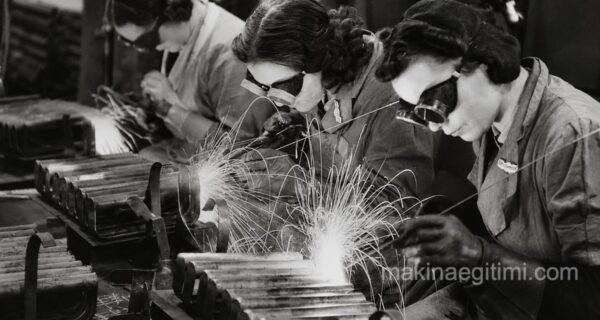
Also known as “electric” welding. An arc forms between the electrode and the parts to be welded. The intense heat produced turns the area being welded and the electrode into a hot liquid state, and they join together.


How electric arc welding is done
Low cost and easy to transport. Its range of applications is wide. This welding method’s symbol is: E
SUBMERGED ARC WELDING
This is one of the welding methods that uses electric current, and is similar to “electric arc” welding. The difference here is that a flux powder is automatically fed onto the weld area. This powder prevents the molten material from immediately contacting air and prevents oxidation.
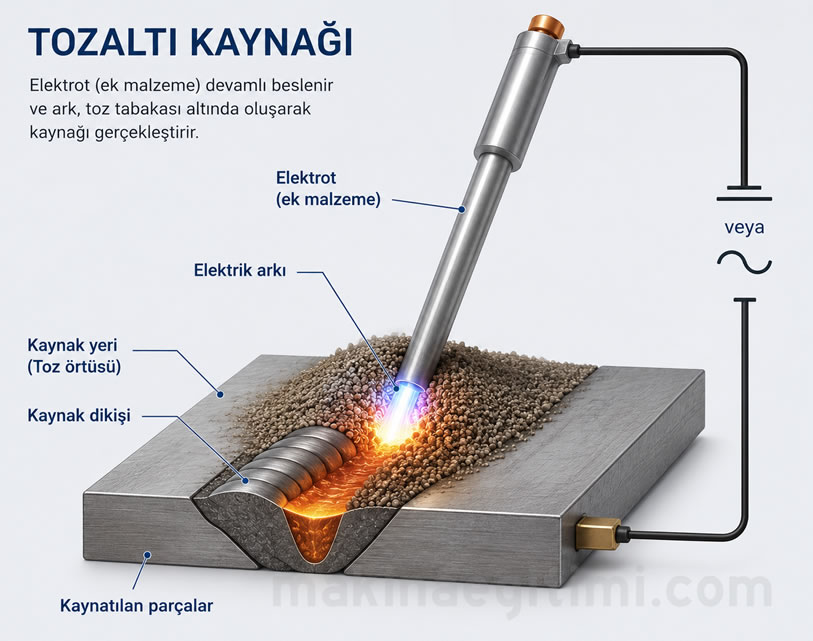

How submerged arc welding is done
The electrode has no protective coating and is wound onto a spool.
For detailed information, see: What Is Submerged Arc Welding? How Is It Done
Spot Welding
In this welding method, two copper electrodes press the materials to be welded together with enough force to make contact, while under electric current.
The electric current generates heat between the plates, and the plates being welded melt at that point and join. The working principle of spot welding is shown in the image alongside.
For details –>
See: What Is Spot Welding? How Is It Done?

Pressure (Upset) Welding
The materials to be welded are brought into contact, electric current is applied, and they’re joined with pressure. Symbol: P

This welding method is used on thick materials with round, square, or angular cross-sections. It’s especially advantageous for steels with varying properties.
Seam (Roller Electrode) Welding
Done similarly to spot welding. Instead of pin-shaped copper electrodes, copper rollers are used to create a continuous, sealed weld. Symbol: RR
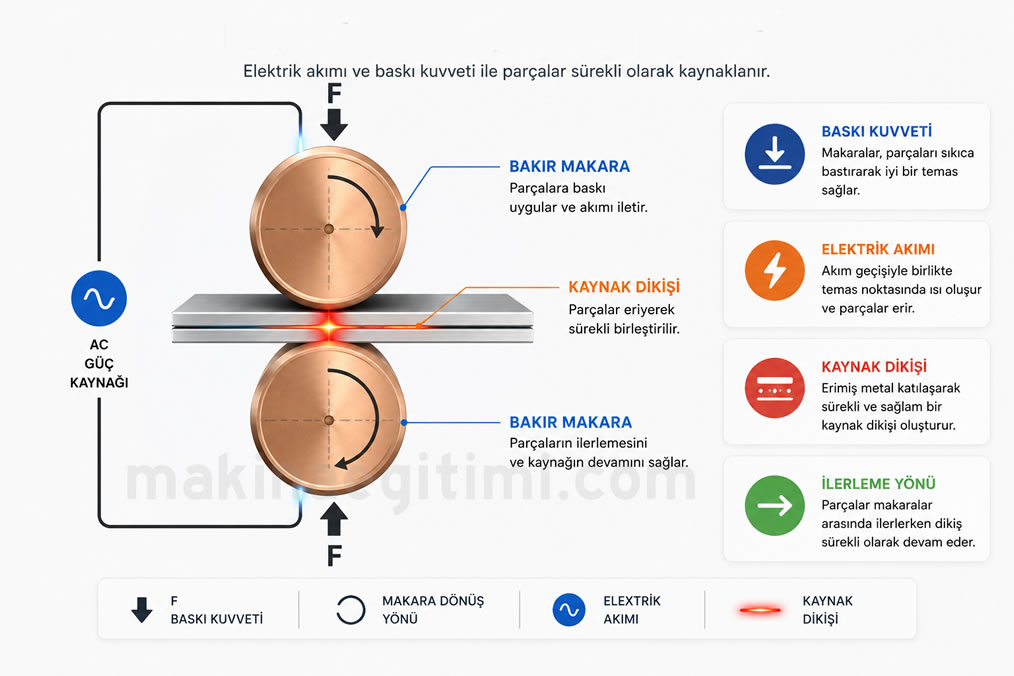
Seam welding is one of the economical welding methods used in sheet-metal construction, shipbuilding and aircraft manufacturing, and the production of fixtures and tools, especially on thin-gauge sheet metal.
Welding Methods Using Gas
These are welding methods where the welding process is carried out using certain gases. These are: oxy-acetylene welding and gas-fusion pressure welding.
Oxy-Acetylene (Oxygen) Welding
Also known as oxygen welding. Using a torch, the combustion of oxygen and acetylene gases produces intense heat (around 3200°C), turning the parts into liquid so they join together. Symbol: G

So where is oxygen welding used? It’s one of the welding methods that can be used in almost any setting. It’s preferred for thin sheet materials and pipes (up to about 15 mm). It’s low-cost and easy to transport. Used for butt and fillet weld joints.
Gas-Fusion Pressure Welding
The materials to be welded are brought into contact, melted with gas, and then joined with pressure.
Where it’s used
This is one of the welding methods especially preferred for steels with varying properties. Used on thick materials.

Prevalence of Arc Welding
Electric arc welding is one of the most widely used welding methods in industry and offers high efficiency.
Flexibility of Oxy-Fuel Welding
Since oxy-acetylene welding doesn’t require electricity, it offers flexibility in field conditions and on thin materials.
Precision of Plasma Welding
Thanks to its very high temperature density, plasma arc welding is preferred for welding thin, precision parts.
Welding Methods Using Gas and Electric Current
These welding methods are known as gas-shielded welding. In this process, the arc forms within a shielding gas atmosphere — argon, helium, CO, or various gas mixtures. This gas protects the weld area from oxidation.
Since the electrode doesn’t need to be replaced frequently, unlike normal arc welding, it’s fast and economical. No slag forms on the weld bead.
For detailed information, see: What Is Gas-Shielded Arc Welding
TIG AND WIG WELDING
TIG: a gas-shielded welding type formed from the initials of “Tungsten Inert Gas.” The TIG welding process is carried out using the intense heat of an arc formed by a non-consumable tungsten electrode. When wolfram is used instead of tungsten, it’s called WIG.
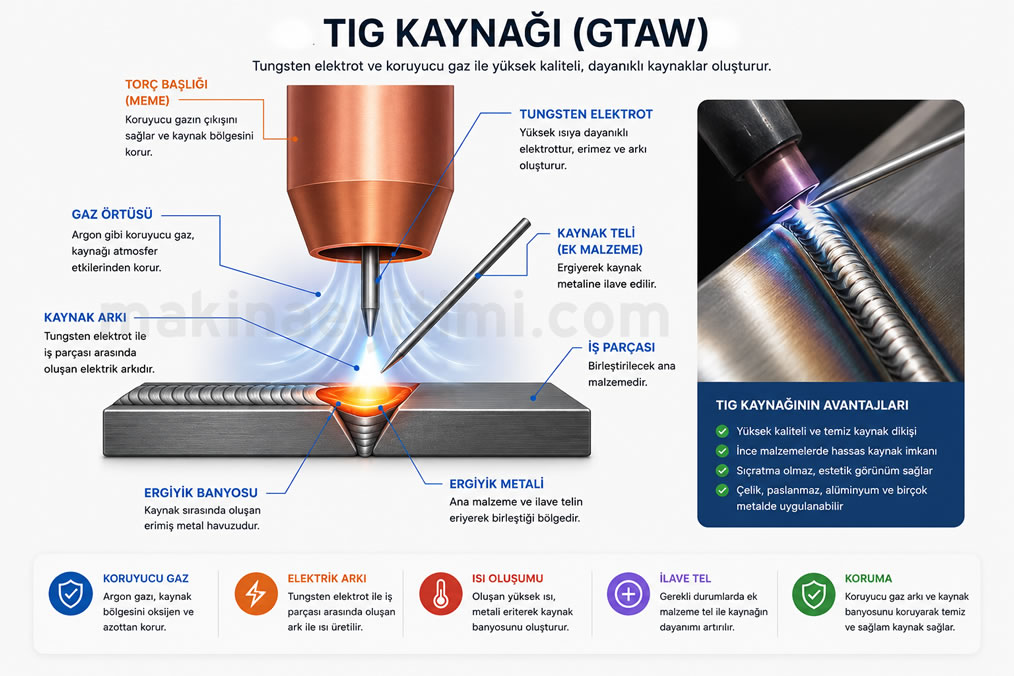
A shielding gas (usually argon) is applied to the molten area to prevent the material from oxidizing.

WIG welding

How WIG welding is done

Equipment used in WIG welding

A part welded using WIG welding
Where WIG Welding Is Used
Nearly all metals can be welded with WIG welding. Chrome-nickel steels, and aluminum and copper alloys, are welded with alternating current, especially to protect against corrosion and oxidation.
It’s also preferred because thick materials can be welded quickly and easily. Used for fixtures, boilers, and household appliances.
Plasma Arc Welding
Plasma arc welding is a shielded arc welding method in which the electric arc is transferred from the tip of a tungsten electrode to the part through a plasma gas that’s been heated to a very high temperature, becoming ionized and electrically conductive, and thereby forming the arc.
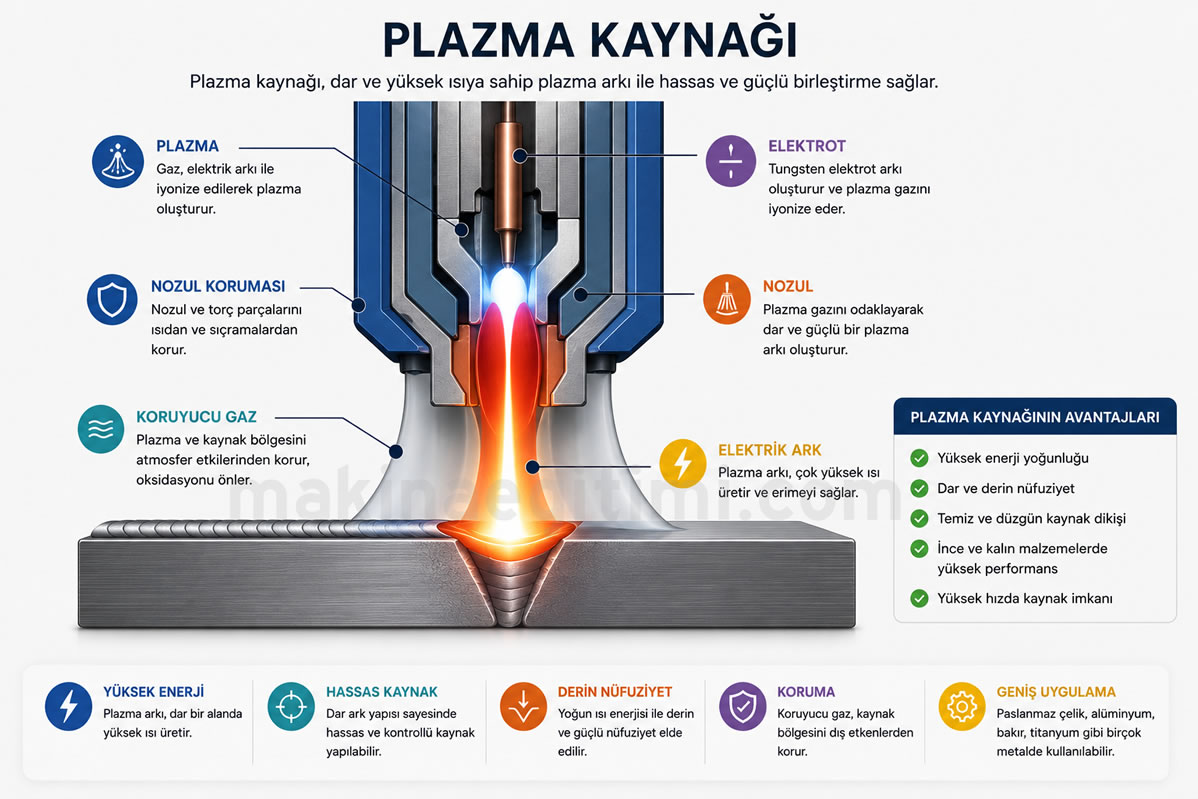
The heat generated by the arc melts the material. A tungsten electrode is used, just like in TIG welding. The difference from the TIG method is that the plasma arc, constricted as it exits through a small-diameter internal nozzle, has higher velocity and energy density.
For detailed information, see: Plasma Arc Welding
MIG Welding
One of the welding methods that uses gas and electric current together. In this welding method, a spool-wound electrode wire is melted to weld the joint. A shielding gas (usually argon, helium, or a mixture of the two) is applied to the molten area to prevent the molten material from oxidizing.

MIG welding

Appearance of MIG welding

How MIG welding is done

Welding structural profile materials together with MIG welding
Where MIG Welding Is Used
MIG welding is one of the preferred welding methods for alloy steels. Very little shrinkage is another reason it’s preferred. Used for all weld joint types. The most prominent use of MIG welding is in fixtures, boilers, and the shipbuilding and aircraft industries.
Welding Methods Lecture Notes
You can download the information covered in this article as a PDF lecture note from the section below.

Related Questions
These two groups are fundamentally different in how they generate heat: one uses the arc or resistance heat produced by electric current, while the other relies on the flame of a combustible gas. This different heat source also changes which materials and thicknesses each method can be used on.
Its equipment is both low-cost and easy to transport, which gives it a very wide range of applications. This practicality makes arc welding an accessible option for both small workshops and large industrial facilities.
Related Posts
 General Information About MIG Welding
  Factors That Make Welding Stainless Steel Difficult
  Plasma Arc Welding
  How Is Underwater Welding Done? Underwater Welding
  What Is Spot Welding. How Is It Done?
  The History of Electric Arc Welding
  Welding of Stainless Steels
  Roles and Benefits of the Electrode Coating