

Qualified welders should be employed for electric welding work. When hired, general health screenings will be performed, and people allergic to chromium, or with skin or respiratory conditions, will not be assigned to this work. Periodic health checks will also be carried out. Anyone found with ulceration of the nasal septum, or with respiratory or skin conditions, will be removed from that job and placed under medical monitoring and treatment.
Protective Equipment Used in Welding Work
During welding, electrical energy is converted into heat and light energy. The ultraviolet and infrared rays given off in this process — especially ultraviolet — are very dangerous. This radiation causes burns to the eyes and skin. For this purpose, protective glass and a mask should be used. The glass used varies depending on the current’s intensity. There are also special auto-darkening glasses that darken in response to light. A panel should be placed between workers working side by side.

Well-insulated, dry leather gloves, sleeves, spats, and a leather apron or clothing should be worn. Shoes with thick rubber soles should be worn. Rubber or wood platforms that prevent contact with the metallic floor being welded should be used. Infrared rays give off heat. Protective clothing should be worn to guard against this heat.
Properties of the Environment Where Welding Work Is Done
Locations where electric welding is done should be separate from areas where other workers are working, or should be separated with suitable fixed or portable, opaque partitions so as not to interfere with other workers.
A suitable extraction system, drawing from below or from the side, should be installed to extract the welding gases and fumes released into the environment during electric welding and expel them outside. The environment should provide 284 m³ of air volume per welder, and the ceiling height should be at least 5 meters.
The fume concentration in the air must not exceed 20 mg/m³. Gas detection equipment should be kept at the welding site.

General ventilation should provide 50 m³/hour of air per unit floor area.
In enclosed, confined spaces where the environment can’t be ventilated, welding should be done using hose-fed or tank-supplied breathing apparatus.
In oxy-acetylene cutting operations, propane gas, used as the fuel gas, also poses an explosion risk when present in air at a concentration between 2% and 9%. Because propane is heavier than air, it settles to the bottom of tanks or enclosed spaces, requiring special precautions.
Dry chemical fire extinguishers should be available for fire safety. Flammable and combustible materials should not be present in the work area.
Safety of Gas Cylinders Used in Gas Welding
Gas cylinders used in gas welding should be secured against falling with a clamp or chain. They should be transported using a cart. Gas cylinders should be kept away from heat sources. The pressure gauges on gas cylinders should be checked frequently.
Open flames and flammable materials should be banned in areas where flammable gas cylinders are stored.
Store empty and full cylinders separately, in a dry, cool, and ventilated location.
Flashback is a backward-burning condition that occurs along with ignition of the flame at the torch. When flashback occurs, the flammable gas hose is very likely to burst, causing serious accidents. Even more dangerous is a cylinder explosion. Flashback-prevention safety valves or a flame-arrestor system should be used in oxy-acetylene welding and cutting operations.

The gas and oxygen pipes in the workshop, and the hoses running to the torch, should be color-coded separately and easily distinguishable from other systems.
All types of pressurized gas cylinders should be stored upright, with their protective caps closed and secured with a strap. When pressurized cylinders are transported from one place to another by vehicle, they should be carried upright, with their pressure gauges removed and their protective caps fitted.
Oxygen cylinders should be at least 6 m away from flammable gas cylinders and easily combustible materials. If there’s a fire-resistant barrier between them rated for at least 60 minutes, they can be stored at least 1.5 m apart.
IMPORTANT: Never touch an oxygen cylinder’s regulator or valve with oily hands or oily gloves (including grease). When pure oxygen comes into contact with oil, it can cause a sudden flash and explosion.
Workplace Safety in Electric Welding
Electric welding machines and equipment should be insulated or grounded, welding clamps should have insulated handles and exteriors, and electrode holders should be properly protected against welding heat.
The switch on electric welding machines should be located on the machine itself, and cables should be securely fastened.

Enclosed guards should be provided at the operating point on automatic or semi-automatic seam and spot welding machines.
Supply and welding cables should be protected so they aren’t damaged if a vehicle passes over them. Overloaded cables heat up. The cables used should be of a quality that can handle the maximum load.
All electrical installations and the welding machine must be fully grounded.
Electric welding should not be done near flammable materials.
Welding clamps must be well insulated so current can’t pass through them.
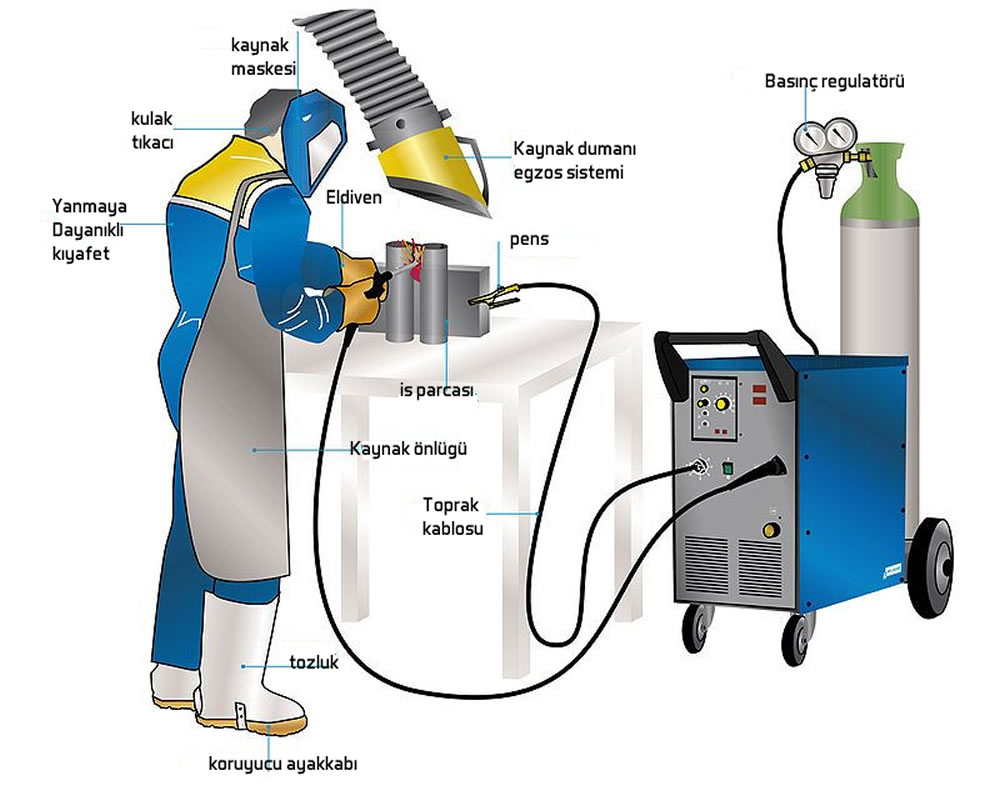
Electric shocks mostly happen while the welding machine is idling. While welding, the voltage is 20-30 V, but when the welding machine is idling, this voltage rises to between 65 and 100 V. DC starts to give a shock sensation above 20-30 V; above 30 V (DC) is dangerous. The equivalent value for AC is 50 V and above.
Electric welding machines should be disconnected from the mains and their power cut during cleaning, repair, maintenance, or relocation. Maintenance and repair of welding machines should be carried out by qualified electricians.
Related Slides and Documents

PRESENTATION CONTENTS:
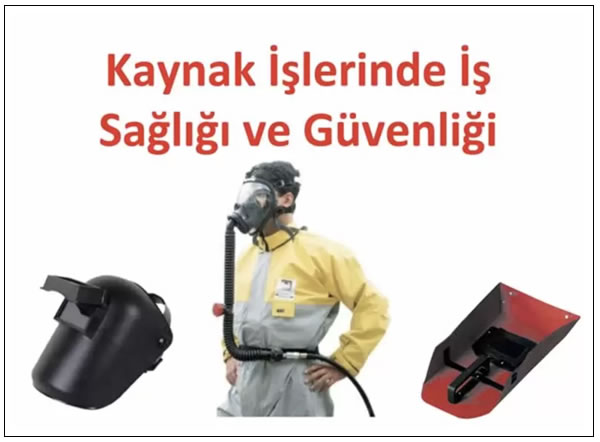
Workplace safety specialist training. Occupational health and safety in welding work.
Types of gas welding. Workplace safety measures that can be taken in gas welding. Electric arc welding workplace safety measures.

PRESENTATION CONTENTS:
The short-term and long-term (acute and chronic) health problems caused by the gases and fumes produced during welding.
Electrical, radiation, noise, fire, and explosion hazards in welding work. Workplace safety measures to be taken
PRESENTATION CONTENTS:
Radiation released during welding work, and the effects of toxic gases on human health
Workplace safety measures to take for safety in welding work
PRESENTATION CONTENTS:
Safety in welding work. Health effects of welding
Workplace safety measures to take for safety in welding work
Related Posts
 Welding Electrode Types
  How Is Underwater Welding Done? Underwater Welding
  General Information About MIG Welding
  The History of Electric Arc Welding
  Advantages and Disadvantages of Laser Welding
  Welding Methods – Techniques – Types
  Factors That Make Welding Stainless Steel Difficult
  Roles and Benefits of the Electrode Coating