

In this article from our Welding Technology section, we’ll look at the different types of welding electrodes, where each one is used, and what the numbers printed on welding rods actually mean.
Welding electrode types are classified according to the tensile strength of the deposited weld metal, the welding position the electrode is used in, the current and polarity (if DC current is used), and the coating type. The main electrode types are:
- Rutile Electrodes / E6012 / E6013 / E7014
- Acid Electrodes / E6020
- Oxide Electrodes
- Basic (Low-Hydrogen) Electrodes / E7015 / E7016 / E7018
- Cellulosic Electrodes / 6010 / 6011
- Special Electrodes / E7024 / E7027
Rutile electrodes
These electrodes mainly contain titanium dioxide in rutile form, or ilmenite (iron and titanium oxide), as the main coating material. They can be welded with DC (usually electrode negative) and AC current, in all positions. Their gap-filling ability is very good on thin and medium coating thickness, and good on thick coatings.
The arc is very stable, easy to strike, and the arc voltage stays relatively low even on AC current (40–45 V). Welding is quite easy and spatter loss is low. Rutile electrodes are not suitable for welds that will undergo radiographic (X-ray) inspection.
E6012 welding electrode
This electrode is characterized by medium penetration, a fairly quiet arc, low spatter loss, and a weld metal fully covered by a thick slag. It can be used in all positions but is mostly used in flat and horizontal positions. It’s especially recommended for single-pass, high-speed, high-current, and horizontal fillet welding. These electrodes can be used to weld many low-alloy steels, particularly those with high carbon content.
E6013 welding rod

These are welding rods often considered “farmer’s welding wire,” as this rod was essentially designed with farmers in mind. It provides a clean, smooth weld and doesn’t dig into rust or paint. Slag removal is quite easy. It maintains a stable arc even at low welding currents, which makes it well suited for sheet metal welding. Welding current: AC, DC(+), DC(-)

E6013 welding electrode amperage and voltage values (above)

E7014 welding electrodes
These electrodes are suitable for welding mild and low-alloy steels. Slag comes off very easily. Weld metal deposition rate is the highest in its group. The current used is higher than for E6012 and E6013 electrodes.
Acid electrodes
These electrodes are very fluid and can be welded in every position except vertical-down. The weld surface is shiny, the bead can be forged, and it gives very good results in radiographic inspection. Acid electrodes weld on both DC and AC current and are best suited to the horizontal position.
E6020 electrode
The coating contains a high amount of iron oxide. Good results are obtained for fillet and butt welds in the flat position with both AC and DC current on either polarity. Penetration is moderate at normal welding current; deep penetration can be achieved using higher current. These electrodes are recommended for horizontal-fillet and flat-position welds that will undergo radiographic inspection. Since they’re generally used at high current, which can cause distortion, these electrodes are not used for welding thin materials.
Oxide electrodes
These electrodes are very fluid and produce smooth beads. They’re mostly used for joining unalloyed, low-carbon steels. They can work on DC (electrode negative) and AC current and are best suited to the horizontal position. Compared to other electrode types, they’re more prone to hot cracking and require very careful preparation work.
Ease of Use of Rutile Electrodes
Rutile electrodes are preferred by beginners because they provide easy arc striking and a smooth weld bead.
Strength of Basic Electrodes
Basic electrodes reduce the risk of cracking in high-strength steels thanks to their low hydrogen content.
Penetration of Cellulosic Electrodes
Cellulosic electrodes are widely used in pipeline welding thanks to their deep-penetration properties.
Basic electrodes
Basic electrodes are used in all positions except vertical-down. Their mechanical properties are superior to other electrode types. They weld mostly on DC current (electrode positive). These electrodes have good gap-filling ability.
Because the coating is hygroscopic (moisture-sensitive), these electrodes must be stored in a dry place. If they’ve picked up moisture, dry them at 250°C for at least half an hour. As a general rule, basic electrodes should not be subjected to high current, because besides causing spatter during operation, it also lowers the mechanical properties of the bead.
Because of the calcium fluoride in the coating, welding fumes can be irritating and even harmful. Serious precautions must be taken when welding with basic electrodes in confined spaces.
Maintaining the arc with these electrodes is difficult. For this reason, basic electrodes should be used by experienced welders. A short arc length should be maintained (about half the electrode diameter) and weaving should be avoided as much as possible.
Where are basic electrodes used?
For X-ray-quality welds, or joints requiring high mechanical properties.
For crack-resistant welding of medium- or high-carbon steels, for hot-crack-resistant welding of phosphorus steels, for welding sulfur-bearing steels. For welding thick sections, to prevent cracking problems arising from high cooling rates. For welded structures that will be exposed to sub-zero temperatures. Basic electrodes are preferred for welded structures subject to dynamic loading.
E7015 Welding Electrode
This is a low-hydrogen electrode used on DC positive polarity. These electrodes were developed for applications requiring high-strength weld beads and for welding high-carbon and alloy steels. They’re also used for welding high-sulfur steels (S, 0.10–0.25%). If other electrode types were used instead, the weld bead would be porous. They can be used in all positions.
Developed mainly for welding hardenable steels, these electrodes are also suitable for welding wrought iron, spring steel, and steels that will be enamel-coated.
E7016 Welding Electrode
These electrodes carry all the properties of E7015 electrodes. What’s different is that their coating contains potassium silicate or potassium salts, which makes them easier to use on AC current.
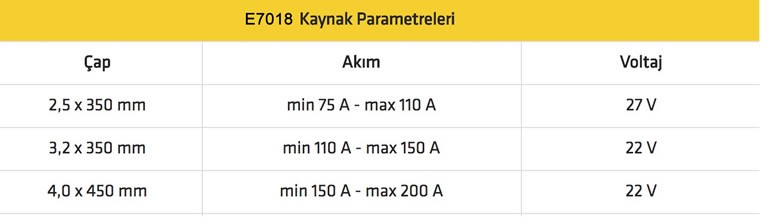
E7018 Welding Electrode
These electrodes contain a high proportion of iron powder in their coating. This electrode can be used on DC (positive polarity) and AC current. It’s suitable for fillet welding of high-strength, high-carbon, or alloy steels. E7018 is an electrode with a smooth, quiet arc, low penetration, very little spatter, and it can be welded at high speed.

7018 welding wire helps weld pipes, and it can be used to repair structural steel welds and any type of damaged part in a pipeline system. It’s considered the backbone of welding. It produces strong, straight welds. It doesn’t release hydrogen. For this reason, this type of welding rod is used in structural welding. It’s used in factories, dams, bridges, power plants, and nuclear power facilities. Because it contains a hydrogen-free flux, the rod must be stored somewhere free of moisture. Welding current: AC, DC(+), DC(-)
Cellulosic electrodes
These are electrodes that leave little slag, can weld in every position, and are especially suited to difficult positions. They’re well suited for vertical-down welds and pipe welding. They’re used on DC (electrode positive) or AC current. Since they have good gap-filling ability, they’re often well suited to welding cast steels with pits and porosity. Because they produce a lot of smoke, avoid using them in enclosed spaces such as tanks and boilers.
The weld metal is good quality, can be forged, and gives good results in radiographic inspection.
6010 welding rod

Where are 6010 electrodes used?
6010 welding rods are used on pipelines. They can be used not only on AC current but also directly on DC current. They provide excellent arc control. This rod penetrates deeply and works well in every position. While used mostly on mild steels, it’s also used for welding galvanized sheet metal and low-alloy steels. Shipbuilding, bridges, storage tank construction, and pipe welding are typical use cases.

6011 arc welding rods
Specially designed for use on AC and DC current electrode. Requires more manipulation than the others. Used in industry and in the construction of steam pipeline systems.
These electrodes are manufactured especially for welding thin sheet metal. Since these electrodes have less penetration than E6012 electrodes, when a larger-diameter electrode is going to be used, a root pass should first be made with E6012.
Special electrodes
These are electrodes suited to deep-penetration welding, always with a thick coating that contains a high amount of organic material. Deep-penetration welding is an arc welding technique that increases process speed compared to classic arc welding methods, taking advantage of higher arc penetration to achieve the required weld strength, ultimately lowering the cost of the welding operation.
E7024 welding electrode
A high-efficiency electrode. Rutile in character. Very well suited to fillet welding of mild steels. E7024 is an electrode with a stable, quiet arc, very little spatter, low penetration, and a high melt-off rate. It can be welded on AC and DC current (either polarity). While mostly used on mild steels, it’s also used successfully for welding many alloy steels along with medium- and high-carbon steels.
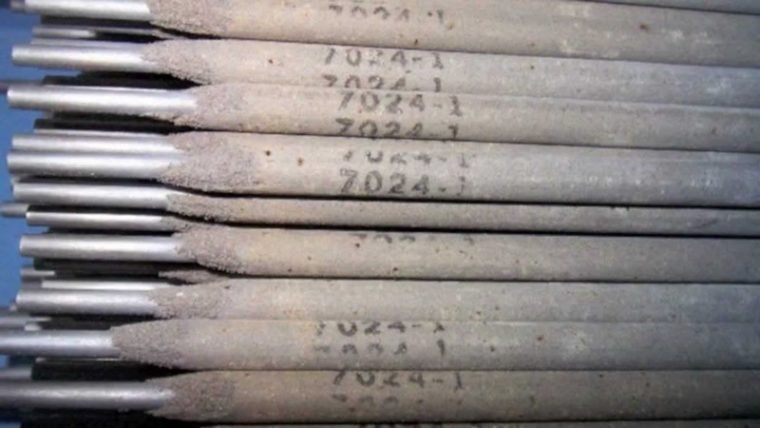
The 7024 rod is suitable for flat and horizontal welding, but not suitable for vertical or overhead welding.
E7027 welding electrode
An acid-character electrode whose coating contains a high proportion of iron powder (approximately 50% of the coating’s weight). It’s made for AC and DC current on either polarity, for fillet and butt welds in the flat position. It’s a medium-penetration electrode with very little spatter and a high melt-off rate. Its slag is thick and comes off easily. This electrode is suitable for welding fairly thick parts.

Welding electrode types table (above). Properties according to electrode rod numbers.
Related Questions
The coating melts during the arc and shields the weld zone with a protective layer of gas and slag. Different coating types such as rutile, basic, or cellulosic directly determine the quality of this protection and the mechanical properties of the weld.
The basic coating leaves less hydrogen in the weld metal, reducing the risk of cracking and producing a stronger structure. This makes them stand out for critical, high-strength structural welds.
Related Posts
 Factors That Make Welding Stainless Steel Difficult
  The History of Electric Arc Welding
  General Information About MIG Welding
  Welding Methods – Techniques – Types
  Roles and Benefits of the Electrode Coating
  What Is Spot Welding. How Is It Done?
  Electrodes Used for Welding Stainless Steels
  Occupational Health and Safety in Welding Work