
Close Menu
  • MAKİNELER ve İMALAT
    • Tools & Equipment
    • Computer-Aided Drawing
    • CAD/CAM Education
    • CNC Machine Programming
    • Casting Technologies
    • Electrical & Electronics Technologies
    • Hydraulics & Pneumatics
    • Manufacturing Processes
    • Manufacturing Technologies
    • Occupational Safety
    • Mold & Die Design
    • Solid Modeling
    • Welding Technology
    • Machine Elements
    • Mechanical Trade Drawing
    • Materials Science
    • Automotive & Vehicle Technologies
    • Robotics Technologies
    • Health Technologies
    • Defense & Aerospace Technologies
    • Descriptive Geometry
    • Technical Drawing
    • Software & Hardware Technologies
    • Innovative Manufacturing Methods
  • TEKNOLOJİ ve YAŞAM
    • OTOMOBİLLER ve TAŞIT
      • Vehicle & Engine Knowledge
      • Safe Driving
      • Sürüş Destek Sistemleri
    • Genel Kültür
      • Movies & TV Shows
      • Görsel ve Grafik Sanat
      • Books & Literature
      • Music
      • Sports
      • History
      • History of Technology
    • GÜNDELİK YAŞAM TEKNOLOJİLERİ
    • Hobbies & Entertainment
    • Internet Technologies
    • Health
    • Mobile Technologies
Makine Eğitimi
  • Machines & Manufacturing
    Machine Elements
    Hydraulics & Pneumatics
    Technical Drawing
    Computer-Aided Design & Manufacturing
    Basic Manufacturing Processes
    Manufacturing Processes
    Industry Technologies
    Other Technical Courses
    Motion & Power Transmission
    Simple Machines
    Chains & Sprockets
    Shafts & Journals
    Gears
    Cams
    Couplings
    Belts & Pulleys
    Springs
    Bearings
    Keys
    Fastening Joining
    Retaining Rings
    Screws, Bolts & Nuts
    Cotter Pins
    Flanges
    Welding
    Rivets
    Pins & Bolts
    Washers
    Calculators
    Gear Ratio Calculator
    Spring Constant Calculator
    Belt Pulley Ratio Calculator
    Other Machine Elements
    Slides & Linear Guides
    Brakes
    Flywheels
    Clamps
    Shock Absorbers
    Gaskets & O-Rings
    Seals & Sealing Elements
    Hydraulics
    Introduction to Hydraulics & Principles
    Hydraulic Systems & Applications
    Accumulators
    Filters
    Motors
    Pumps
    Valves
    Pneumatics
    Introduction to Pneumatics & Principles
    Pneumatic Systems & Applications
    Pneumatic Circuit Components
    Valves
    Cylinders
    Silencers
    Motors
    Compressors
    Dryers
    Conditioning Units
    Common Topics & Maintenance
    Hydraulic & Pneumatic Maintenance
    Study Notes, Exams & Tests
    Technical Drawing
    Introduction to Technical Drawing
    Geometric Drawings
    Perspective & Projection
    Orthographic Views
    Dimensioning
    Sectioning
    Assembly & Detail Drawings
    Tolerances
    Surface Finish Symbols
    Mechanical Engineering Drawing
    Screws, Bolts & Nuts
    Pulley Drawings
    Gear Drawings
    Shafts & Journals
    Bearing Drawings
    Pins & Bolts
    Spring Drawings
    Welds in Technical Drawing
    Washers
    Cotter Pins
    Technical Drawing Exercises
    Mechanical Drawing Exercises
    Gear Exercises
    View Extraction Exercises
    Pulley Exercises
    Pin & Bolt Exercises
    Threaded Fastening Exercises
    Descriptive Geometry
    Computer-Aided Drawing
    AutoCAD Drawing Lessons
    Solid Modeling & Animation
    Solid Model Drawing Files
    Solid Model Assembly Examples
    Solid Model Drawing Lessons
    3D CAD Software Reviews
    Solid Modeling Exercises
    CNC Programming
    CAM
    Measurement & Inspection
    Dial Indicators
    Calipers
    Gauges
    Micrometers
    Materials Science
    Steels
    Cast Iron
    Aluminum
    Plastics
    Material Testing & Hardness Measurement
    Occupational Safety
    Workshop Safety
    Safety When Working With Electricity
    Machine Safety Rules
    Hand Operations
    Filing
    Marking
    Cutting Operations
    Reaming
    Tapping
    Threading With a Die
    Drill Bit Sharpening
    Working With Machines
    Basic Turning Operations
    Basic Milling Operations
    Shaper Machine
    Machining
    Turning
    Milling
    Grinding
    Innovative Manufacturing Methods
    EDM (Electrical Discharge Machining)
    Laser Machining
    Waterjet Machining
    3D Printing
    3D Scanners
    Welding
    Rolling
    Casting
    Mold & Die Design
    Mechanical & Hydraulic Presses
    Blanking & Piercing Dies
    Bending Dies
    Drawing Dies
    Plastic Injection Molds
    Extrusion Dies
    Compound Dies
    Progressive Dies
    Blow Molds
    Spinning Dies
    Spray Molds
    Manufacturing of Machine Parts
    Automotive & Vehicle Technologies
    Motor Vehicle Manufacturing
    Raw Material Production
    History of Technology
    Health & Medical Technologies
    Defense & Aerospace
    Robotics Technologies
    Software & Hardware Technologies
    Mechanics - Strength of Materials
    Physics Topics
  • Technology & Life
    Hobbies & Entertainment
    Sports
    Music
    Vehicle & Engine Knowledge
    Vehicle Maintenance & Repair
    Safe Driving
    Driver Assistance Systems
    History
    Movies & TV Shows
    Books & Literature
    Computers & Internet
    Computer Tips
    Software Reviews
    Hardware & Peripherals
    Practical & Safe Internet Use
    Visual & Graphic Art
    Mobile Technologies
    Travel
    Science
    Health
    First Aid Knowledge
    Everyday Technologies
Makine Eğitimi
Home»Manufacturing Processes»What Is Soldering? Soft Soldering and Brazing Methods
22 September 2026

What Is Soldering? Soft Soldering and Brazing Methods

Close-up of a soldering iron and solder wire joining a chip to a green circuit board

Another way of joining metal parts is soldering. Unlike welding, in this method the parts to be joined do not melt themselves. Instead a separate metal (the solder), which melts below the melting point of the parts, comes into play and holds the two pieces together.

  • How Does Soldering Work?
  • Soft Soldering
  • Brazing (Hard Soldering)
  • Differences Between Soft Soldering and Brazing
  • Soldering Compared with Welding
  • Frequently Asked Questions

How Does Soldering Work?

During soldering the metals to be joined keep their solid state, because the melting point of the filler used is lower than that of those metals. The molten filler penetrates between the crystal structure of the parts and forms a sound bond.

Soldering is divided into two according to working temperature:

  • Soft soldering: carried out below 450°C
  • Brazing (hard soldering): carried out above 450°C

Soft Soldering

Soft soldering is carried out with filler materials that melt below 450°C. The alloy most used for this purpose is the easily melting lead-tin mixture.

This method is preferred especially for joining thin sheets such as tinplate, zinc and brass, for airtight canning work, and for assembling electronic components.
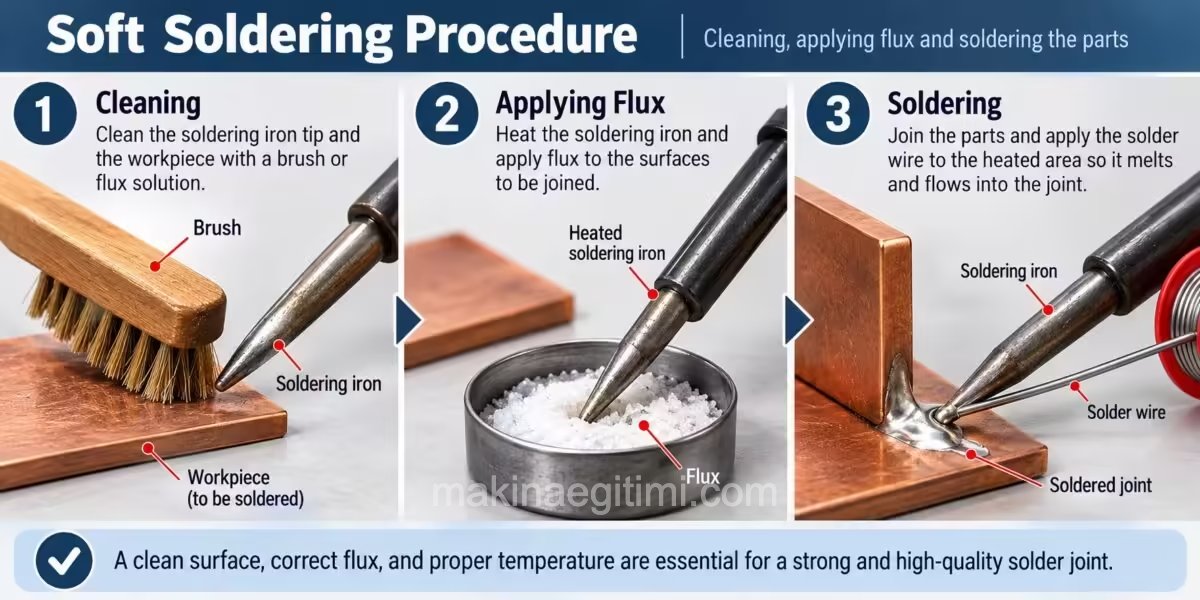
soft soldering procedure

To make a sound soft-soldered joint, the surface to be soldered must be thoroughly clean and must come into direct contact with the filler. This cleaning is usually achieved with soldering fluid (flux).

What is soldering fluid? It is a cleaning liquid obtained by dissolving zinc chloride in hydrochloric acid.

During the operation, the tip of the heated soldering iron is first cleaned by rubbing it on a block of sal ammoniac. A small amount of filler is then picked up with the iron tip and applied to the surface to be joined. Once the solder cools, the joint is complete.

Soft solders generally consist of a tin-lead alloy and their melting points are always below 450°C. An interesting property of these alloys is that they melt gradually rather than suddenly: first they reach a paste-like consistency, then they turn into a thick liquid, and once they reach a certain temperature they become fully fluid. A special alloy in which tin and lead are mixed in equal proportions (50/50) is the exception to this rule and melts directly at 182°C.
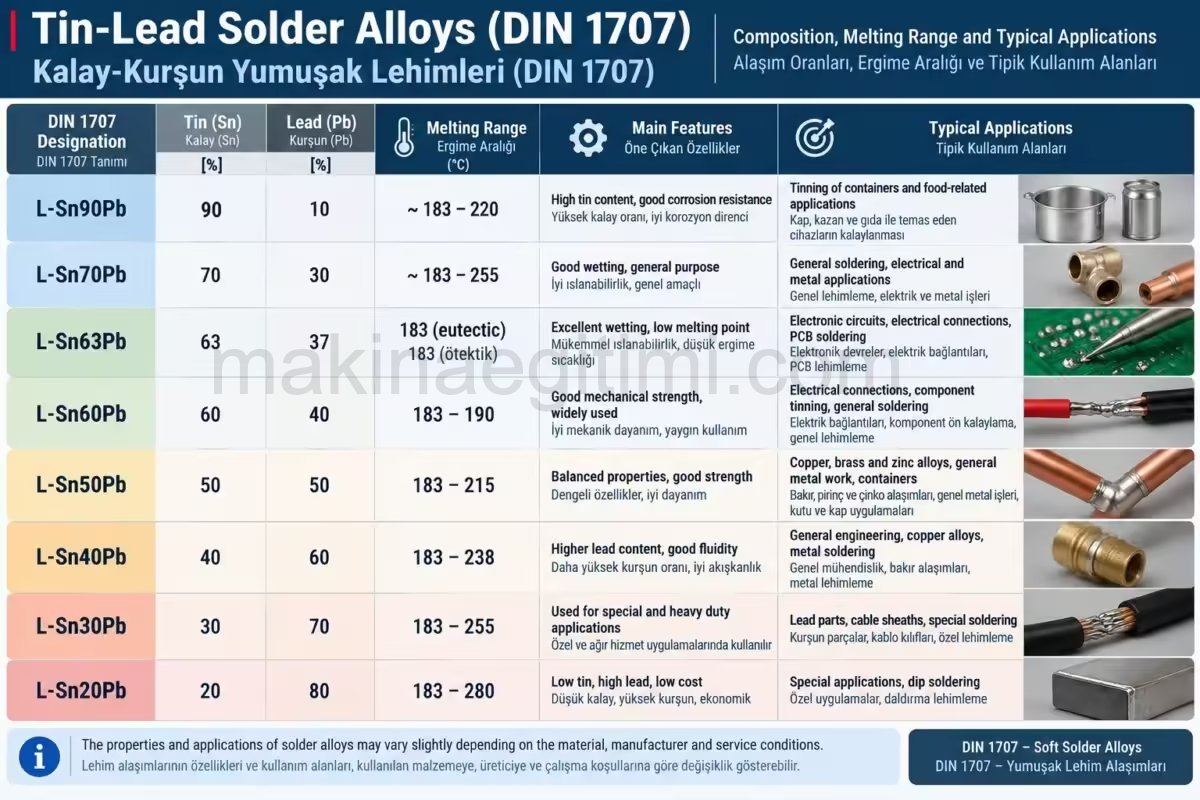
tin-lead soft solders (DIN 1707)

As the tin content rises, the strength of the solder changes as well. A solder containing 8% tin, for example, is used for soldering parts exposed to small forces such as radiators, while a solder containing 60% tin is preferred for tinning electrical cables. Solders with a tin content of 90% are used for tinning vessels, boilers and equipment that comes into contact with foodstuffs.

Brazing (Hard Soldering)

Brazing is carried out with filler materials that melt at temperatures above 450°C, and it is far stronger than soft soldering. This method is preferred for joining metal parts with a high melting point, sheet plates, boilers, pipes and wires. A copper and zinc alloy is generally used as the joining medium.

When brazing, the parts to be joined are first heated and the surfaces are cleaned by applying borax. The filler, in the form of brass wire, is dipped in borax, melted with the torch flame and run onto the surface to be joined. After it cools, the surface is cleaned with 10% sulphuric acid.

The copper-to-zinc ratio of the brass alloys used in brazing, and the working temperature, vary according to which material is being joined. A brass filler containing 42% copper, for example, works at 845°C, while one containing 54% copper works at 900°C and is used for brazing steel and bronze alloys.
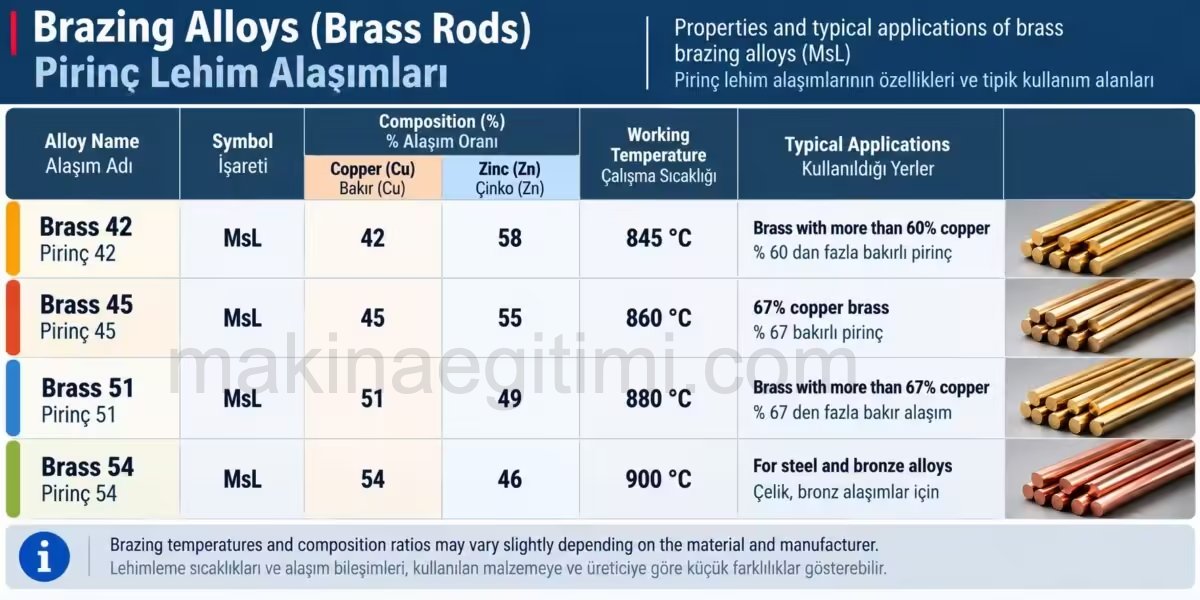
brass brazing alloys

Differences Between Soft Soldering and Brazing

The main differences between the two methods can be summed up as follows:

The difference in temperature is the deciding factor: soft soldering is done below 450°C and brazing above it.

The filler wires used in brazing are very varied. Materials such as silver, aluminium, copper, gold, magnesium and nickel can be used for this purpose. In soft soldering the wires used are fixed, and consist of a lead-tin alloy.

Soldering Compared with Welding

Although soldering and welding resemble each other, there are important differences between them:

In soldering, the materials to be joined do not have to be of the same kind. In welding, materials of the same kind, or with similar properties, are generally joined.

In welding the material itself melts, while in soldering only the filler melts. Soldering is preferred in situations where excessive heat could damage the material.

Soldering is applied where joining by welding would not be practical or economical. Where strength is required, welding is preferred.

Frequently Asked Questions

In welding the joined metal itself melts, while in soldering only the filler melts and the parts to be joined keep their solid state.

450°C. Soldering carried out below this temperature is called soft soldering, and above it brazing.

It cleans the surface to be soldered so that the filler can make direct and sound contact with the metal.

Brass wires of copper-zinc alloy are generally used. Materials such as silver, aluminium, gold, magnesium and nickel can also be chosen for brazing.

Soldering is preferred where the material could be damaged by excessive heat, where metals of different kinds have to be joined, or in work where welding would not be practical or economical.

Related Posts

How is underwater welding done - header image How Is Underwater Welding Done? Underwater Welding What Is Spot Welding. How Is It Done? What Is Spot Welding. How Is It Done? Welding Methods - Techniques - Types Welding Methods – Techniques – Types Lazer Kaynağının Avantaj ve Dezavantajları Advantages and Disadvantages of Laser Welding The History of Electric Arc Welding The History of Electric Arc Welding Welder using an oxy-acetylene torch on a steel block, with red acetylene and green oxygen cylinders behind him Oxy-Fuel (Oxy-Acetylene) Welding: Working Principle and Uses Electrodes used for welding stainless steels Electrodes Used for Welding Stainless Steels Welding Electrode Types Welding Electrode Types
Share. Facebook Twitter WhatsApp Tumblr Email Telegram Copy Link

Leave A Reply Cancel Reply

When Should the Timing Belt Be Replaced
Inspection and Replacement Times for Vehicle Parts
  • Contact
  • Terms of Service
  • Privacy & Cookie Policy

Type above and press Enter to search. Press Esc to cancel.