
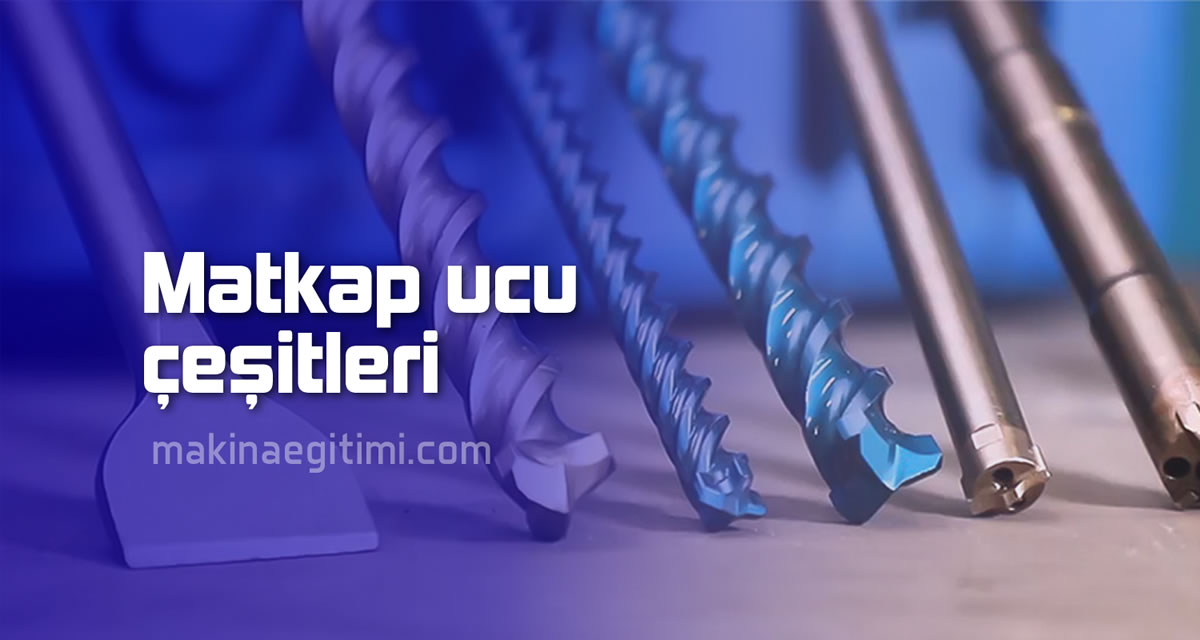
Types of Drill Bits
The types of drills used in industry today are generally made in 5 different groups. These are:
Twist Drills
Twist drills are cutting tools with two opposing helical flutes on a cylindrical body, with a cutting edge at the end of each flute. Twist drills are made from high-quality tool steel (HSS), through grinding, milling, or rolling.
The drill’s helical flutes carry away the chips produced and, at the same time, deliver cutting fluid into the hole. To reduce the friction the drill would otherwise create against the hole surface while cutting, the flute backs are relieved, leaving a strip called the margin. During drilling, only the margin contacts the hole’s surface.

Grinding the drill’s point to 120 degrees exposes the drill’s cutting edges. During grinding, a clearance angle of 6-8 degrees is given behind the cutting edge. This way, since the relieved surfaces are prevented from rubbing against the surfaces being cut during cutting, the edges bite into the work and cutting occurs. Because the angles that make cutting easier at the twist drill’s edges can be easily given during grinding, the drill diameter stays the same after grinding, and drills are easy and highly practical to remove and reinstall — these factors have increased the importance of these tools. For this reason, in many jobs, roughing or clearing operations are performed with drills.
Twist drills are manufactured in two forms: straight-shank and taper-shank. Generally, drills up to 16 mm in diameter are made with a straight shank, and drills above 16 mm in diameter are made with a taper shank. However, for some special purposes, drills made outside this general rule may be encountered.
For detailed information, SEE: Twist Drills
Center Drills
A center drill is a type of drill made specifically to drill center holes, with a drill-shaped tip on both ends. Since their tips are short and their body is thick, they don’t wander during drilling.
The main cutting portion at the tip of a center drill is called the pilot, and the drill is named according to the pilot’s diameter. For example, a 2.5 center drill, etc.

Here, the number 2.5 refers to the drill’s pilot diameter. Besides drilling center holes, center drills can also be used for countersinking holes and forming a center hole for holes that will be drilled precisely.
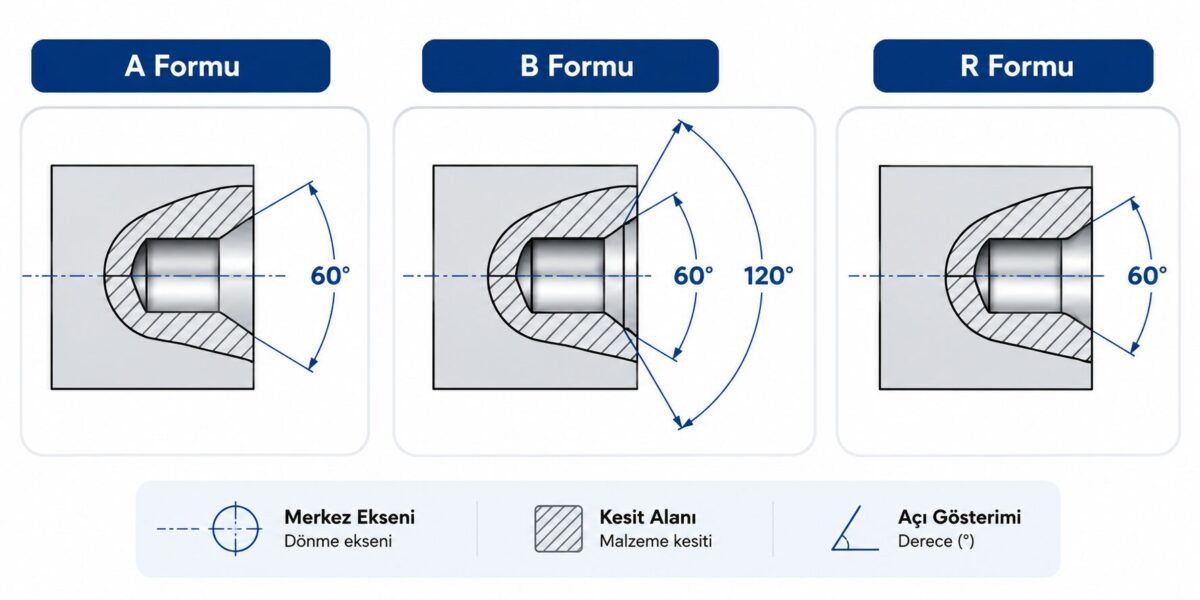
There are three types of center drills. These are:
1.Standard center drills with a 60-degree countersink angle (Form A),
2.Center drills that drill a protected-countersink center hole (Form B),
3.Center drills that drill a radiused center hole. Radiused-countersink center drills (Form R) are generally used to drill the center holes of workpieces that will be taper-turned.
Gun Drills
Rifle Gun Drills
The cutting portion of these drills is made of high-speed steel with a single flute, and this drill piece is brazed into a drilling tube.This main drill section’s length is 6-8 times its diameter, and it also has a lubrication hole drilled through it. Cutting fluid is sent through this hole under a pressure of 30-50 kg/cm². This way, chips are cleared out, preventing the hole from being damaged. Otherwise, chips would jam inside the hole, wrap around it, and cause damage.These drills produce very clean holes. Their feed force is 50% less than that of twist drills. The chip flutes should be as close to the drill axis as possible.
The drilling tube must be made of steel and have adequate resistance to torsion.These drills should not be sharpened by hand, but with a special sharpening fixture.The cutting tip should be positioned 1/4 above the drill’s diameter.
Spade (Ball) Gun Drills
These are used to drill deep holes. The back-grinding (relief) angle is about 6-10 degrees. The larger the drill, the smaller the feed rate and back-grinding angle become.
Countersink Drills
Countersink drills are made for tasks such as removing burrs and sharp edges at the mouths of holes, countersinking hole edges, and forming seats for the heads of fasteners such as screws and rivets.

The point angle of countersink drills made for deburring and plain countersinking is 60 degrees;
the point angle of countersink drills used for riveting is 75 degrees,
the point angle of countersink drills made for flat-head screws is 90 degrees,
and the point angle of countersink drills made for sheet-metal rivets is 120 degrees.
Since fluted countersink drills have more cutting edges, they produce a clean surface when enlarging holes.
For this reason, they’re mostly used in assembly work. Because of this property, these drills are also called hole-enlarging drills.
There are countersink drills made of HSS high-speed steel, as well as countersink drills with detachable carbide tips.

For detailed information about countersink drills and countersinking, SEE: Countersinking and Countersink Drill
Special-Purpose Drills
As the name suggests, special-purpose drills are drills made to drill or enlarge holes outside of standard sizes, or made according to a workplace’s own capabilities. There are also special-purpose drills made in standard sizes. Drills used on CNC machines can be counted as an example of this.
One reason for making special-purpose drills is to avoid expensive tools. For example, to drill a large hole, it’s always possible to make a special drill costing one-twentieth of the price of a normal twist drill.
The smallest drills are used to drill holes with diameters between 0.05mm and 1.45mm. These are manufactured as twist drills, straight-fluted drills, or spade drills.
The main drill portion is very short and seats onto a longer, thicker shank. The smallest-diameter drills are used above all in the watch and electronics component industries, in the manufacture of small holes. With heavily relieved stepped drills, stepped holes and profiled holes are manufactured complete in a single operation.
NC Spotting (Center) Drill
NC drills are used specifically on NC-controlled machines for drilling exactly in position and quickly.These drills are manufactured with a point angle of 90 degrees or 120 degrees and a smaller rake angle than conventional twist drills.These drills are used to center holes that will later be drilled with twist drills.
NC spotting drills have no margin, because only a conical hole is drilled by way of the cutting edge. These special drills aren’t suitable for drilling deep holes. The web thickness, and thus the chisel edge, is quite small, allowing the twist drill to be well centered at the start of drilling. They’re very short in length and have a cylindrical shank. With a 90-degree point-angle NC drill, both centering and a shoulder for the subsequent tapping operation are achieved.

Indexable Insert Drill
Indexable drill inserts (cutting inserts), made of high-speed steel or carbide, are mounted in a replaceable manner in a holder.
Indexable insert drills can be used especially for holes larger than 20mm in diameter that need to be drilled precisely at high cutting speeds. In addition, indexable insert drills are self-centering. Short chips are achieved through ground-in chip-breaker and chip-splitting grooves.
Insert-type drills must be adequately cooled. With an indexable insert drill, drilling should essentially be done into solid material. There’s a risk of tool breakage in holes that have been previously cast or pre-drilled.
Indexable-Insert Blind-Hole Drill
For blind holes to be drilled, indexable-insert drills through which cutting fluid is delivered internally are used for hole depths up to 3 times the hole diameter. These drills can be used on drilling and turning machines, as well as machining centers, at high cutting speeds and large chip removal volumes.
Prevalence of Twist Drills
Standard twist drills are the most commonly used drill type for general-purpose drilling operations.
Precision of the Center Drill
Center drills are used to create a precise starting point before the main drilling operation.
Durability of Carbide-Tipped Drills
Carbide-tipped drills offer much longer tool life and higher speed than HSS drills in hard materials.
Related Questions
Standard twist drills, center drills, and carbide-tipped drills are the most commonly used types of drill bits.
Center drills are used to create a precise starting point before the main drilling operation.
Carbide-tipped drills offer much longer tool life and higher speed than HSS drills in hard materials.
Related Posts
 How to Calculate Cutting Speed, Feed and Spindle RPM: A Practical Guide With Worked Examples
 What Is Honing? How Is It Done? Where Is It Used?
 Cutting with a Hacksaw
 Countersinking and Countersink Drill
 How Is a Rivet Gun Used
 Saw Benches
 Steady Rests on a Lathe. Supporting a Workpiece on a Lathe
 How to Read a Caliper. Caliper Reading Explained