Close Menu
  • MAKİNELER ve İMALAT
    • Tools & Equipment
    • Computer-Aided Drawing
    • CAD/CAM Education
    • CNC Machine Programming
    • Casting Technologies
    • Electrical & Electronics Technologies
    • Hydraulics & Pneumatics
    • Manufacturing Processes
    • Manufacturing Technologies
    • Occupational Safety
    • Mold & Die Design
    • Solid Modeling
    • Welding Technology
    • Machine Elements
    • Mechanical Trade Drawing
    • Materials Science
    • Automotive & Vehicle Technologies
    • Robotics Technologies
    • Health Technologies
    • Defense & Aerospace Technologies
    • Descriptive Geometry
    • Technical Drawing
    • Software & Hardware Technologies
    • Innovative Manufacturing Methods
  • TEKNOLOJİ ve YAŞAM
    • OTOMOBİLLER ve TAŞIT
      • Vehicle & Engine Knowledge
      • Safe Driving
      • Sürüş Destek Sistemleri
    • Genel Kültür
      • Movies & TV Shows
      • Görsel ve Grafik Sanat
      • Books & Literature
      • Music
      • Sports
      • History
      • History of Technology
    • GÜNDELİK YAŞAM TEKNOLOJİLERİ
    • Hobbies & Entertainment
    • Internet Technologies
    • Health
    • Mobile Technologies
Makine Eğitimi
  • Machines & Manufacturing
    Machine Elements
    Hydraulics & Pneumatics
    Technical Drawing
    Computer-Aided Design & Manufacturing
    Basic Manufacturing Processes
    Manufacturing Processes
    Industry Technologies
    Other Technical Courses
    Motion & Power Transmission
    Simple Machines
    Chains & Sprockets
    Shafts & Journals
    Gears
    Cams
    Couplings
    Belts & Pulleys
    Springs
    Bearings
    Keys
    Fastening Joining
    Retaining Rings
    Screws, Bolts & Nuts
    Cotter Pins
    Flanges
    Welding
    Rivets
    Pins & Bolts
    Washers
    Calculators
    Gear Ratio Calculator
    Spring Constant Calculator
    Belt Pulley Ratio Calculator
    Other Machine Elements
    Slides & Linear Guides
    Brakes
    Flywheels
    Clamps
    Shock Absorbers
    Gaskets & O-Rings
    Seals & Sealing Elements
    Hydraulics
    Introduction to Hydraulics & Principles
    Hydraulic Systems & Applications
    Accumulators
    Filters
    Motors
    Pumps
    Valves
    Pneumatics
    Introduction to Pneumatics & Principles
    Pneumatic Systems & Applications
    Pneumatic Circuit Components
    Valves
    Cylinders
    Silencers
    Motors
    Compressors
    Dryers
    Conditioning Units
    Common Topics & Maintenance
    Hydraulic & Pneumatic Maintenance
    Study Notes, Exams & Tests
    Technical Drawing
    Introduction to Technical Drawing
    Geometric Drawings
    Perspective & Projection
    Orthographic Views
    Dimensioning
    Sectioning
    Assembly & Detail Drawings
    Tolerances
    Surface Finish Symbols
    Mechanical Engineering Drawing
    Screws, Bolts & Nuts
    Pulley Drawings
    Gear Drawings
    Shafts & Journals
    Bearing Drawings
    Pins & Bolts
    Spring Drawings
    Welds in Technical Drawing
    Washers
    Cotter Pins
    Technical Drawing Exercises
    Mechanical Drawing Exercises
    Gear Exercises
    View Extraction Exercises
    Pulley Exercises
    Pin & Bolt Exercises
    Threaded Fastening Exercises
    Descriptive Geometry
    Computer-Aided Drawing
    AutoCAD Drawing Lessons
    Computer-Aided Drawing Exams
    Solid Modeling & Animation
    Solid Model Drawing Files
    Solid Model Assembly Examples
    Solid Model Drawing Lessons
    3D CAD Software Reviews
    Solid Modeling Exercises
    CNC Programming
    CAM
    Measurement & Inspection
    Dial Indicators
    Calipers
    Gauges
    Micrometers
    Materials Science
    Steels
    Cast Iron
    Aluminum
    Plastics
    Material Testing & Hardness Measurement
    Occupational Safety
    Workshop Safety
    Safety When Working With Electricity
    Machine Safety Rules
    Hand Operations
    Filing
    Marking
    Cutting Operations
    Reaming
    Tapping
    Threading With a Die
    Drill Bit Sharpening
    Working With Machines
    Basic Turning Operations
    Basic Milling Operations
    Shaper Machine
    Machining
    Turning
    Milling
    Grinding
    Innovative Manufacturing Methods
    EDM (Electrical Discharge Machining)
    Laser Machining
    Waterjet Machining
    3D Printing
    3D Scanners
    Welding
    Rolling
    Casting
    Mold & Die Design
    Mechanical & Hydraulic Presses
    Blanking & Piercing Dies
    Bending Dies
    Drawing Dies
    Plastic Injection Molds
    Extrusion Dies
    Compound Dies
    Progressive Dies
    Blow Molds
    Spinning Dies
    Spray Molds
    Manufacturing of Machine Parts
    Automotive & Vehicle Technologies
    Motor Vehicle Manufacturing
    Raw Material Production
    History of Technology
    Health & Medical Technologies
    Defense & Aerospace
    Robotics Technologies
    Software & Hardware Technologies
    Mechanics - Strength of Materials
    Physics Topics
  • Technology & Life
    Hobbies & Entertainment
    Sports
    Music
    Vehicle & Engine Knowledge
    Vehicle Maintenance & Repair
    Safe Driving
    Driver Assistance Systems
    History
    Movies & TV Shows
    Books & Literature
    Computers & Internet
    Computer Tips
    Software Reviews
    Hardware & Peripherals
    Practical & Safe Internet Use
    Visual & Graphic Art
    Mobile Technologies
    Travel
    Science
    Health
    First Aid Knowledge
    Everyday Technologies
Makine Eğitimi
Home»Manufacturing Processes»Steady Rests on a Lathe. Supporting a Workpiece on a Lathe
29 August 2026

Steady Rests on a Lathe. Supporting a Workpiece on a Lathe

Supporting a Workpiece on a Lathe

Topics covered in Supporting a Workpiece on a Lathe;

  • What Is a Steady Rest on a Lathe
  • Why Is a Workpiece Supported with a Steady Rest on a Lathe
  • How Is a Workpiece Supported with a Steady Rest on a Lathe?
  • Types of Steady Rests on a Lathe
    • Fixed steady rests
      • Mounting the fixed steady rest on the lathe
      • Facing and turning between centers with a fixed steady rest
    • Follower (traveling) rests

What Is a Steady Rest on a Lathe

When turning workpieces that are long in length and small in diameter, or heavy workpieces with a large diameter, support is generally needed to prevent the part from springing or bending, or to relieve the load on the center points. The fixtures used for this purpose are called a steady rest. Supporting a workpiece on a lathe in this way is called steadying. Steady rests are important auxiliary attachments on a lathe.
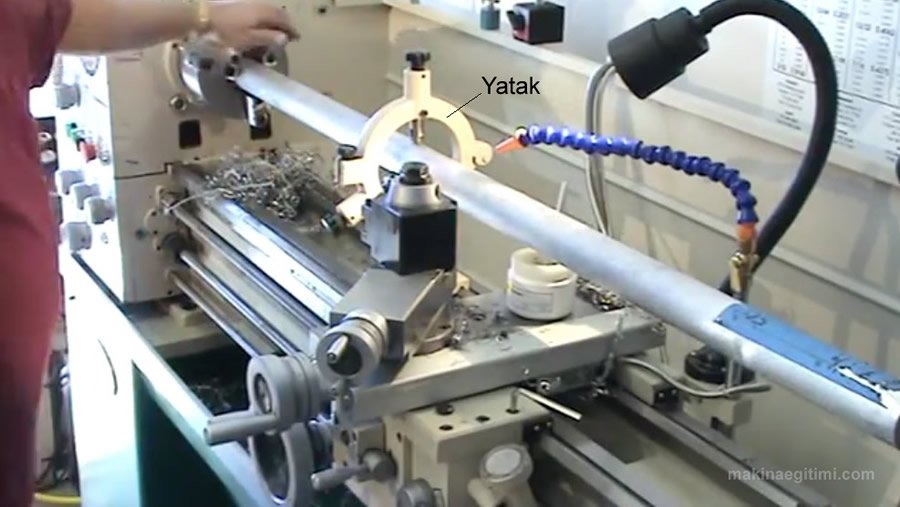
steady rests and steadying operation on a lathe

Why Is a Workpiece Supported with a Steady Rest on a Lathe

Even if the free end of a long shaft is supported with a traveling (revolving) center, the pressure of the tool and the weight of the part will always cause the workpiece to deflect. Steady rests are used on a lathe to prevent this deflection.

The effect of the lathe tool during cutting and the weight of the workpiece cause a pressure to build up at the center points. Steady rests are also used to prevent this pressure.

How Is a Workpiece Supported with a Steady Rest on a Lathe?

To adjust the steady rest, which is mounted on the lathe as required, a certain section of the workpiece must first be turned to a suitable diameter. The set screws should be turned so that the jaws, which must lightly touch the workpiece, are advanced by the same amount. Otherwise the workpiece will rotate off-center. A dial indicator is used to check the runout. Based on the reading shown by the dial indicator, the jaws should be moved forward and back to ensure the workpiece rotates smoothly. Once smooth rotation is achieved, the locking screws should be tightened.

This adjustment should be carried out with the workpiece rotating at low speed. From the sound and vibration that occur during rotation, it is possible to tell whether the steady rest has been adjusted properly. The jaws should never be tightened more than necessary.

Types of Steady Rests on a Lathe

Fixed steady rests

Fixed steady rests have a base prepared to match the lathe bed ways, and can be clamped like a vise anywhere along the ways where needed.

parts of a fixed steady rest for turning while steadying

Parts of a fixed steady rest (above). Click on the image to enlarge it.

A fixed steady rest is used when the workpiece is long and has a large diameter. For long, small-diameter workpieces turned between two centers, it is used to support one end of the part during facing, drilling, thread cutting, and boring operations.

4-jaw steady rest for turning long shafts

Fixed steady rests have three jaws that provide support. These can be adjusted according to the workpiece. Four-jaw fixed steady rests have also been made for large workpieces (above).

Mounting the fixed steady rest on the lathe

A special mounting shoe is used to fix fixed steady rests onto the lathe bed ways. The fixed steady rest is placed on the bed ways and mounted with this clamping shoe. The video above shows how the fixed steady rest is mounted.

Facing and turning between centers with a fixed steady rest

Mount the end of the workpiece that will not be turned into the universal chuck. Pull the carriage back to the tailstock body. Clamp the fixed steady rest onto the lathe bed ways.

turning long shafts with support of a three-jaw fixed steady rest

Good results are usually obtained if the steady rest jaws are first adjusted at a point on the workpiece near the chuck and then moved to the end. With this method, the steady rest is aligned with the axis of the workpiece.

Dial indicators are used to check runout when machining long shafts between the chuck and tailstock center. The runout detected by the dial indicator can be corrected either from the steady rest jaws, or by using a chuck with independent jaws and tightening each chuck jaw enough to eliminate the runout.
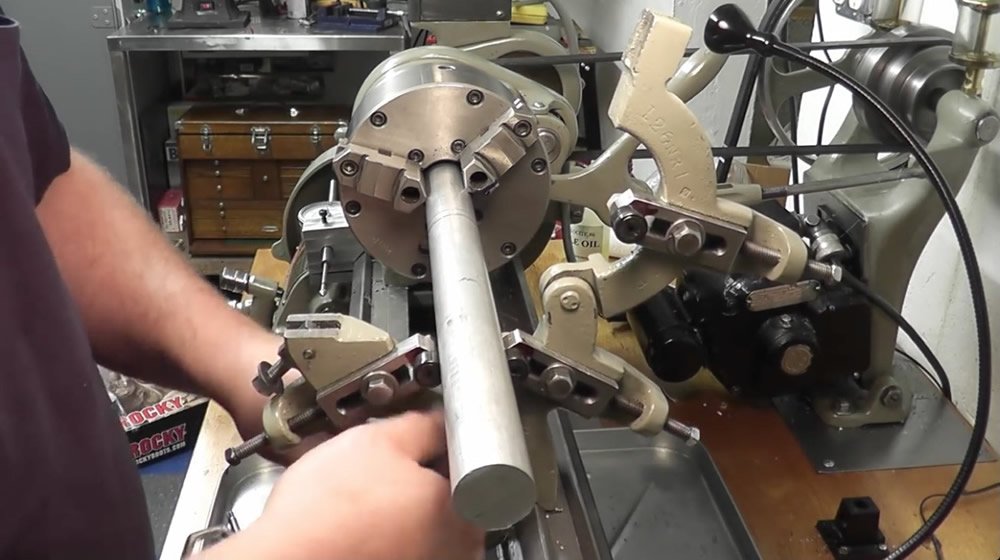
using a fixed steady rest on a lathe

Next, loosen the locking screw of the fixed steady rest, open its jaws, move it a little further away from the chuck, and clamp it again.

machining a long shaft on a lathe

You can hold sandpaper against the area closest to the end of the part to clean it of rust and oxides.

facing long workpieces

Move the fixed steady rest to the section you sanded and clamp it there.
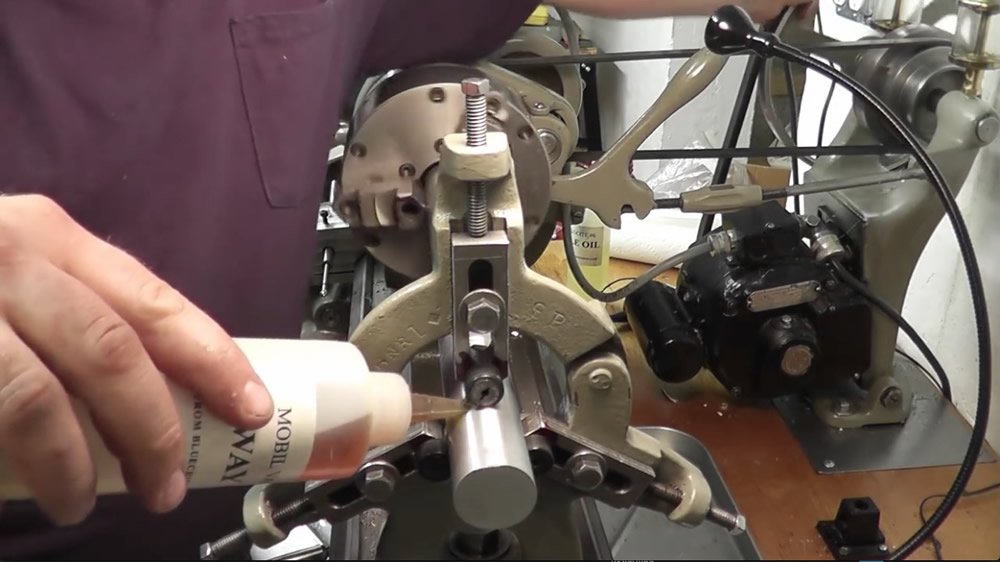
turning long shafts

 Apply a bit of oil to reduce the friction between the fixed steady rest and the workpiece.
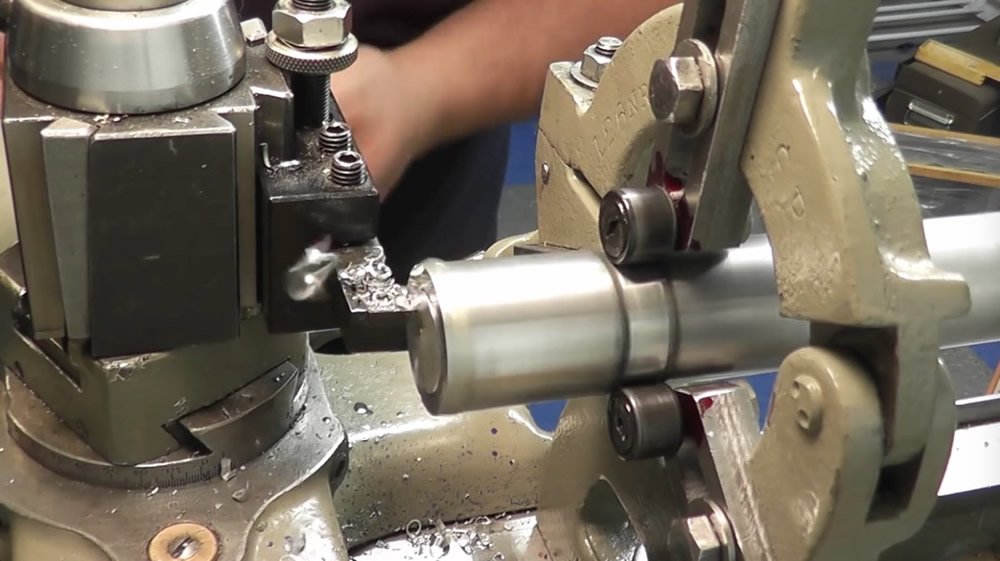
facing long shafts

Once the workpiece is supported at its end point, we can proceed to the facing operation. Facing must be done before drilling the center hole.
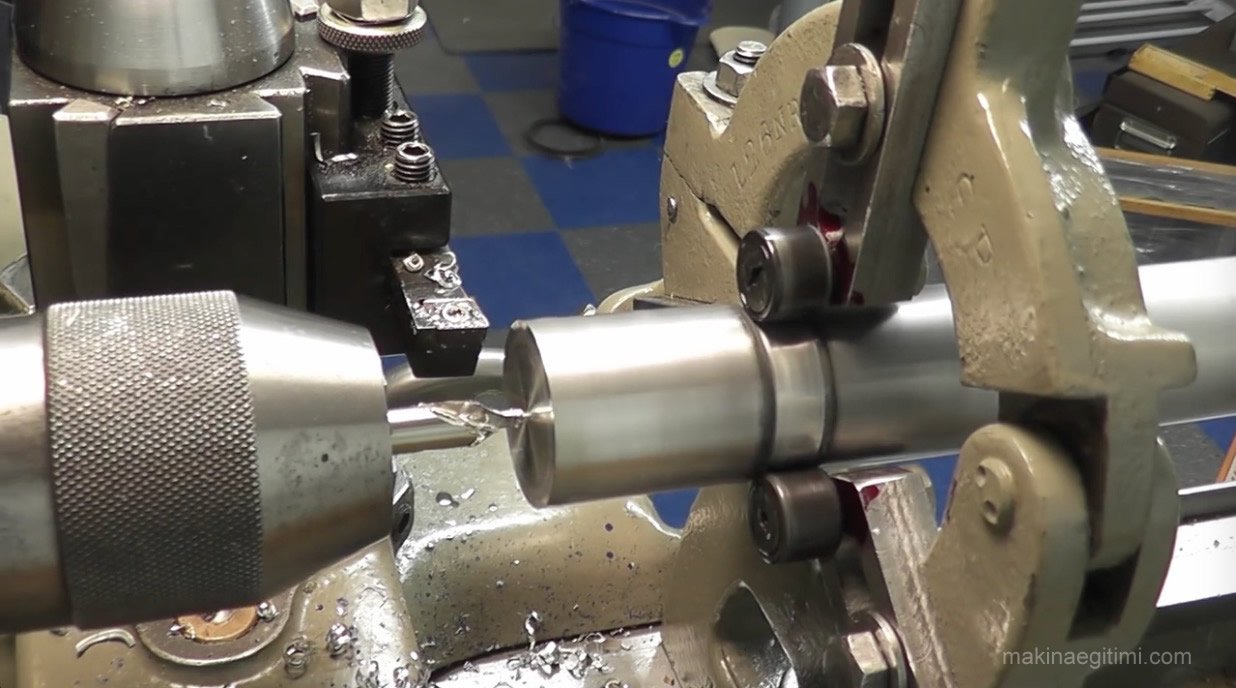
drilling the center hole on a lathe with a center drill and steady rest

Mount the drill chuck onto the tailstock, bring it up, and drill the center hole. When drilling the center hole, it is enough for 2/3 of the center drill’s tip to enter.

mounting onto the tailstock center with a traveling center and fixed steady rest

And finally, we place the tip of the tailstock center into the center hole and lock the tailstock in place.

Follower (traveling) rests

A follower rest is used to prevent small-diameter cylindrical parts from flexing under the pressure of the tool during turning. The follower rest has two jaws that follow the tool during turning. At the start, to adjust the rest’s two jaws, a short section near the head end of the workpiece is turned to a suitable diameter.

Bolted onto the carriage, the follower rest moves together with the carriage. In this way, the support of the two jaws prevents the workpiece from springing up onto the tool.

Turning with a follower rest on a lathe (above)

In some cases, a follower rest and a fixed steady rest can be used together on the same workpiece. If the workpiece is long and small in diameter, both a fixed steady rest and a follower rest are used.

Related Posts

Operations Performed on a Lathe Operations Performed on a Lathe Work Instructions at a Drill Press Work Instructions at a Drill Press About Marking What Is Marking? What Are the Marking Tools? Cutting Tools Used on a Milling Machine Cutting Tools Used on a Milling Machine Circular Indexing with a Dividing Head Circular Indexing with a Dividing Head – Simple and Differential Indexing Twist drills, title image Twist Drills Micrometer Reading Questions Micrometer Reading Questions Safety Rules for Working on a Lathe Safety Rules for Working on a Lathe


Turning
Share. Facebook Twitter WhatsApp Tumblr Email Telegram Copy Link

Leave A Reply Cancel Reply


How Is a Diesel Particulate Filter Cleaned
The Birth and Golden Age of Reggae: From Jamaica to the World
  • Contact
  • Terms of Service
  • Privacy & Cookie Policy

Type above and press Enter to search. Press Esc to cancel.