

What is honing: We can define honing as the process where a cylindrical tool, fitted with abrasive stones, rotates about its own axis while making a periodically reversing stroke motion, removing material from the workpiece under continuous surface contact. This process is used to achieve precise dimensions in cylindrical bores. It’s the most suitable method for finishing engine cylinders.
How Is Honing Done
The Honing Process: Honing stones made of an abrasive material such as aluminum oxide, silicon carbide, diamond, etc. are pressed against the workpiece with a pressure of 10 N/cm² to 100 N/cm². Even during rough stock removal at low pressure and low cutting speed (up to 5 m/s), the temperature at the cutting edge doesn’t rise above 100°C.

In honing, a cylindrical tool fitted with abrasive stones rotates on its own axis. The tool’s diameter is nearly equal to the workpiece’s bore diameter. This tool rotates about its own axis and, at the same time, moves up and down, allowing material to be removed in the form of micro-sized chips. It can achieve a tolerance of roughly 0.25 – 1.5 microns. This process creates a crosshatch pattern on the workpiece.

The structure of the stone is similar to that of a grinding wheel. These stones need to be self-sharpening under light pressure, meaning the grains need to be able to fracture and break away even under small grain loads. Commonly used diamond and cubic boron nitride grain types are used in grain sizes of 20 μm to 200 μm. Accordingly, a smaller grain size produces lower surface roughness (Rz=0.1…10 μm).
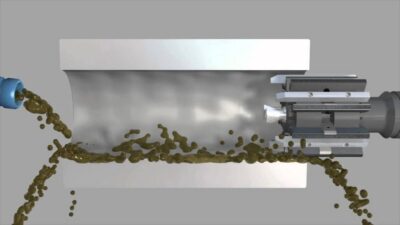
Mollart Cox Engineering – Honing Operation

Honing Process

ROTTLER H75A CNC Vertical Honing Machine
Some videos about the honing process (above)
How Is Manual Honing Done
In manual honing, a store-bought honing tool is fitted to a hand drill and inserted into the bore as shown in the video below, and made to move back and forth like a piston a few times.
Machine Honing
Honing heads have holders capable of moving radially to match any bore size, and can hold 3 to 12 honing stones. How deep these stones extend is set through a form-dependent tapered feed cone. Mandrels equipped with pneumatic gauging nozzles automatically stop the feed once the bore reaches its theoretical dimension.

Form correction: Long honing stones make it possible to correct cylindrical form errors in bores. When machining through-bores, the stroke position and length must be set so that about a third of the honing stone’s length extends past the end of the bore. When a previously machined bore deviates from a true cylindrical shape, the stroke overtravel on the narrow side is increased, and reduced on the wide side.
The honing stones are mounted inside an oscillating head driven either electromechanically or pneumatically. These stones make an oscillating motion along the workpiece’s length, shifting 1 mm to 6 mm sideways relative to the previously machined turning or grinding marks, while also being pressed against the rotating workpiece with a pressure of 10 N/cm² to 40 N/cm².
Crosshatch Pattern
Honing produces the characteristic crosshatch pattern on the cylinder surface, which helps retain oil.
Micron-Level Precision
Honing provides extremely precise dimensional control at the micron level for cylinder diameter.
Engine Cylinder Application
Honing is commonly used, in particular, for finishing the inner surface of engine cylinders.
Advantages of Honing
Some advantages of honing over other machining methods are listed below.
- Less complex or lower cost.
- Provides a high-quality surface finish.
- Can be used for both long and short bores.
- Preserves the original bore centerline.
- Any material can be machined, regardless of hardness.
Where Is Honing Used?
With short-stroke honing (a very fine finishing method), preferably cylindrical external surfaces — for example, the bearing journals of crankshafts and the raceways of bearings — are given a fine finish.
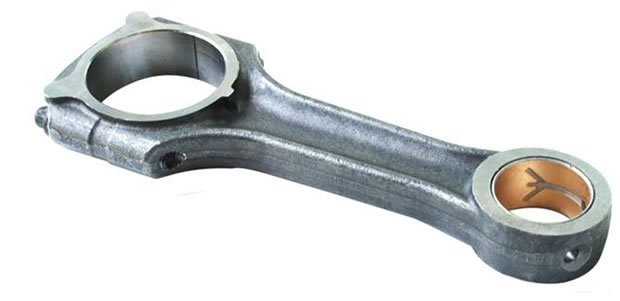
Since honed surfaces with crosshatch marks also demonstrate adequate oil retention, engine cylinders, connecting rod bores, and the control housings of hydraulic valves are precisely finished with long-stroke honing.

The Effect of Certain Parameters on Surface Quality in Honing
Pressure Applied to the Stones
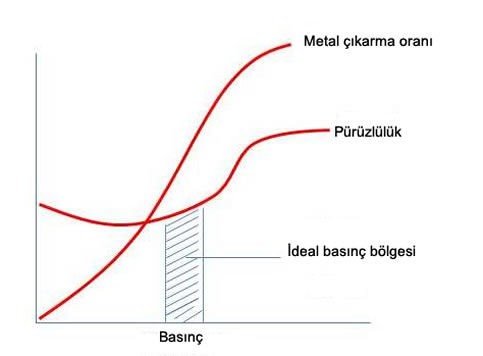
The change in metal removal rate and surface roughness with unit pressure is shown in the graph. Stone pressure is chosen to achieve the minimum roughness at the highest metal removal rate.
Ideal Honing Time
If we extend the process time, it will reduce the surface roughness to some degree. However, considering how important efficient use of machining time is in industry, the best process timing, keeping surface roughness at a minimum level, will be as shown in the graph below.

Tool Rotational Speed in Honing
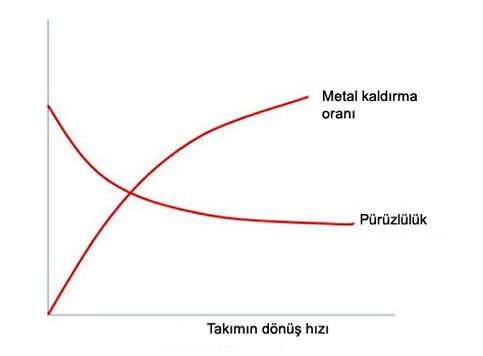
If the rotational speed of the tool used in honing increases, the metal removal rate increases and the surface roughness decreases. (Graph below)
Related Questions
Honing achieves both a very precise diameter tolerance (as tight as 0.25-1.5 microns) and leaves fine crosshatch marks on the cylinder surface that help retain oil. Together, these two properties support both dimensional accuracy and long service life for the engine.
Rotation alone would leave parallel, single-direction marks on the cylinder surface. The simultaneous up-and-down motion makes these marks form a crosshatch pattern, which helps oil adhere to the surface better.
Related Posts
 Laser Cleaning: Removing Rust, Dirt, and Grease
 Heat Treatments Applied to Cast Iron
 Professional 3D Scanners and Their Applications
 Gear Making by the Hobbing Method
 Mold Making With the Selective Laser System
 How Are Washers Made
 The Complete Manufacturing Process of the China-Made Jetta VS5
 Applications of Lasers