Close Menu
  • MAKİNELER ve İMALAT
    • Tools & Equipment
    • Computer-Aided Drawing
    • CAD/CAM Education
    • CNC Machine Programming
    • Casting Technologies
    • Electrical & Electronics Technologies
    • Hydraulics & Pneumatics
    • Manufacturing Processes
    • Manufacturing Technologies
    • Occupational Safety
    • Mold & Die Design
    • Solid Modeling
    • Welding Technology
    • Machine Elements
    • Mechanical Trade Drawing
    • Materials Science
    • Automotive & Vehicle Technologies
    • Robotics Technologies
    • Health Technologies
    • Defense & Aerospace Technologies
    • Descriptive Geometry
    • Technical Drawing
    • Software & Hardware Technologies
    • Innovative Manufacturing Methods
  • TEKNOLOJİ ve YAŞAM
    • OTOMOBİLLER ve TAŞIT
      • Vehicle & Engine Knowledge
      • Safe Driving
      • Sürüş Destek Sistemleri
    • Genel Kültür
      • Movies & TV Shows
      • Görsel ve Grafik Sanat
      • Books & Literature
      • Music
      • Sports
      • History
      • History of Technology
    • GÜNDELİK YAŞAM TEKNOLOJİLERİ
    • Hobbies & Entertainment
    • Internet Technologies
    • Health
    • Mobile Technologies
Makine Eğitimi
  • Machines & Manufacturing
    Machine Elements
    Hydraulics & Pneumatics
    Technical Drawing
    Computer-Aided Design & Manufacturing
    Basic Manufacturing Processes
    Manufacturing Processes
    Industry Technologies
    Other Technical Courses
    Motion & Power Transmission
    Simple Machines
    Chains & Sprockets
    Shafts & Journals
    Gears
    Cams
    Couplings
    Belts & Pulleys
    Springs
    Bearings
    Keys
    Fastening Joining
    Retaining Rings
    Screws, Bolts & Nuts
    Cotter Pins
    Flanges
    Welding
    Rivets
    Pins & Bolts
    Washers
    Calculators
    Gear Ratio Calculator
    Spring Constant Calculator
    Belt Pulley Ratio Calculator
    Other Machine Elements
    Slides & Linear Guides
    Brakes
    Flywheels
    Clamps
    Shock Absorbers
    Gaskets & O-Rings
    Seals & Sealing Elements
    Hydraulics
    Introduction to Hydraulics & Principles
    Hydraulic Systems & Applications
    Accumulators
    Filters
    Motors
    Pumps
    Valves
    Pneumatics
    Introduction to Pneumatics & Principles
    Pneumatic Systems & Applications
    Pneumatic Circuit Components
    Valves
    Cylinders
    Silencers
    Motors
    Compressors
    Dryers
    Conditioning Units
    Common Topics & Maintenance
    Hydraulic & Pneumatic Maintenance
    Study Notes, Exams & Tests
    Technical Drawing
    Introduction to Technical Drawing
    Geometric Drawings
    Perspective & Projection
    Orthographic Views
    Dimensioning
    Sectioning
    Assembly & Detail Drawings
    Tolerances
    Surface Finish Symbols
    Mechanical Engineering Drawing
    Screws, Bolts & Nuts
    Pulley Drawings
    Gear Drawings
    Shafts & Journals
    Bearing Drawings
    Pins & Bolts
    Spring Drawings
    Welds in Technical Drawing
    Washers
    Cotter Pins
    Technical Drawing Exercises
    Mechanical Drawing Exercises
    Gear Exercises
    View Extraction Exercises
    Pulley Exercises
    Pin & Bolt Exercises
    Threaded Fastening Exercises
    Descriptive Geometry
    Computer-Aided Drawing
    AutoCAD Drawing Lessons
    Computer-Aided Drawing Exams
    Solid Modeling & Animation
    Solid Model Drawing Files
    Solid Model Assembly Examples
    Solid Model Drawing Lessons
    3D CAD Software Reviews
    Solid Modeling Exercises
    CNC Programming
    CAM
    Measurement & Inspection
    Dial Indicators
    Calipers
    Gauges
    Micrometers
    Materials Science
    Steels
    Cast Iron
    Aluminum
    Plastics
    Material Testing & Hardness Measurement
    Occupational Safety
    Workshop Safety
    Safety When Working With Electricity
    Machine Safety Rules
    Hand Operations
    Filing
    Marking
    Cutting Operations
    Reaming
    Tapping
    Threading With a Die
    Drill Bit Sharpening
    Working With Machines
    Basic Turning Operations
    Basic Milling Operations
    Shaper Machine
    Machining
    Turning
    Milling
    Grinding
    Innovative Manufacturing Methods
    EDM (Electrical Discharge Machining)
    Laser Machining
    Waterjet Machining
    3D Printing
    3D Scanners
    Welding
    Rolling
    Casting
    Mold & Die Design
    Mechanical & Hydraulic Presses
    Blanking & Piercing Dies
    Bending Dies
    Drawing Dies
    Plastic Injection Molds
    Extrusion Dies
    Compound Dies
    Progressive Dies
    Blow Molds
    Spinning Dies
    Spray Molds
    Manufacturing of Machine Parts
    Automotive & Vehicle Technologies
    Motor Vehicle Manufacturing
    Raw Material Production
    History of Technology
    Health & Medical Technologies
    Defense & Aerospace
    Robotics Technologies
    Software & Hardware Technologies
    Mechanics - Strength of Materials
    Physics Topics
  • Technology & Life
    Hobbies & Entertainment
    Sports
    Music
    Vehicle & Engine Knowledge
    Vehicle Maintenance & Repair
    Safe Driving
    Driver Assistance Systems
    History
    Movies & TV Shows
    Books & Literature
    Computers & Internet
    Computer Tips
    Software Reviews
    Hardware & Peripherals
    Practical & Safe Internet Use
    Visual & Graphic Art
    Mobile Technologies
    Travel
    Science
    Health
    First Aid Knowledge
    Everyday Technologies
Makine Eğitimi
Home»Manufacturing Processes»How to Read a Caliper. Caliper Reading Explained
28 August 2026Updated:3 September 2026

How to Read a Caliper. Caliper Reading Explained

How to Read a Caliper

In the measurement and inspection category of our machine education lessons, we’ve dedicated this article to vernier caliper reading lesson notes. How to read a caliper. For those who want to learn how to read 1/10, 1/20, and 1/50 calipers, we’ll provide simple, easy explanations. We hope you’ll enjoy the explanations, supported by exercises and caliper questions.

  • Caliper Reading
    • How is a caliper read?
      • First step in caliper reading. Reading the whole-number value
      • Second step in caliper reading. Finding the caliper’s precision
      • Third step in caliper reading. Finding the coinciding line
      • How is a caliper’s precision determined?
    • Reading a 1/10 Caliper
      • 1/10 Caliper Reading Examples
      • 1/10 Caliper Reading Examples 2
    • Reading a 1/20 Caliper
      • 1/20 Caliper Reading Examples
      • 1/20 Caliper Reading Examples 2
      • 1/20 Caliper Reading Examples 3
    • Reading a 1/50 Caliper
      • 1/50 Caliper Reading Examples
      • 1/50 Caliper Reading Examples 2
    • Caliper Reading Questions and Solutions

Caliper Reading

A caliper is a measuring tool with precise graduated markings. While caliper precision varies by preference, the most commonly used precisions are 1/10 (0.1 mm), 1/20 (0.05 mm), and 1/50 (0.02 mm). Caliper reading may seem difficult to some, but it’s actually quite easy once you grasp how it works.

How is a caliper read?
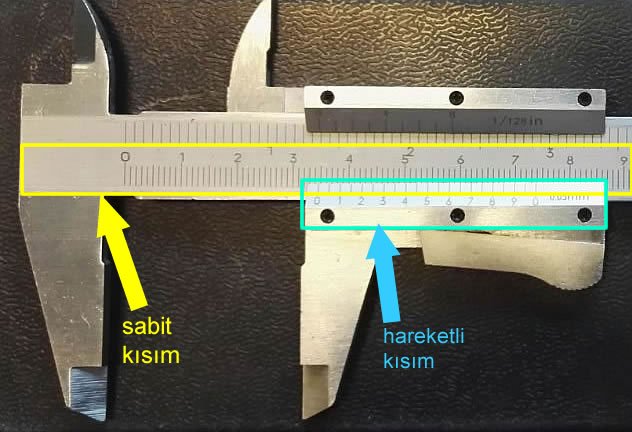
how to read a caliper

A caliper has two basic parts: a moving jaw and a fixed jaw. The first step in reading a caliper is finding which graduation on the fixed scale the zero point of the moving scale (the vernier) lines up with. Let’s take a closer look at the example above:

First step in caliper reading. Reading the whole-number value

how to read a caliper

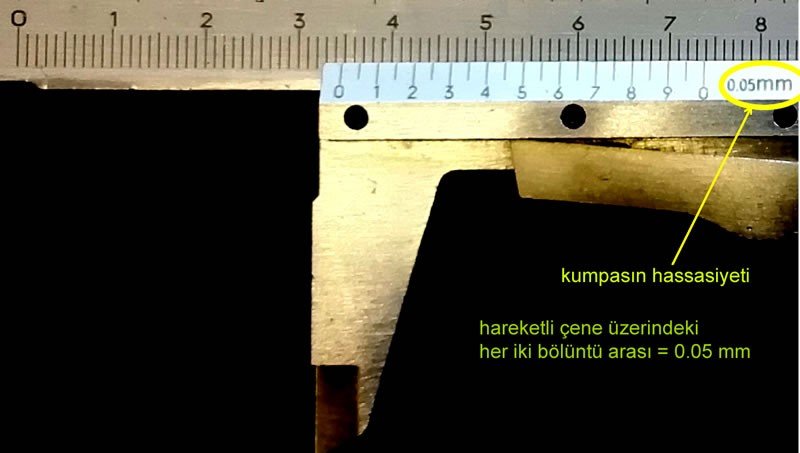
We can see that the zero point on the moving jaw’s scale falls somewhere between 34 and 35 on the fixed scale. So what’s the measured value? Is it 34.6? 34.8? What’s the value after the decimal point?

Second step in caliper reading. Finding the caliper’s precision
caliper precision

Many calipers have their precision printed on them. For example, the precision of the caliper shown above is 1/20 = 0.05 mm. Even if the precision isn’t printed on the caliper, it’s still possible to determine it. We’ll explain how to find a caliper’s precision further below.

Third step in caliper reading. Finding the coinciding line
how to read a vernier caliper

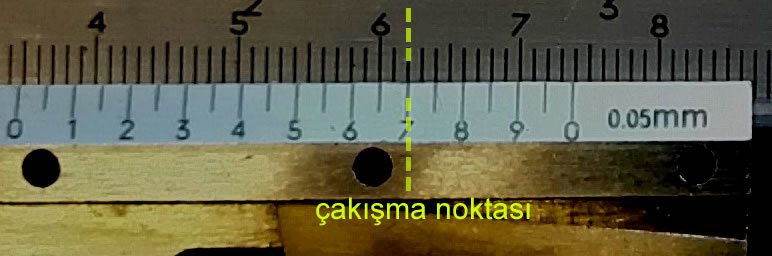
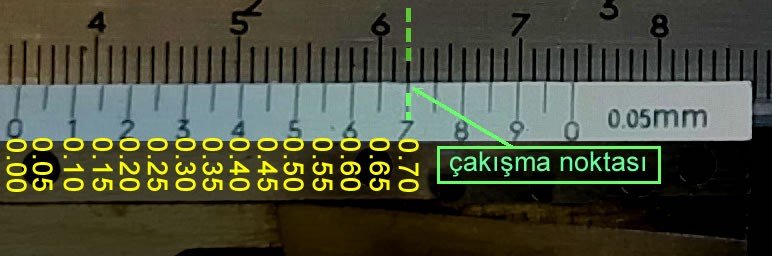
In this step, we determine where a line on the moving jaw’s scale exactly lines up with a line on the fixed jaw’s scale. (In the example above, this is where the number 7 is.)
coinciding line in caliper reading

Since the caliper’s precision — the spacing between two lines — is 0.05, the coinciding point gives us: 14 x 0.05 = 70, which is the digit after the decimal point.

final step in caliper reading

The final step in caliper reading. Now that we’ve found the digit after the decimal point, the value read on the caliper is 34.70 mm.

How is a caliper’s precision determined?

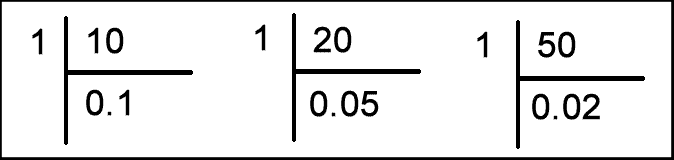
A caliper’s precision is the smallest measurement increment it can measure.
determining caliper precision

How to determine a caliper’s precision is shown above.

1/10 calipers have a precision of 0.1 mm. In other words, this type of caliper can take measurements like 6.2, 7.3.

1/20 calipers have a precision of 0.05 mm. In other words, this type of caliper can take measurements like 6.25, 7.35.

1/50 calipers have a precision of 0.02 mm. In other words, this type of caliper can take measurements like 6.22, 7.34.


Question: Which of the following caliper types is more precise?

a) 1/10    b) 1/20    c) 1/50

Answer: The 1/50 caliper is the most precise. It can measure increments as small as 2% of a millimeter (0.02).


Reading a 1/10 Caliper

How do we know a caliper is a 1/10 caliper?

1/10 caliper reading

On 1/10 calipers, a 9 mm length on the fixed scale (the ruler) is divided into 10 equal parts on the moving scale (the vernier).

When you fully close a caliper’s jaws and the 9th line lines up as shown in the picture above, that caliper is a 1/10 caliper.

1/10 Caliper Reading Examples

1/10 caliper reading examples

The zero point falls between 16 and 17 on the fixed scale = 16.?

Line 7 on the vernier (moving scale) lines up = 0.7
Reading = 16 + 0.7 = 16.7

1/10 Caliper Reading Examples 2

1/10 caliper reading examples 2

The zero point falls between 13 and 14 on the fixed scale = 13.?
Line 3 on the vernier (moving scale) lines up = 0.3

Reading = 13 + 0.3 = 13.3

Reading a 1/20 Caliper

On 1/20 calipers, a 19 mm length on the fixed scale (the ruler) is divided into 20 equal parts on the moving scale (the vernier).
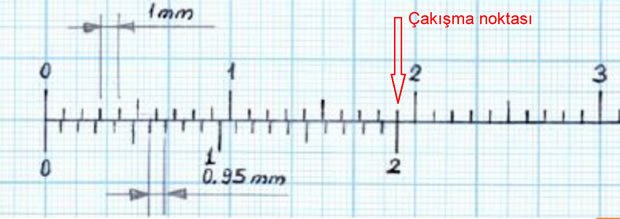
1/20 caliper reading

If the jaws are closed and the 19th line lines up as shown above, we know that caliper is a 1/20 caliper.

1/20 calipers have a precision of 0.05 mm. In other words, this type of caliper can take measurements like 6.25, 7.35, 7.40.

1/20 Caliper Reading Examples

1/20 vernier caliper reading

In this 1/20 caliper measurement, we can see the zero point on the moving scale (vernier) has passed 16 on the fixed scale. We determine how much it has passed by finding where a line on the vernier lines up with a line on the fixed scale. Measurement result:  16 + 0.60 = 16.60

1/20 Caliper Reading Examples 2

1/20 caliper reading examples 2

The zero point sits somewhere after line 14 on the fixed scale.

We can see line 7 on the vernier (moving scale) lines up. The caliper’s precision is 0.05. So, if the spacing between two lines is 0.05 mm, then 7 x 0.05 = 0.35 

Measurement result: 14 + 0.35 = 14.35 mm.

1/20 Caliper Reading Examples 3
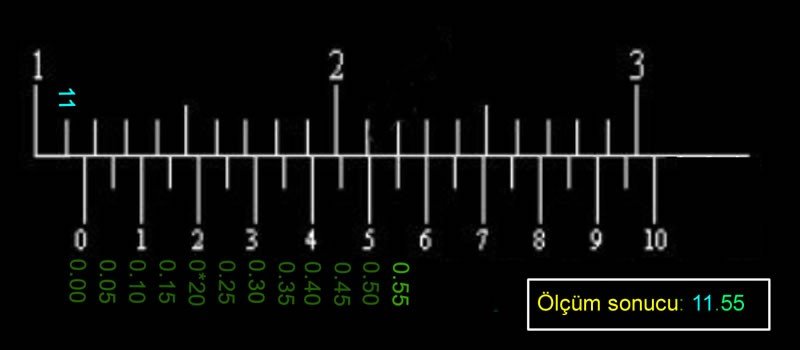
1/20 caliper reading

Reading a 1/50 Caliper

On 1/50 calipers, a 49 mm length on the fixed scale (the ruler) is divided into 50 equal parts on the moving scale (the vernier).

1/50 caliper reading

If the jaws are closed and the 49th line lines up as shown above, we know that caliper is a 1/50 caliper.

1/50 calipers have a precision of 0.02 mm. In other words, this type of caliper can take measurements like 6.22, 6.24, 6.28.

1/50 Caliper Reading Examples

1/50 caliper reading examples

Given that the caliper’s precision — the spacing between two lines — is 0.02 mm, the value read on the caliper shown above is 10.42 mm.

1/50 Caliper Reading Examples 2
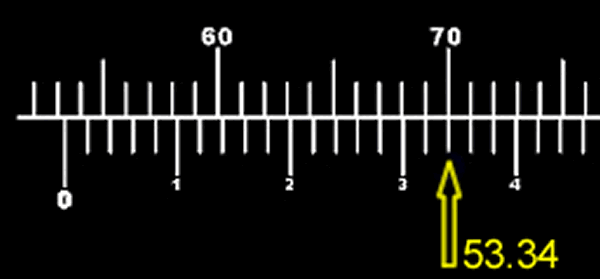
1/50 caliper reading examples 2

The zero point starts somewhere after 53 on the fixed scale. Line 17 on the vernier lines up. Given a caliper precision of 0.02 mm, 17 x 0.02 = 0.34

Reading on the caliper: 53 + 0.34 = 53.34 mm.

Caliper Reading Questions and Solutions

We’ve tried to keep the explanations as simple as possible, supported by examples, so that no question marks remain in your mind about 1/10, 1/20, and 1/50 calipers. Even though we think this should be enough, practice will still be needed to reinforce what you’ve learned.

We’ve prepared caliper reading questions and solutions suitable for use in exams at vocational and technical high schools, technical private schools, and vocational training centers that teach in industrial fields. You can find them in the Related Posts section below.


In this article, we’ve tried to put together a page of manual caliper reading lesson notes for anyone wondering how to read a caliper. If you have any questions or would like to add anything about vernier calipers, feel free to share it with us and other readers in the comments section.

Related Posts

1/10 1/20 1/50 Caliper Reading Practice Questions 1/10 1/20 1/50 Caliper Reading Practice Questions Vernier caliper simulator tool Vernier Caliper Simulator Tornada Kesme Hızı ve Devir Sayısı Cutting Speed and RPM on a Lathe Lathe Tool Angles and Their Effect on Surface Quality Lathe Tool Angles and Their Effect on Surface Quality Cutting a Triangular Thread on a Lathe Cutting a Triangular (V) Thread on a Lathe Reamer Hole Tolerance Table Reamer Hole Tolerance Table Making a Worm Wheel Making a Worm Wheel Band Saw Machine Work Instructions Band Saw Machine Work Instructions
Calipers
Share. Facebook Twitter WhatsApp Tumblr Email Telegram Copy Link

Leave A Reply Cancel Reply


What’s Under the Hood? A Guide to the Engine Bay
Engine Knocking Noise
  • Contact
  • Terms of Service
  • Privacy & Cookie Policy

Type above and press Enter to search. Press Esc to cancel.