
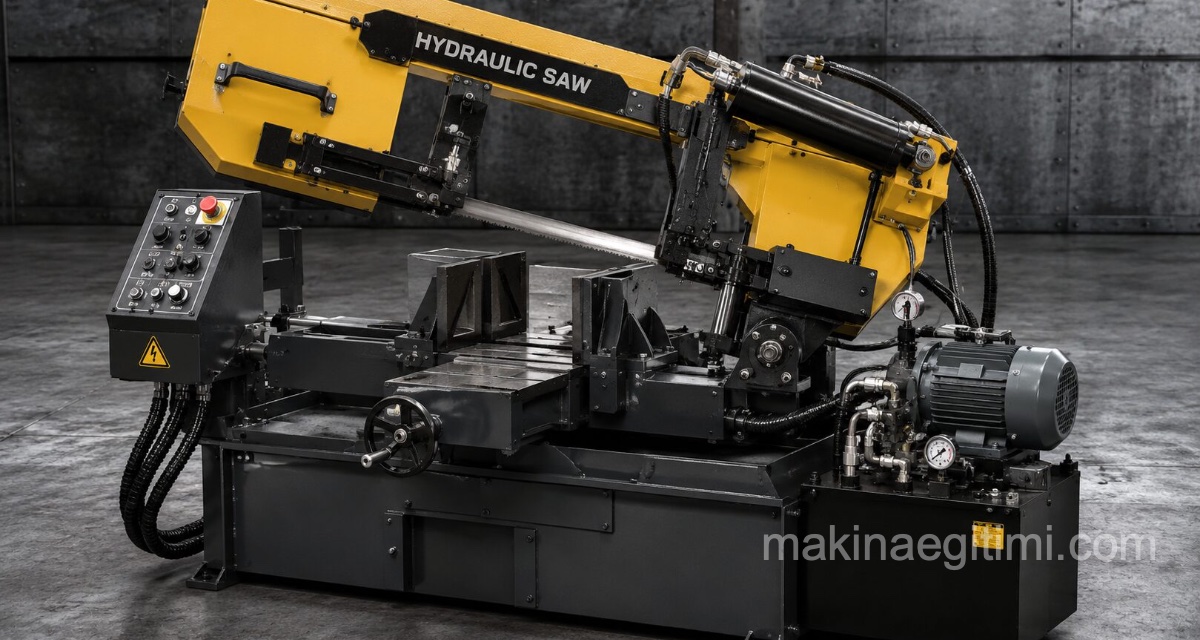
Thick cylindrical and prismatic materials and workpieces are cut on purpose-built sawing machines. Cutting a job on the machine is both quick and clean. Let’s take a look at the types of saw benches used for cutting metal;
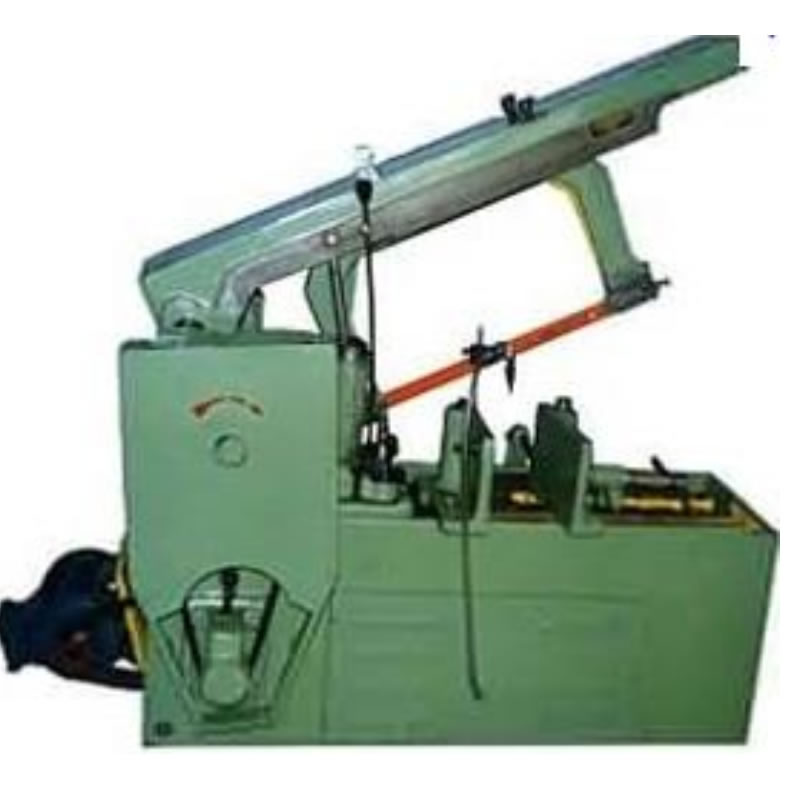
Hydraulic Power Hacksaw (Horizontal)
Also known as a hacksaw machine.
The saw blades used on this machine are similar in shape to hand hacksaw blades. However, these blades are larger.
They are made of higher-quality material, and each tooth is set individually. The stroke of the blade is provided by an eccentric driven by an electric motor.
Working Principle
Motion from the motor is transmitted to the gearbox via a belt-and-pulley system. The gearbox sets the desired speed. This speed is transmitted to the eccentric disc connected to the eccentric arm.
The eccentric disc converts circular motion into linear motion, driving the saw arm connected to it.
The saw blade moves within the upper body with the help of a feed slide.
Cutting fluid is pumped from the reservoir into the system during cutting. It operates on a recirculation principle.
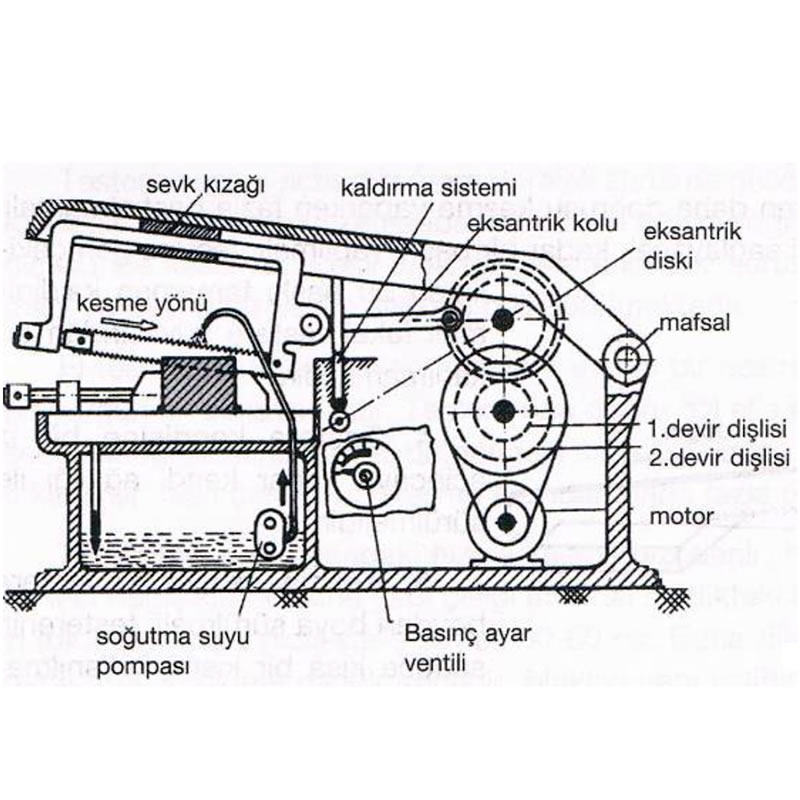
The moving saw arm must descend to cut. After cutting is complete, it must rise again to allow for the next cutting stroke. A lifting system is provided for this. The piston rod of a hydraulic cylinder is connected to the upper body, and the upper body is raised and lowered by using a pressure control valve to increase or decrease the pressure in the hydraulic oil.
Metal-Cutting Band Saw Machine
The saw blade is circular in loop, moving like a belt between two wheels.
Suitable for fast and practical cutting operations. Solid and thick materials are cut with ease.
It has a cooling system that continuously pumps cutting fluid into the system.

Working System
Motion from the motor is transmitted to the drive wheel. The drive wheel turns the other wheel by means of the band saw blade wrapped around it.
The saw blade both transmits motion and does the cutting. The blade passes between two rollers, called guide rollers, so that it travels straight between the two wheels.
With the help of the hydraulic system, the upper body lowers, and the band saw blade rotating around the wheels performs the cut.
Advantages
- Since it moves in one direction using a continuous band with many teeth, cutting is uninterrupted. There’s no wasted time.
- From thick, thin, hard, tough, soft, and abrasive materials — from asbestos to zinc — as well as castings, linoleum, rubber, stone, and plastics, all can be cut on this machine.
- The part can be cut directly along the marked line.
- By fitting different cutting attachments, cutting, filing, and polishing operations can be performed.
- Since the saw band is thin, there is no material waste.
Band Speed
On metal-cutting band saws, cutting speed is generally set between 20-100 meters per minute depending on the material type.
Choosing Tooth Pitch
Fine-toothed blades are preferred for thin-sectioned parts, and coarser-toothed blades for thick sections.
Use of Coolant
The coolant applied during cutting both extends blade life and improves the surface finish quality of the cut.
Vertical Band Saw Machine
Has a working principle similar to the horizontal band saw machine. Generally used for cutting wood materials.
Circular Saw Machine
The blade is circular and receives motion from the electric motor through a worm gear system.
These saws cut at low speeds, either wet or dry. They are practical and fast. Frequently used for profile cutting jobs.

Saw Machine Blades
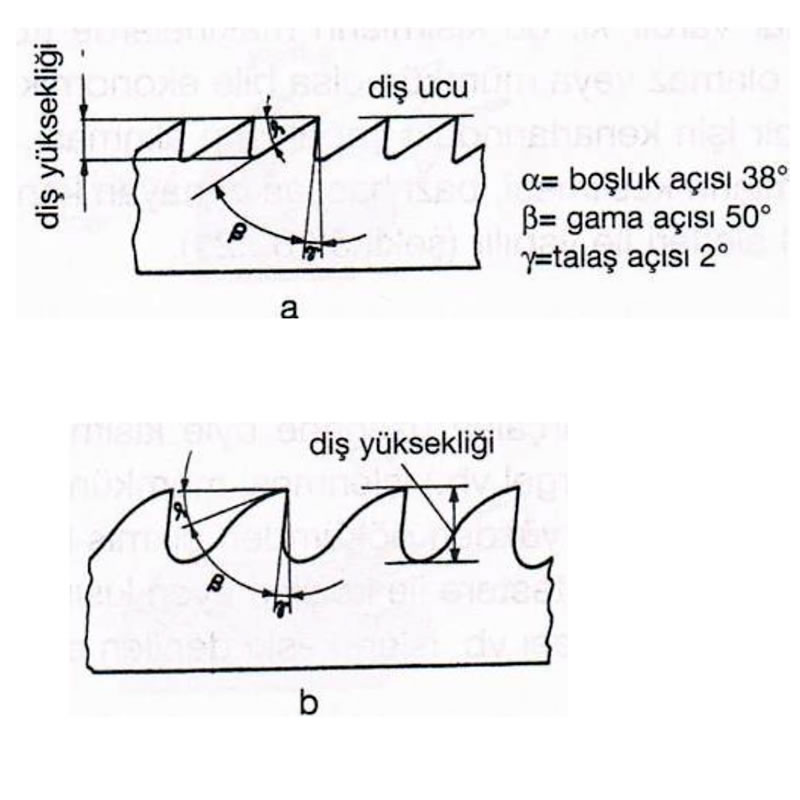
Since machine saws are subjected to greater strain during cutting, their teeth need to be strong. For this reason, machine saws are manufactured in two types based on tooth shape: sharp-toothed machine saws and wide-backed machine saws.
The chip clearance of machine saw teeth is designed to let the teeth cut easily. Especially on coarse-pitch machine saws, the teeth are curved to allow chips to flow out easily.
The wide-backed saw (b) also has a large chip clearance. This clearance and curvature give the saw teeth their strength, and make it easier for the chips produced to flow out.
Problems Encountered When Cutting With Saw Machines
| If the saw binds | The cut is not parallel to the marked line. |
| If it makes excessive noise | The saw blade is dull. |
| If the saw dulls quickly | Cutting speed is too high. Blade quality is low. |
| If saw efficiency is low | The blade may be dull, the pitch may be too small, or chip clearance may be insufficient. Cutting speed is either too high or too low. |
| If the saw overheats despite adequate cooling and lubrication | Cutting speed may be too high. If it’s a circular saw, the diameter may be too small. The blade may be dull. |
| If the saw’s teeth break | Feed rate is too high. |
Related Questions
The motion coming from the motor is circular, but cutting requires a back-and-forth (linear) motion of the blade. The eccentric disc converts this circular motion into linear motion and transmits it to the saw arm.
The friction heat generated during cutting heats both the saw blade and the workpiece. Cutting fluid lowers this heat, which both extends the blade’s life and produces a smoother cut.
Related Posts
 Types of Inspection Equipment and Their Use
  What Is a Dial Indicator? How to Use It
  Indexing Operations on a Milling Machine
  Balancing a Grinding Wheel. Grinding Wheel Balancing
  Mounting Grinding Wheels on the Machine
  Cutting with a Hacksaw
  Parts of a Lathe, Illustrated
  Metric-Whitworth Thread Tables