
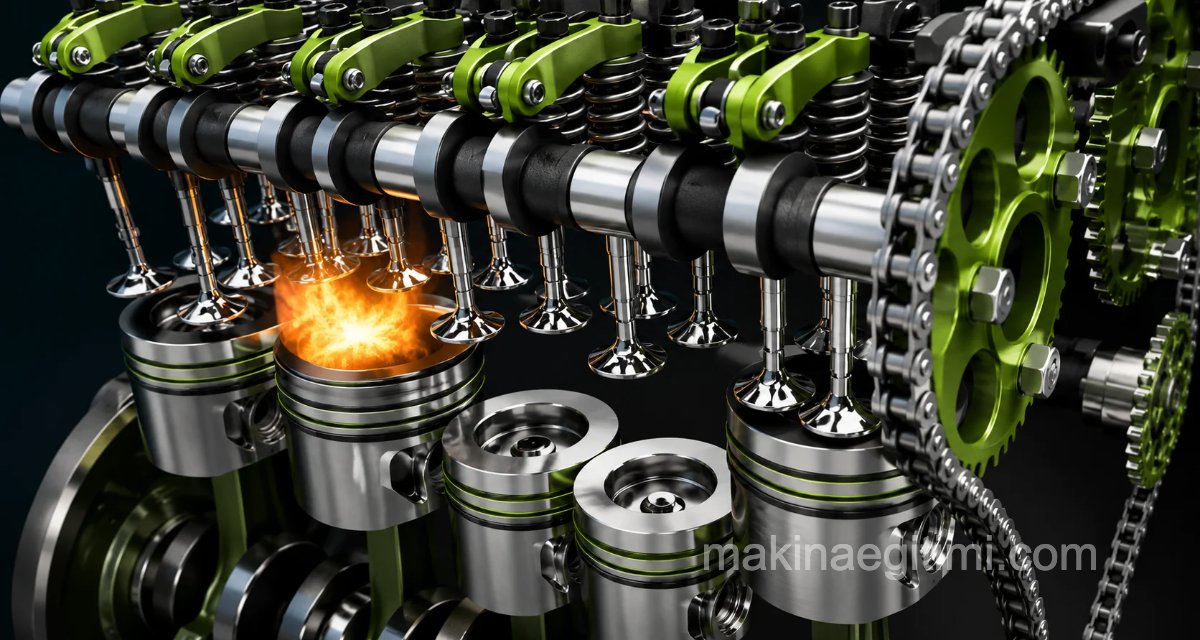
An illustrated album of the engine’s parts. What are the parts of the engine. The engine’s main components. Driving school preparation material. Driver’s license course engine knowledge lesson notes.

Job of the engine block: It forms the main body of the engine. Inside, it houses the cylinders, crankshaft, camshaft, oil pump, as well as fuel system components, the distributor, oil filter, alternator, and starter motor. The engine is bolted to the chassis using engine mounts.
The precision machining of the cylinder bores in the engine block is done by honing.
See: What is honing. How is it done

It closes off the top of the cylinder block, forming the combustion chambers. It carries the spark plugs, or in diesel engines the injectors, and the valve mechanism. There are water passages around the combustion chambers.

Job of the radiator: In water-cooled engines, it stores the coolant and helps the water that heats up in the system to cool down.

The water pump is the component that circulates the coolant inside the engine.

Job of the oil pump: It’s the component that draws oil from the oil pan and pumps it to all the engine parts that need lubrication.
See: Types of Engine Oil Pumps

Job of the oil filter: It’s the component that cleans the oil circulating inside the engine.

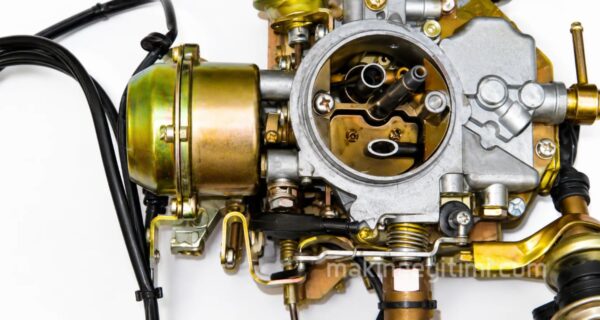
This is the component that, to obtain the desired power and speed from the engine, mixes gasoline and air (needed to obtain heat energy) into a vapor, at a ratio of about 1/15 (gasoline/air) depending on various conditions. It’s located on the intake manifold.

There are two types: intake and exhaust. The intake manifold distributes the gasoline-air mixture, formed in the carburetor, to the cylinders. The exhaust manifold, on the other hand, collects the exhaust gases produced at the end of combustion and directs them to the exhaust pipe, from where the burnt gases are released into the atmosphere. See: What Is an Intake Manifold. What Is Its Job?

Job of the injection pump: It’s the part that pumps diesel fuel to the injectors under high pressure, according to the firing order.

Job of the car engine’s injector: It’s the component that sprays the diesel fuel coming from the fuel pump onto the heated air.

Job of the ignition coil: It’s the part that steps up the 12-volt direct current coming from the battery to 18-25 thousand volts.

Job of the distributor: It’s the component that distributes the high voltage coming from the ignition coil to the spark plugs, according to the firing order.

What does a spark plug do: Spark plugs are the part that ignites the gasoline-air mixture compressed in the combustion chamber. The spark plug’s job is to produce a spark using the energy it receives from the battery when you turn the ignition on.

Job of the fuel pump: It’s the component that pumps the fuel it draws from the gas tank to the carburetor.
Related to this topic, see: Fuel Pump Failure Symptoms

Job of the piston: Its motion inside the cylinder produces the strokes. It transmits the power produced during the power stroke to the connecting rod.

Job of the connecting rod: It transmits the vertical force it receives from the piston to the crankshaft.

Job of the crankshaft: It converts the vertical motion coming from the pistons via the connecting rods into rotational motion. There’s a gear and a pulley at the front end of the crankshaft. The gear drives the camshaft. The pulley drives the water pump and the alternator.

Job of the starter motor: It’s the DC electric motor that gives the engine its initial rotation.
For detailed information, see: What Is a Starter Motor, What Does It Do?

The charging generator, also called the alternator, is the component that converts mechanical energy into electrical energy while the engine is running, and also meets the vehicle’s electrical needs.
Related to this topic, see: What Is an Alternator. What Does It Do?

Job of the voltage regulator: It’s the part that regulates the current and voltage produced by the alternator.

Job of the air filter: It’s the component that cleans the air being drawn from outside into the engine.

Job of the valves: They’re divided into intake and exhaust valves. Intake valves let only air into the cylinder in diesel engines, and the gasoline-air mixture in gasoline engines. Exhaust valves, meanwhile, let the burnt gases exit the cylinder.
The Cylinder Block Foundation
The engine block forms the cylinders the pistons move in, and the main structure onto which all other parts are mounted.
Job of the Crankshaft
The crankshaft converts the linear motion of the pistons into rotational motion via the connecting rods.
Camshaft Synchronization
The camshaft controls the opening-closing timing of the valves in sync with the crankshaft.
Related Questions
Since the piston is constantly moving inside these bores, the surface needs to be extremely smooth and dimensionally accurate. Honing provides this precision, guaranteeing the piston’s sealing and efficient operation.
Besides forming the combustion chamber together with the block, the cylinder head also carries the spark plugs or injectors, and the valve mechanism. This makes the head not just a cover, but an active part housing the engine’s ignition and breathing systems.
Related Posts
 What Is a Carburetor? What Does It Do? How Does It Work?
 Differences Between Leaf Spring and Coil Spring Suspension
 Why Does the Traction Control System Light (TCS Light) Come On?
 Properties of Ethanol (Ethyl Alcohol) Blended Gasoline
 What the Markings on a Car Tire Mean
 The Importance of Engine Oil for a Vehicle
 Why Does an Engine Misfire? Engine Misfire Problem
 Disc Hydraulic Brakes and Their Working System