
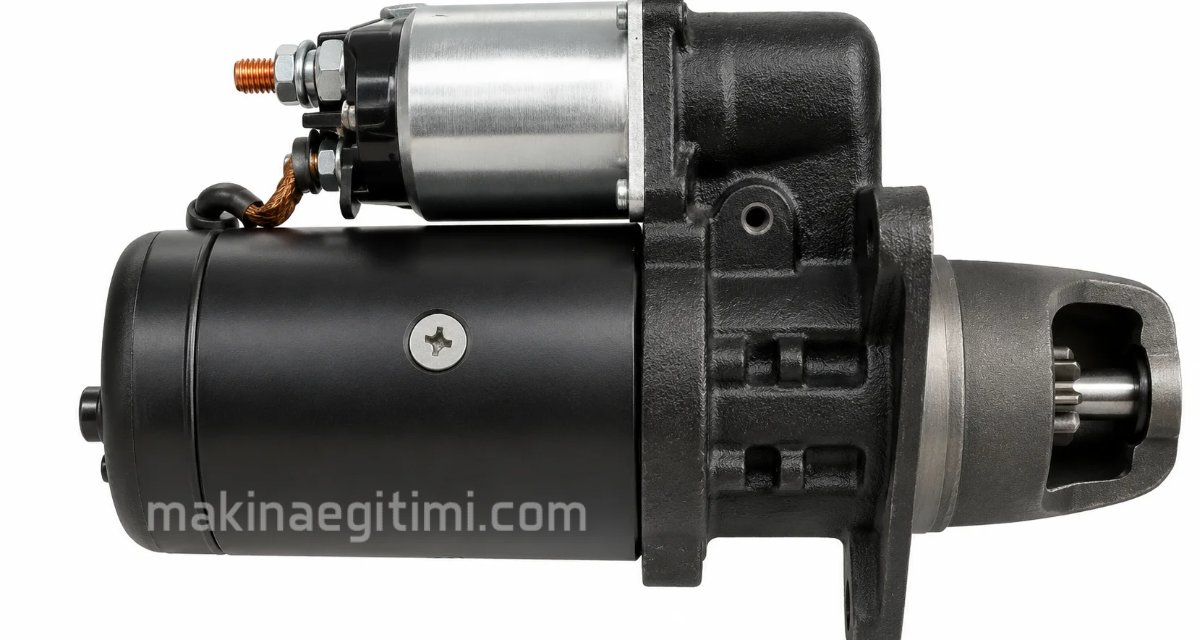
What Is a Starter Motor?
On gasoline-powered chainsaws, the first-generation automobiles we see in movies, and propeller airplanes, the engine was started with manual effort by using an attachment or rope connected directly to the crank and turning it by hand.
In today’s motor vehicles, a starter motor is used to do this job.
A starter motor is a small electric motor in motor vehicles, powered by current from the battery, used to give the engine’s pistons their initial movement. These motors are generally low-power and low-speed.
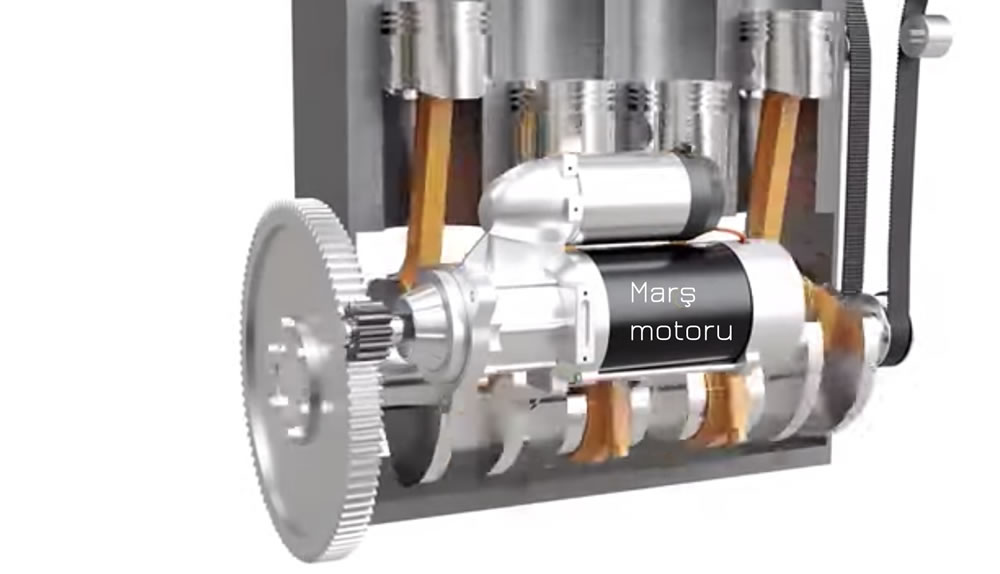
Components of the Starter Motor

Since the starter motor’s only job is to set the pistons in motion, it’s manufactured using lightweight materials. The basic components of the starter motor are shown above.
What Is a Starter Motor Brush
One of the most important parts of the starter motor’s construction is the starter motor brush. It’s located at the ends of the starter motor’s housing. There are generally four, though some vehicles have starter motors with just two brushes. Since it’s present in every design, it’s actually an important part. The starter motor brush transmits the electricity coming from the battery, which needs to turn the armature, to the starter motor. Also called the commutator brush, the starter brush is made of copper and carbon.
The starter motor brush is one of those products that can wear out over time and need replacing. If you press the ignition when you want to drive your vehicle and get no response, you should check the starter brush. Once the starter motor brush wears out, the vehicle won’t crank.
What Does a Starter Motor Do?
The starter motor’s job is to give gasoline or diesel engines their initial movement. When the ignition key is turned and the starter is engaged, the starter motor runs using energy taken from the battery. The starter gear engages the flywheel ring gear, turning the flywheel. Since the flywheel is connected to the crankshaft, the pistons move and draw in the air-fuel mixture. The air-fuel mixture is ignited by the ignition system. With the force of the explosion, the pistons move up and down. This is how the gasoline or diesel engine is given its initial motion.
Operating Current
Starter motors can draw a high current of 100-200 amps from the battery while operating.
Bendix Gear
The starter motor’s bendix gear automatically disengages from the flywheel ring gear once the engine starts running, preventing damage.
The Solenoid’s Function
The solenoid on the starter motor both switches the electrical current and pushes the bendix gear toward the flywheel.
How Does a Starter Motor Work
A starter motor is more than just an electric motor.
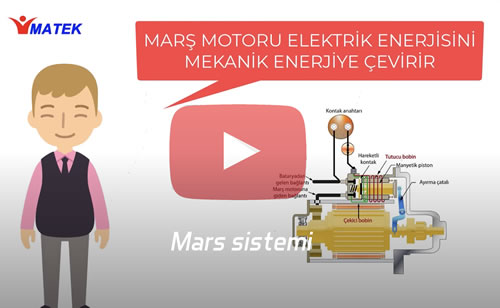
With the help of the mechanism and solenoid inside it, the pinion gear extends forward only when the starter is engaged, and retracts back into its housing when the electrical current is cut.
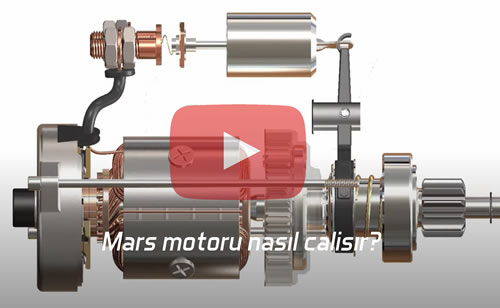
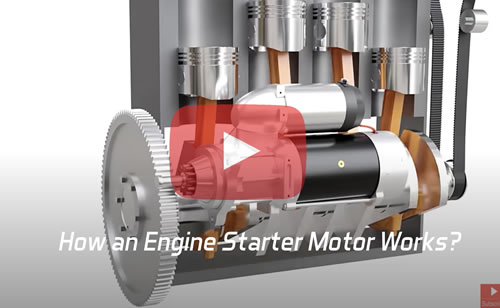
This prevents damage to the gear that has completed its job of transmitting motion to the crankshaft’s ring gear. You can watch the starter motor working in the video alongside.
Through its internal electro-mechanical system, the starter motor brings the pinion gear, spinning at a certain speed once the starter is engaged, into contact with the ring gear, causing the ring gear to begin turning.
Once the ring gear has been given its initial motion (once the engine has started), the starter motor’s job is done. When the engine starts, we release the key. This retracts the pinion gear back into its housing.
In the video alongside, we can see how a starter motor works.
Engaging the starter while the engine is already running will needlessly bring the pinion gear into contact with the ring gear, and the ring gear can be damaged by the impact. For this reason, it’s strongly recommended not to engage the starter while the engine is running.
Frequently Asked Questions About the Starter Motor
Question: Where in the Vehicle Is the Starter Motor?
The starter motor’s location varies depending on your vehicle’s make and model, but it’s generally in the engine bay area. Since it works connected to the battery, you can typically find it next to the battery.
Question: Does running the starter motor while the engine is running damage the engine?
Answer: The starter motor must absolutely not be engaged while the engine is running. If the starter motor is engaged while the pistons are running, the flywheel gears can be damaged.
Question: What happens if the starter motor’s brush wears out completely?
If the starter motor’s brush wears out completely, the starter motor cannot spin smoothly, and sudden speed fluctuations are seen in the armature.
Question: At what RPM does a starter motor operate?
The operating speed of starter motors can vary depending on the motor type and manufacturer. Generally, starter motors operate between 14,000 and 18,000 RPM. This allows higher speeds to be used to increase the motor’s power. However, higher speeds can consume more energy and produce more noise.
Question: How much energy does the starter motor consume?
The starter motor consumes a great deal of energy. When accelerating from 0-60 mph, it’s on the order of about 0.3-0.5 kWh. Because of this high energy requirement, you’ll notice the vehicle’s headlights and interior lighting dim when you engage the starter. For this reason, it’s recommended to run the starter motor for no more than 10 seconds. If run for longer than 10 seconds, it will drain the entire battery.
Video Walkthroughs About the Starter Motor



Related Questions
The starter motor’s only job is to spin the engine for a short enough time to give it its initial motion; it doesn’t run continuously. For this reason, lightness is prioritized over durability, which both lowers cost and reduces the power draw from the battery.
The brushes are the contact points that transmit electricity from the battery to the spinning starter motor. If the brushes wear down and lose this contact, the motor doesn’t get the electricity it needs, and the starter either won’t turn or will turn weakly.
Related Posts
 5 Tips for Fuel Economy
  The Importance of Engine Oil for a Vehicle
  Differences Between Leaf Spring and Coil Spring Suspension
  Properties and Advantages of Alloy Wheels
  How Does a Manual Transmission Work? The Synchromesh Mechanism
  What Is AdBlue, What Does It Do?
  Is It Harmful to Drive Off Without Warming Up the Engine?
  What Is ESP in Vehicles? What Does It Do? How Does It Work?