

Before fuel injection systems became widespread, the vast majority of automobiles were built with a carburetor. Even though new automobiles no longer use them, you can still find carbureted systems in classic cars, some motorcycles, farm equipment, and small gasoline engines.
So what exactly does a carburetor do, how does it work, and what symptoms does it show when it fails? In this article, we cover the essential things drivers should know about carburetors, in plain language.
What Is a Carburetor?
A carburetor is a mechanical fuel delivery system that mixes gasoline and air in the correct ratio and sends it to the engine.
Fuel alone, or air alone, isn’t enough for the engine to run properly. The carburetor mixes these two elements in the right proportion and sends them to the cylinders through the intake manifold.

In short, the carburetor’s job is to prepare the air-fuel mixture the engine needs.
What Does a Carburetor Do?
A carburetor’s main jobs are:
- Mixing gasoline and air in the correct ratio
- Making the engine easy to start
- Keeping the idle stable
- Sending more fuel to the engine when the throttle is pressed
- Making it easier to start in cold weather
Advantages of a Carbureted System
- Its design is simple.
- It’s usually easier to repair.
- It doesn’t need an electronic control system.
- Replacement parts are affordable for many models.
- Simple failures can often be fixed easily.
Disadvantages of a Carbureted System
- Fuel consumption is higher.
- Exhaust emissions are higher.
- The fuel-air mixture isn’t as precise as electronic systems.
- Starting can be harder in cold weather.
- It can be more affected by changes in altitude.
- It may require regular adjustment.

The Venturi Effect
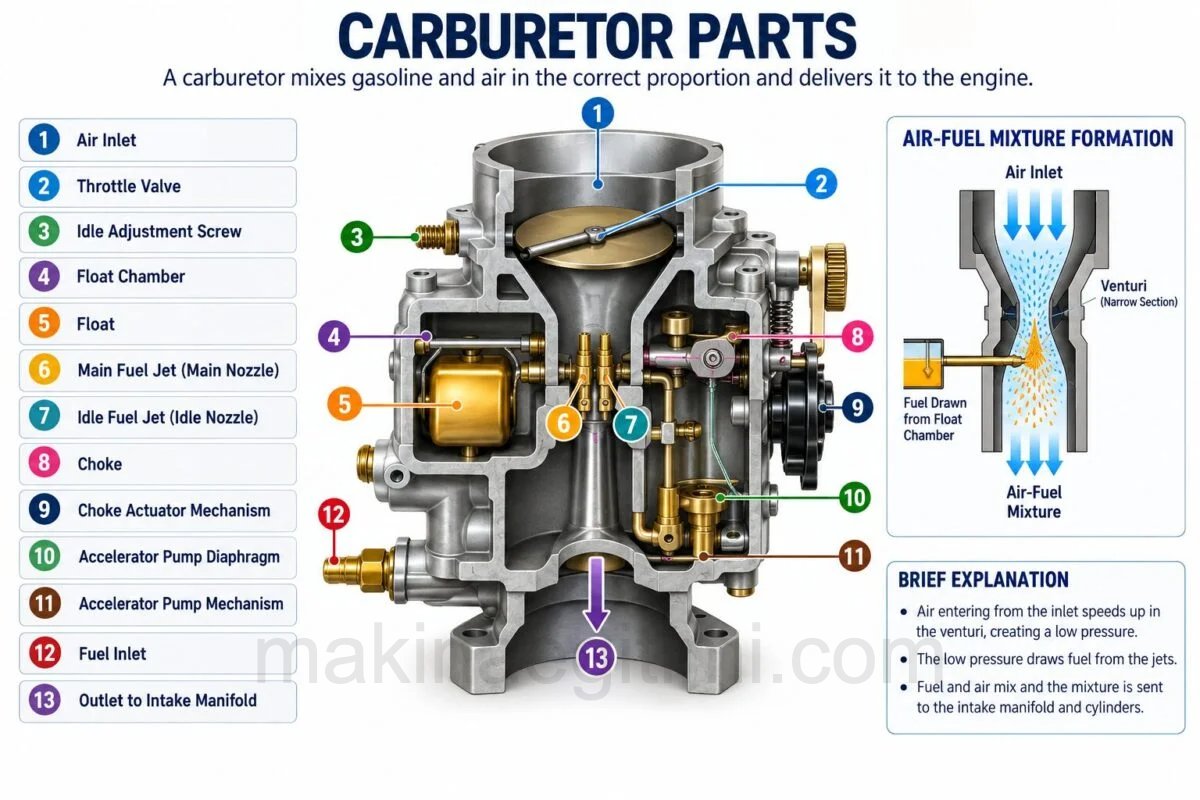
The carburetor draws fuel by using the pressure drop in a narrowed section of tube (the venturi), where airflow speed increases.
The Float Bowl
The float bowl, which keeps the fuel level constant, provides a steady, stable flow of fuel to the carburetor.
The Shift to Fuel Injection
Carburetors began to be phased out starting in the 1980s in favor of electronic fuel injection systems, which offer more precise control.
How Does a Carburetor Work?
A carburetor’s operating principle is quite simple. While the engine runs, the pistons draw air into the cylinder. As this air passes through the carburetor, it flows at high speed through a narrowed section (the venturi).
Thanks to the vacuum this air creates, gasoline from the carburetor’s bowl mixes with the air as fine droplets. The resulting air-fuel mixture travels through the intake manifold and reaches the cylinders, where it’s ignited by the spark from the spark plug.
When you press the throttle, the throttle plate opens further, sending more air and fuel to the engine. This lets the engine produce more power.

Carburetor or Fuel Injection?
Nearly all automobiles produced today use an electronic fuel injection system. Fuel injection systems;
- Provide lower fuel consumption.
- Are more environmentally friendly.
- Offer easier starting.
- Provide higher performance.
- Require less maintenance.
That said, carbureted systems are still preferred by some users for their ease of repair and mechanical simplicity.
Basic Components of a Carburetor
A carburetor is made up of many small parts. But the basic components a driver should know are:
- Float bowl
- Venturi
- Fuel nozzles (jets)
- Throttle plate
- Choke
- Idle adjustment system
What Is a Choke?
When the engine is first started in cold weather, fuel has a harder time vaporizing. The choke system makes it easier to start by sending a richer mixture (with more gasoline) to the engine than normal.
On older vehicles, the choke was usually pulled by hand by the driver, while some models have an automatic choke system.
Carburetor Failure and Maintenance
Symptoms of a Carburetor Failure
A failure in the carburetor can show up through various symptoms. The most common symptoms are:

Difficulty starting the engine. Uneven idle. The engine bogging down when the throttle is pressed. The vehicle misfiring. Increased fuel consumption. Black smoke from the exhaust. Reduced traction. The engine stalling. A gasoline smell.
These symptoms may not necessarily be caused by the carburetor alone. Failures in the ignition system or fuel pump can produce similar symptoms.
Why Do Carburetor Failures Happen?
The most common causes of carburetor failures are:
- Dirty Fuel: Sediment in the fuel can clog the carburetor’s fine passages and nozzles over time.
- A Clogged Fuel Filter: If the fuel filter can’t do its job, dirt can reach the carburetor.
- Float Failure: If the float doesn’t work properly, the fuel level in the bowl goes off. This can cause the vehicle to consume too much fuel or run erratically.
- Vacuum Leaks: Leaks in the intake manifold or vacuum hoses can throw off the air-fuel mixture.
- Incorrect Adjustment: An out-of-adjustment idle or mixture setting can cause the engine to run erratically.
What Can the Driver Check on Their Own?
Instead of working on adjustments that require technical knowledge, you can perform these simple checks:
- Check the fuel filter.
- Look for a fuel leak.
- Make sure the air filter is clean.
- Check that the throttle cable moves freely.
- Visually inspect the vacuum hoses for cracks or breaks.
- Watch for a strong gasoline smell around the engine.
Beyond this, disassembling and adjusting the carburetor requires expertise.
What to Watch For When Driving a Carbureted Vehicle
Carbureted vehicles require slightly different driving habits from modern fuel-injected vehicles. It’s worth paying attention to the following:
- Don’t drive the vehicle at high RPM right away while the engine is cold.
- Only use the choke when necessary.
- Choose quality fuel.
- Replace the fuel and air filters on time.
- Keep in mind that fuel residue can build up inside the carburetor on vehicles left unused for long periods.
- Don’t skip periodic adjustments and cleaning.
How Is Carburetor Maintenance Done?
Regular maintenance lets the carburetor run trouble-free for many years. Maintenance typically involves the following steps:
- Disassembling and cleaning the carburetor
- Cleaning the fuel nozzles
- Checking the float level
- Checking gaskets and seals
- Adjusting the idle and mixture settings
- Checking the air filter
- Replacing the fuel filter
Cleaning the carburetor at regular intervals can reduce fuel consumption and help the engine run more smoothly.
In conclusion;
A carburetor is a mechanical system that lets a gasoline engine run by mixing air and fuel in the correct ratio. Even though it has largely been replaced today by electronic fuel injection systems, it’s still used in classic automobiles and some small engines. With regular cleaning, quality fuel, and timely maintenance, a carburetor can run trouble-free for many years.
When symptoms like a hard-starting engine, uneven idle, increased fuel consumption, or a gasoline smell show up, having the carburetor checked by a specialized service center will help prevent bigger problems down the road.
Frequently Asked Questions
Fuel injection systems can adjust the air-fuel mixture electronically with far more precision, providing lower fuel consumption and emissions. Since a carburetor is purely mechanical, it can’t achieve that level of precision.
Since fuel has a harder time vaporizing when cold, the carburetor uses the choke mechanism to prepare a richer mixture (with a higher fuel ratio) than normal. This lets the engine catch easily even while cold.
Classic automobiles, some motorcycles, farm equipment, and small gasoline engines (like lawn mowers) can still run on carburetors. For engines like these, the cost of switching to electronic injection usually isn’t seen as necessary.
Related Posts
 Characteristics and Advantages of Rear-Wheel-Drive Vehicles
  Forces That Affect Engine Parts
  Meanings of the Abbreviations in Honda Vehicle Models
  What Is a Coilover (Coil Spring Shock Absorber)? What Is It For?
  How Hydraulic Brakes Work
  What Does the Noise from the Valves Mean?
  5 Tips for Fuel Economy
  The Importance of Using Original Parts on a Motorcycle