

In our vehicle maintenance and engine knowledge section, we’ve dedicated this article to choosing engine oil. We’ll take a look at how to choose engine oil for diesel vehicles and how to choose engine oil for gasoline vehicles. What are engine oil numbers? We’ll try to explain what an engine oil number means.
Choosing Engine Oil
Selecting the right oil for your engine is an important topic. The oil suitable for each engine is specified in the vehicle’s manual. Beyond that, if you’re deciding on the oil yourself and asking which engine oil should I use, we recommend taking a look at the points explained below.
First, let’s try to explain what viscosity is. Viscosity is the resistance shown against flowing. If an engine oil’s viscosity is high, it will show high resistance to flowing. In other words, an oil with high viscosity is a thick oil.

Choosing Engine Oil According to the Engine’s Technical Specifications
Engine oils are classified by their S.A.E series number. S.A.E stands for the Society of Automotive Engineers, the American engineering organization for motor vehicles.

What Do Engine Oil Numbers Mean?
Engine oils with a smaller S.A.E number are thinner and more fluid. The lower this number is, the thinner the engine oil will be, which also tells us how fluid the oil will be at low temperatures and how easily the engine will start.

Oils with a higher S.A.E number are thicker and less fluid.
For example, 10-weight oil is thinner and more fluid than 30-weight oil.
Engine oils are manufactured with different properties for gasoline and diesel engines.
For gasoline engines, oils starting with the letter S, such as SA, SB, SC, SD, are used.
For diesel engines, oils starting with the letter C, such as CA, CB, CC, CD, are used.
Choosing Engine Oil by Season
Both gasoline and diesel engine oils come in three types: summer, winter, and combined (all-season) oils.
Summer Oils:
These are 10, 20, 30, 40, 50 weight oils.
Winter Oils:
These are oils such as 5W, 10W, 15W.
(The letter W indicates the oil is a winter grade, being the initial of the English word “winter”.)
All-Season Oils:
They behave like a summer oil in summer and a winter oil in winter.
These are oils such as 10W-40, 15W-50, 15W-50.
For example;
10W-30 weight oil;
is used in place of 10W-weight oil in winter,
and in place of 30-weight oil in summer.
High RPM – Low RPM
Since high-RPM and newer engines have less oil clearance, oil with a lower S.A.E number is used.

Since medium-RPM engines and engines that have reached the middle of their service life have more oil clearance, an oil with a middle-range S.A.E number is used.
For low-RPM engines and engines with increased oil clearance, a somewhat higher S.A.E number is selected.
Choosing Engine Oil According to the Engine’s Operating Conditions
Choosing Engine Oil for Gasoline Engines
SA service-type oils are additive-free oils. They’re used in gasoline and diesel engines operating under light load.
SB-type oils contain a rust-inhibiting rubber-based substance. They’re used for gasoline engines operating under light load.
SC-type oils are suitable for operation at low and high temperatures, and have anti-wear and anti-rust properties.
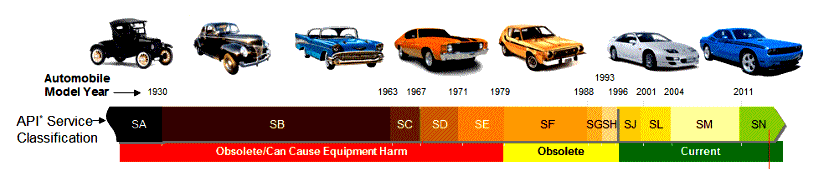
SD-type engine oils were produced to match 1968 engine technology and are used in gasoline engines. They’re also used anywhere SB or SC service-type oils are recommended.
SE-type engine oil was produced to match 1972 engine technology. It’s used in gasoline engines. It can also comfortably be used anywhere SC and SD service oils are used.
SF-type engine oils were prepared to match 1980 engine technology. They’re used in gasoline engines.
SG service-type oils: prepared to match 1988 engine technology. Used in gasoline engines. This is the highest-grade oil on the market.
Choosing Engine Oil for Diesel Engines
CA service-type oils are for diesel engines running on low-sulfur, good-quality diesel fuel, as well as gasoline engines in light-duty service.
CB service-type oils are used in diesel engines operating under medium load with high-sulfur, low-quality diesel fuel. They can also be used in light-duty gasoline engines.
CC service-type oils are used in low-supercharge (blower) or turbo-diesel engines operating under medium and heavy loads, and in gasoline engines operating under heavy load.
CD service-type oils are for supercharged and turbo-diesel engine oil operating at high speed and high efficiency.
Choosing Engine Oil According to the Ambient Temperature of the Vehicle’s Operating Environment
The temperature of the environment the vehicle is in also affects the choice of engine oil. Temperature is related to the fluidity of the engine oil, and therefore to the amount of friction. Friction in vehicle engines is one of the topics that gives engineers the most headaches. Recently, efforts have been made to minimize friction in engines.

The second number gives the oil’s high-temperature viscosity. The “40” in 10W-40, for example. The higher this number, the more viscous, meaning thicker, the oil is when hot.
Does Choosing Engine Oil Affect Fuel Consumption?
Yes, the engine oil used in a car is connected to fuel consumption.
An oil’s viscosity (resistance to flow) is connected to the oil’s own internal friction. The higher an oil’s viscosity, meaning the thicker it is, the more friction there will be. If friction is high, the vehicle consumes more fuel.

When you use a 10W-40 viscosity oil instead of 20W-50 oil, friction will be lower, and this will save us fuel.
However, it’s especially worth reminding that the main criterion in choosing engine oil shouldn’t be fuel consumption, but the climate conditions you’re in. Using an unnecessarily thin oil isn’t beneficial. On the contrary, it causes harm rather than benefit.
SAE Viscosity Grade
Codes like SAE 5W-30 in engine oil selection indicate the oil’s fluidity in cold and hot weather.
API Classification
API certification shows that the engine oil meets performance standards for a specific engine technology.
Synthetic vs Mineral Oil
Full synthetic oils offer higher temperature resistance and longer change intervals compared to mineral oils.
Related Questions
Each engine is designed to run most efficiently with an oil of a certain fluidity, based on its own design and operating temperature. An oil with the wrong viscosity might not flow fast enough to protect the parts, or might flow too easily to form an adequate film layer.
A low SAE number indicates the oil is thinner and more fluid. Such oils can start protecting the parts sooner by reaching them faster, especially in the first moments the engine runs in cold weather.
Related Posts
 How Is Engine Oil and Oil Filter Change Done?
  Vehicle Drivetrain: Components, How It Works, and Common Failures
  What’s Under the Hood? A Guide to the Engine Bay
  Is It Harmful to Drive Off Without Warming Up the Engine?
  What Is a Drum Brake System, How Does It Work
  Engine Air Intake System and Components
  5 Tips for Fuel Economy
  Parts of the Engine, Illustrated Explanation