

This guide will give you an idea of roughly where the components sit in front-wheel-drive, rear-wheel-drive, four-wheel-drive and hybrid vehicles. Always refer to your owner’s manual to learn the exact layout of your own car.
Every car is different, but knowing where the main components in the engine bay are matters for two reasons: it lets you handle small maintenance jobs yourself, and it lets you tell whether a mechanic is giving you accurate information.
Engine Bay Layout in Front-Wheel-Drive Cars
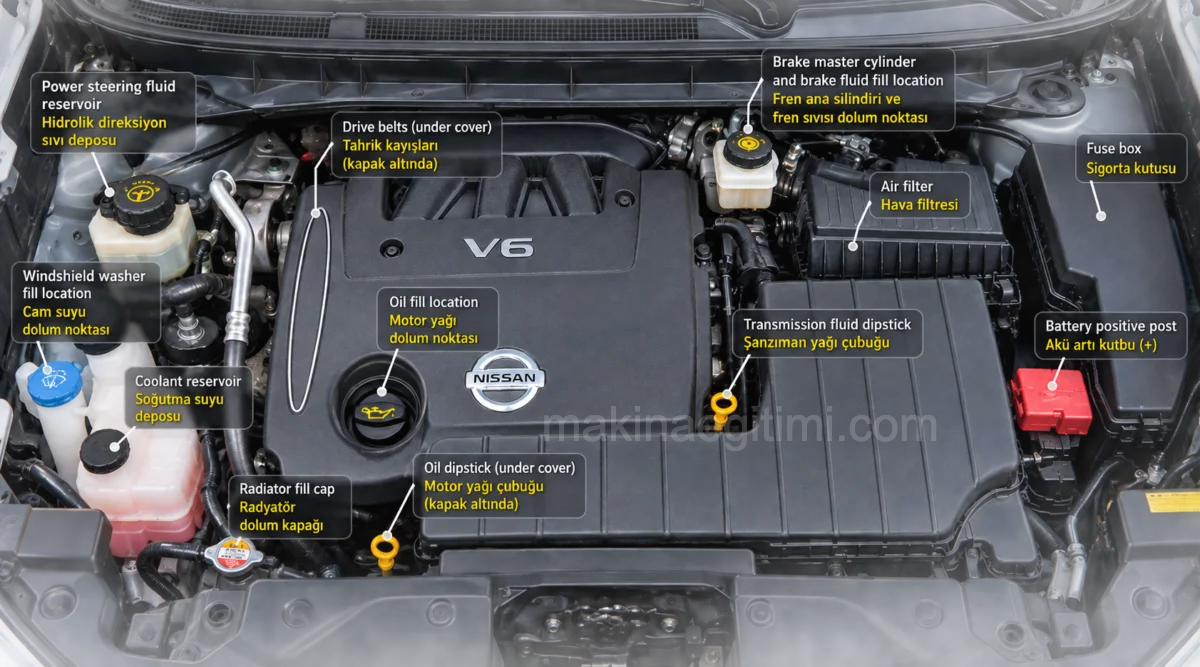
In a typical front-wheel-drive car the engine sits on the left and the transaxle on the right.
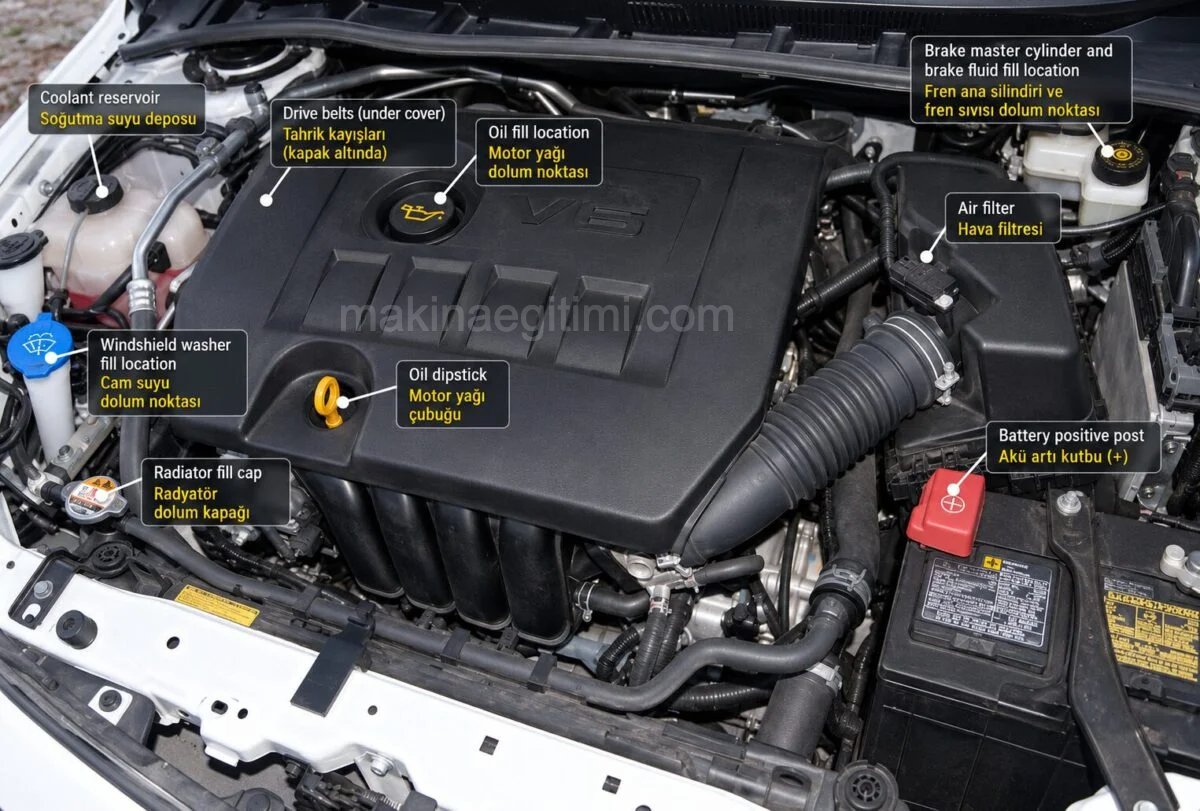
Unlike the previous example, the V6 car above has no transmission fluid dipstick tube. It also has no power steering fluid reservoir, because it uses an electric power steering system. This is a good illustration of how two cars in the same “front-wheel-drive” category can still differ in the engine bay.
Layout in Rear-Wheel-Drive and Four-Wheel-Drive Vehicles
Rear-wheel-drive and four-wheel-drive vehicles usually have more components packed into the engine bay. In the example of a four-wheel-drive truck, the engine sits directly at the front and there are two batteries, one on each side of the radiator. The engine belts are at the front of the engine. Most rear-wheel-drive vehicles follow a similar layout.

How Is the Engine Bay Different in a Hybrid?
Hybrids have a battery cooling system that you will not find in a conventional engine-only car. In the hybrid example below you can see that there is no hydraulic power steering system, that the batteries sit somewhere further away, and that because of this the charging point is located inside the fuse box.

The extra component to watch out for in a hybrid is the battery coolant. This fluid is found only in hybrids and keeps the high-voltage battery pack running at a safe temperature. When working in the engine bay of a hybrid, always follow the manufacturer’s safety instructions before going anywhere near the high-voltage systems.
Why Does It Matter to Know Where These Components Are?
Knowing where the main components in the engine bay sit is useful in several ways. You can check fluid levels such as oil, coolant and brake fluid yourself. Knowing where the battery is saves you time when a jump-start is needed.
Knowing where the fuse box is means you can fix a minor electrical fault quickly instead of waiting at the roadside. And finally, understanding which component a mechanic is talking about gives you the means to judge whether the work being done is really necessary.
Conclusion
Although every car has its own engine bay layout, the basic components — the dipstick, the coolant tank, the brake fluid reservoir, the battery, the fuse box and the radiator cap — are present in almost every vehicle.
Whether your car is front-wheel drive, rear-wheel drive, four-wheel drive or hybrid, taking the time once to look carefully over your own engine bay and compare it with the owner’s manual will let you deal quickly with the small problems you may run into later.
Frequently Asked Questions
Checking fluids such as oil, coolant, brake fluid and screen wash once a month, or before a long trip, is a good habit. Some fluids (transmission fluid, for example) can be checked less often; for the exact interval, see the owner’s manual.
The owner’s manual states this clearly. You can also get an idea from the layout of the components in the engine bay (the position of the transaxle, the direction of the belts), but for a definite answer the manufacturer’s data is the thing to trust.
Hybrids carry a high-voltage battery system. Before touching hybrid-specific components such as the battery coolant yourself, be sure to read the manufacturer’s safety warnings, and consult an authorised service centre if necessary.
On twin-battery vehicles the manufacturer usually specifies which battery should be used for jump-starting. Connecting to the wrong battery can damage the electrical system, so it is important to check the owner’s manual.
Many modern cars have a fuse box in both places — one in the engine bay and one inside the car, usually under the glovebox. For the exact location, the owner’s manual is the most reliable guide.
Related Videos

What's Under The Hood Of Your Car? – A Beginner's Guide To Car Basics
Engine Basics – What's Under The Hood?

Under the Hood Basics! Learn About the Stuff Under Your Car's Hood!
Car Parts Under The Hood You Should Know About
Related Posts
 Characteristics and Advantages of Rear-Wheel-Drive Vehicles
  10 Basic Things Every Driver Should Know
  What Is a Carburetor? What Does It Do? How Does It Work?
  What Is Biodiesel? Properties, Production, and Advantages
  Why Do Electric Cars Use a Single Gear?
  Main Components and Advantages of Electric Vehicles
  Coilover (Coil Spring Shock Absorber) Advantages and Disadvantages
  What Is a Camshaft? What Does It Do? How Does It Work?