
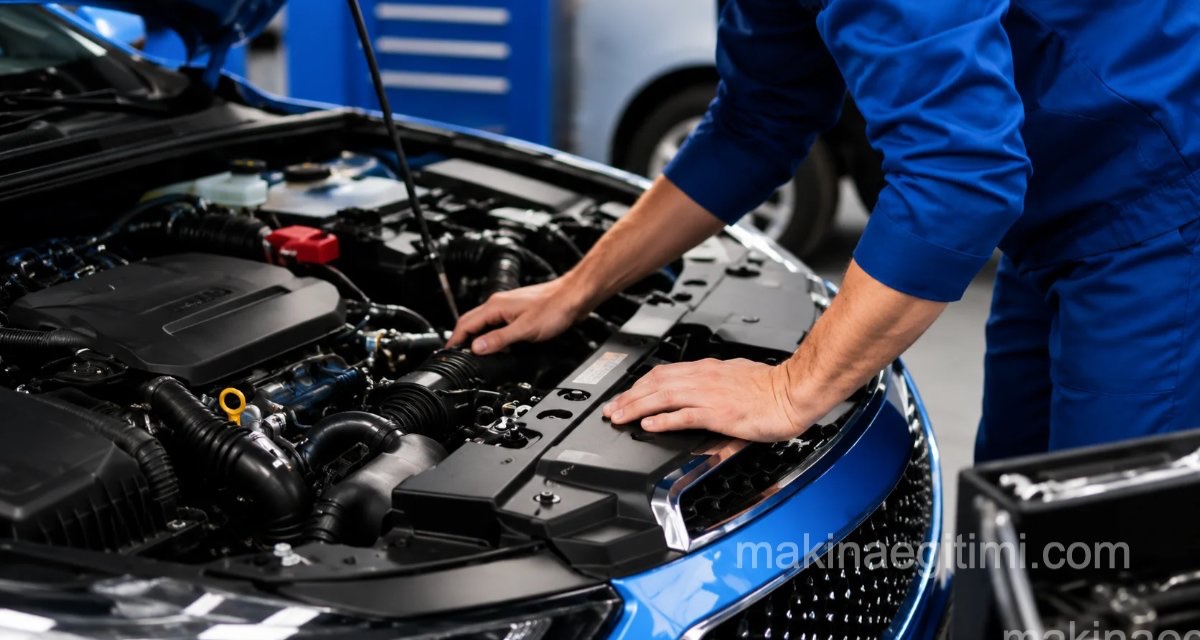
This article, in the machine technology vehicle maintenance and repair section, covers what causes engine knocking noise. It will focus on diagnosing and identifying faults based on the knocking noises coming from the engine.
Engine Knocking Noise and What It Means

Using a stethoscope and a listening rod for fault diagnosis based on engine noises provides a more professional way to work.
Sounds called crankshaft knock are generally dull, heavy metallic knocks, and their frequency increases as the engine’s speed and load increase. Or, they can be heard better only when the engine is running irregularly at very low speeds.
The most common knocking sound, caused by excessive bearing clearance, is heard more while the engine is running under heavy load, while starting the engine, during clutch engagement, or at speeds above 60 km/h. If only one or two crank journals have excessive clearance, the knocking sound in the engine will be less frequent and weaker. Generally, the location of the bearing with excessive clearance can be roughly determined by short-circuiting the spark plugs one at a time in sequence.
Engine Knocking Noise Can Be Caused by the Connecting Rod Bearing

Connecting rod bearing noises are usually a light knock or rattle, and the intensity of the sound is much weaker than main bearing knocks. The sound is heard best when the engine is running under light load and at speeds around 40 km/h.
As engine speed increases, the sound gets stronger. The best way to locate connecting rod bearing knocks is to short-circuit the spark plugs one by one, in sequence. Generally, when a spark plug is short-circuited, the sound doesn’t disappear completely, but it decreases significantly.
Engine Knocking Noise Can Be Caused by the Pistons
The most common piston noise is the slapping sound produced when the piston, under the effect of side thrust as it passes through TDC, separates from one bearing surface and leans against the other.
Piston-Related Knocking Noises
Although in some engines the sound produced by the piston is a rattle, generally this sound is hollow, muffled, like a bell. Light piston noises heard when the engine is cold and that disappear once it warms up don’t require any correction.

Piston ring noises are generally heard as a rattle or, during clutch engagement, as a sharp cracking sound.
Sound of piston ring wear in an engine. Click the PLAY icon to listen (above)
To locate piston ring noises, short-circuit the spark plugs one by one. Since short-circuiting spark plugs will also affect other engine noises, the result can be surprising. To better detect piston knocking sound, drive the car on the road at low speed and light load. Generally, the sound increases as speed and load are increased. In some engines with excessive piston-cylinder clearance, at speeds of 50-80 km/h, a rattling sound is heard in the pistons while driving at a constant speed.
To briefly stop piston and piston ring noises, pour about 30-40 grams of very heavy motor oil into each cylinder through the spark plug hole. With the ignition off, crank the engine with the starter a few times to allow the oil to spread between the piston and the cylinder. Then install the spark plugs, start the engine, and check whether the knocking sound in the engine is still there.
Engine Knocking Noise Can Be Caused by the Piston Pin
The most common pin noise is the sound produced by excessive piston pin clearance. This excessive clearance is generally a sharp, metallic, double-knock sound that is heard best while the engine is idling. However, in some engines, this sound is heard much better at speeds of 40-60 km/h.
The sound produced by the connecting rod bearing and piston bore striking each other is hard to recognize and can often be confused with valve lifter noise.
To investigate piston pin noises, run the engine at idle. Most of the time, the sharp, double-knock metallic sound produced by the pin is heard more clearly when the spark plug of the cylinder with pin clearance is short-circuited. When ignition timing is retarded, the sound generally decreases. If all piston pins have clearance, a metallic rattling sound is heard in the engine, and this sound cannot be eliminated by short-circuiting any spark plug.
Engine Knocking Noise Can Be Caused by the Valve Mechanism
The valve mechanism makes a distinctive rattling sound occurring at regular intervals. Since valves operate at half the speed of the crankshaft, the frequency of the sounds produced by the valve mechanism is lower than the frequency of sounds produced by other engine parts.
To determine whether the valve noise is due to excessive clearance, insert a feeler gauge of the appropriate thickness between the valve stem and the rocker arm or lifter. If the sound stops, the valve clearance is excessive and needs adjustment. Never set the valve clearance smaller than the factory-specified value. Otherwise, the valve will burn.
A sticking valve makes a rattling sound similar to that of a valve with excessive clearance, and this sound comes and goes depending on driving conditions.
A sticking valve can be diagnosed by running the car under heavy load for a while, thoroughly warming up the engine, and then quickly letting it idle. If there’s a sticking valve, the rattling sound from the engine will get stronger, and as the engine cools toward its normal temperature, the sound will gradually decrease and occasionally disappear. Along with the engine knocking noise, there will also be a rhythmic shaking due to the engine misfiring. When the rattling sound disappears, the shaking also stops, and as the valve begins to seat properly, the engine’s running smooths out.

To find the noisy hydraulic lifter, touch your finger to the valve spring retainers one at a time. If a lifter isn’t working properly, you’ll feel a distinct knock in your finger when the valve seats.
Knocking Noise Caused by Clearance in the Camshaft Gear
If there’s clearance in the camshaft gear, a sharp rattling sound is heard while the engine idles, and the idle isn’t smooth. To confirm this, roughen up the engine’s idle by short-circuiting one or two spark plugs.

Related Post Camshaft Failures. Causes and Prevention
What are camshaft failures. How do they occur. What causes them. How can camshaft failure be recognized? How can camshaft failures be prevented.
Spark Knock (Detonation)
Pre-ignition or spark knock produces a ringing metallic sound. This sound generally occurs while the engine is running under heavy load, during sudden clutch engagement, or when the engine overheats.
Pre-ignition is the result of a piece of carbon or metal that has become incandescent in the combustion chamber igniting the mixture prematurely during the compression stroke. In this case, the piston is subjected to a very high pressure at an inappropriate time, and the piston, connecting rod, and bearing vibrate, producing the sound called “spark knock”
Detonation is a condition that mostly occurs when low-octane fuel is used. This fuel burns very quickly, and the pressure on the piston rises suddenly and abnormally.
Knocking Noise Caused by the Alternator and Water Pump
Noises from accessory parts such as the alternator and water pump can be checked by removing the belt for a short time. If the noise continues, the source isn’t the alternator or water pump.
Checklist of Faults That Cause Engine Knocking Noises
Diagnostic points and causes for engine knocking noise:
Crankshaft Knock
Excessive bearing clearance.
Excessive crankshaft end play (axial clearance).
Journals have become out-of-round.
The crankshaft may be bent, or the crank web may be broken.
Bearings may be off-center.
A main bearing may be receiving too little oil.
Oil pressure is low, or the oil has become too thin.
The flywheel is loose.
Connecting Rod Bearing Knocks
Excessive bearing clearance.
Journals have become out-of-round.
Connecting rods installed incorrectly.
The rod cap bolt head is installed reversed, striking the camshaft.
Bearings are receiving too little oil.
Oil pressure is low, or the oil has become too thin.
Piston Noises
Piston skirt has collapsed
Excessive clearance between piston and cylinder
Cylinders have become out-of-round or tapered
Piston pin too tight
Connecting rod installed incorrectly
Piston or piston rings striking the ridge at the top of the cylinder.
Piston striking carbon deposits at the top of the cylinder.
Piston striking the cylinder head gasket.
Broken piston ring.
Excessive side clearance between the ring and its groove.
Pin bore is not perpendicular to the piston.
Ring lands have been machined excessively
Piston Pin Noises
Excessive clearance between the pin and the bushing.
Piston pin retaining bolt loose.
Piston pin rubbing against the cylinder wall.
Connecting rod small end rubbing against the pin bore.
Pin is too tight, causing the piston to strike the cylinder wall.
Spark Knock
Low-octane fuel.
Excessive carbon deposits.
Too much ignition advance.
Mixture too lean.
Automatic advance springs too weak.
Manifold heat control valve stuck closed.
Spark plug insulator burned.
Sharp metal edges in the combustion chamber.
Cylinder head gasket protruding into the combustion chamber.
Valves overheating.
Coolant temperature too high.
Fan belt loose
Valve Mechanism Noises
Excessive clearance between the valve stem and the rocker arm
Valve is sticking
Excessive clearance between the valve lifter and the block
The bottom of the lifter is scored or broken.
The tappet adjusting screw or the rocker arm’s valve-contacting surface is grooved.
Valve spring weak or broken.
Valve spring installed backwards.
Valve head bent.
Valve seat and guide are not concentric.
Excessive clearance between the valve stem and the guide.
The tip of the valve stem is not ground flat.
Rocker arm auxiliary springs weak.
Camshaft gear loose
Pre-Ignition Sound
Engine knock can result from the fuel-air mixture igniting on its own before its intended time.
Low-Octane Effect
Using fuel with a lower octane rating than the engine requires is one of the most common causes of knocking noise.
Carbon Deposits
Carbon deposits building up in the combustion chamber can raise the compression ratio and cause knocking.
Related Questions
As load increases, the force on the crankshaft also increases, and this force strikes the shaft against the excessive bearing clearance more forcefully. At low load, this clearance is less noticeable, while at high load the impact intensity increases and the sound becomes more pronounced.
When a cylinder’s spark plug is short-circuited, that cylinder is temporarily disabled. If the knocking sound noticeably decreases during this, it becomes clear that the source of the sound is related to that cylinder.
Related Posts
 What Is a Piston Ring, What Does It Do? Its Job and Installation.
  Piston Ring Wear in an Engine Camshaft Failures. Causes and Prevention
  Forces Acting on the Piston and Piston Material
  Alternator (Charging Dynamo) Faults
  How to Repair a Rear Window Defroster
  Car Cranks But Won’t Start: What Could Be the Cause?
  Why Does an Engine Develop an Oil Leak?