
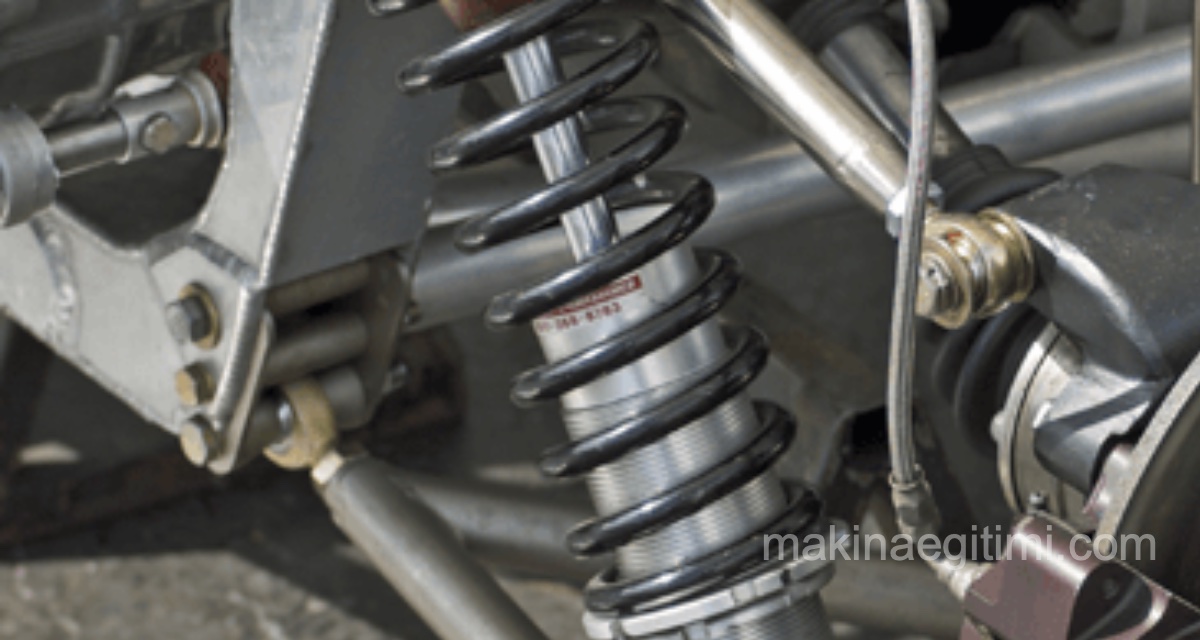
In the vehicle maintenance and repair section, we’ve addressed a question some drivers ask: when is the right time to replace shock absorbers? If you’re wondering how long shock absorbers last and at how many kilometers they should be replaced, read on.
Shock Absorber Replacement Time
Shock absorbers are one of the most important parts of your vehicle’s suspension system. The car’s road handling, its performance on curves, wet, snowy, and icy roads, keeping vehicle stability during braking, and driving comfort on potholed and rough roads all depend on the shock absorbers. So neglecting a part this critical is essentially knowingly putting your own life at risk. If shock absorber replacement is done at the right time, your driving comfort stays unaffected and you avoid other faults being caused by a bad shock absorber.

When is the right time to replace shock absorbers?
Shock absorbers wear out under the influence of the driver’s driving style, the vehicle’s load, road conditions, and other factors. This wear happens so slowly at first that it’s not noticeable. For this reason, before the situation becomes dangerous, shock absorbers should be checked periodically, every 20,000 km or at every vehicle service, by a qualified technician.

The fact that shock absorber replacement time depends on usage conditions means we can’t give a single exact figure for it. The average shock absorber replacement time is around 60-70 thousand kilometers, though depending on driving style and the road conditions the car is used on, it can also end up being replaced at even higher mileages.

Service life of shock absorbers
Many drivers wonder how long shock absorbers last. Shock absorber failures can also occur at lower mileages. This is related to how you drive your car on rough surfaces. The shock absorbers of a vehicle driven carefully might show proper performance all the way up to 100,000-120,000 kilometers. This will also lower your car’s service costs in the short term.

Why does shock absorber replacement time matter?
It’s also worth remembering: experts don’t recommend driving if your car’s shock absorbers are faulty. When driving at speed, braking while moving fast, the underside of the car hitting the ground, longer braking distances, being overly affected by crosswinds, or the steering being unresponsive to steering input on curves, causing swerving — these are the kinds of major problems that can occur. Especially if you’re driving with a heavy load and heading out on a long trip. This is exactly where the importance of shock absorber replacement time comes into play. Paying attention to shock absorber replacement time is essential for safe driving.

When choosing car parts, always make sure to choose genuine spare parts. When selecting spare parts, private and authorized service centers should be well researched, and proper care should be taken on this matter.
Especially for a critical part like the shock absorber, if you choose your replacement from quality brands, you’ll see the major benefit of that in the long run.
In this article, we covered one of your vehicle’s parts that isn’t obvious at first glance but is vital: shock absorbers. We tried to answer questions such as how long a shock absorber lasts, at how many kilometers shock absorbers should be replaced, and why shock absorber replacement time matters. For other topics related to shock absorbers, check out the “related topics” section below. Wishing you healthy trips and enjoyable drives.
Average Replacement Interval
Depending on usage conditions, shock absorbers are generally recommended to be replaced in the 80,000-100,000 km range.
Bounce Test
A simple bounce test — pushing down on a corner of the car and releasing it — can give an initial idea of the shock absorber’s condition.
Replace-in-Pairs Rule
For balanced driving performance, shock absorbers are usually replaced in pairs, together with the other one on the same axle (front or rear).
Related Questions
Wear happens in very small amounts, gradually, with each drive. Since the driver gradually gets used to this slow change over time, they may only notice the drop in performance once the situation has become serious.
Since wear is too slow for the driver to notice, regular technical inspection is the only reliable way to catch this hidden wear early. This allows precautions to be taken before the problem reaches a dangerous level.
Related Posts
 What is OBD-II? How do you read vehicle fault codes?
 What Happens If a Timing Belt Breaks? Breakage and Tooth-Skipping
 Spark Plug Oil Fouling: Causes and Symptoms
 Causes and Symptoms of Catalytic Converter Failure
 Engine Noises and What They Mean
 Spark Plug Faults and Their Causes
 Alternator (Charging Dynamo) Faults
 Vehicle Dashboard Warning Lights and Their Meanings, Illustrated