
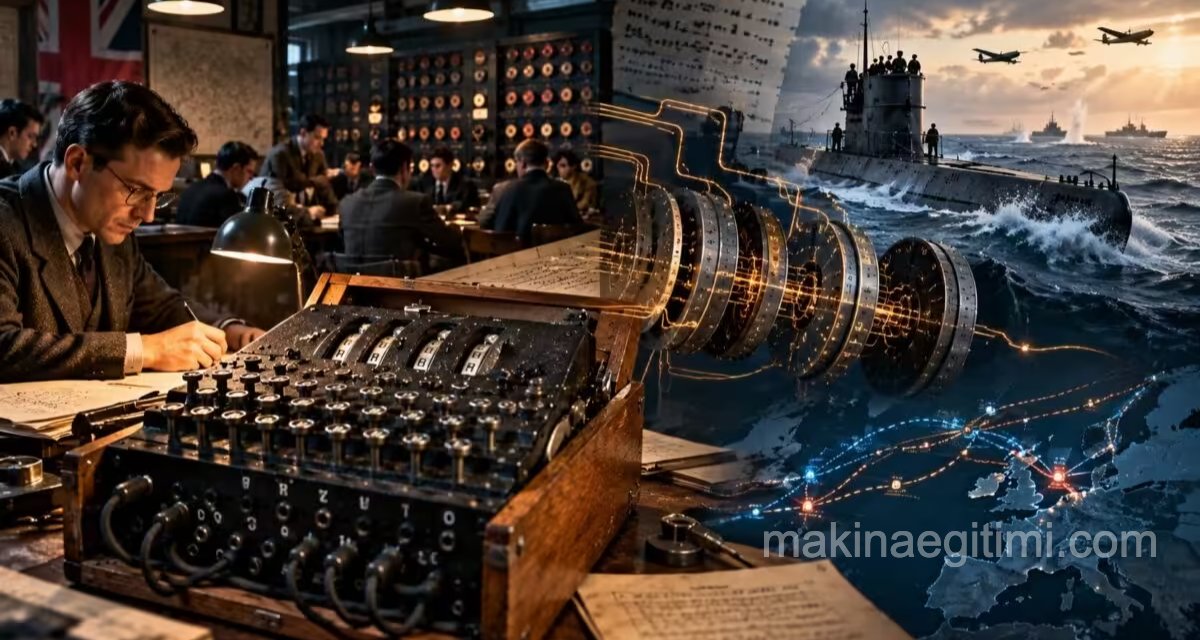
Dear readers, today we bring you the story of a puzzle no one was supposed to solve, and how a team of a few thousand people quietly solved it anyway. It was such a triumph that some historians believe it shortened World War II by as much as two years and saved millions of lives.
Throughout World War II, Germany encoded its most secret military messages using a machine called Enigma. The Germans were so confident that messages encrypted by this machine could never be broken by human effort that they even transmitted their most critical operational plans through it.
How Did Enigma Actually Work?
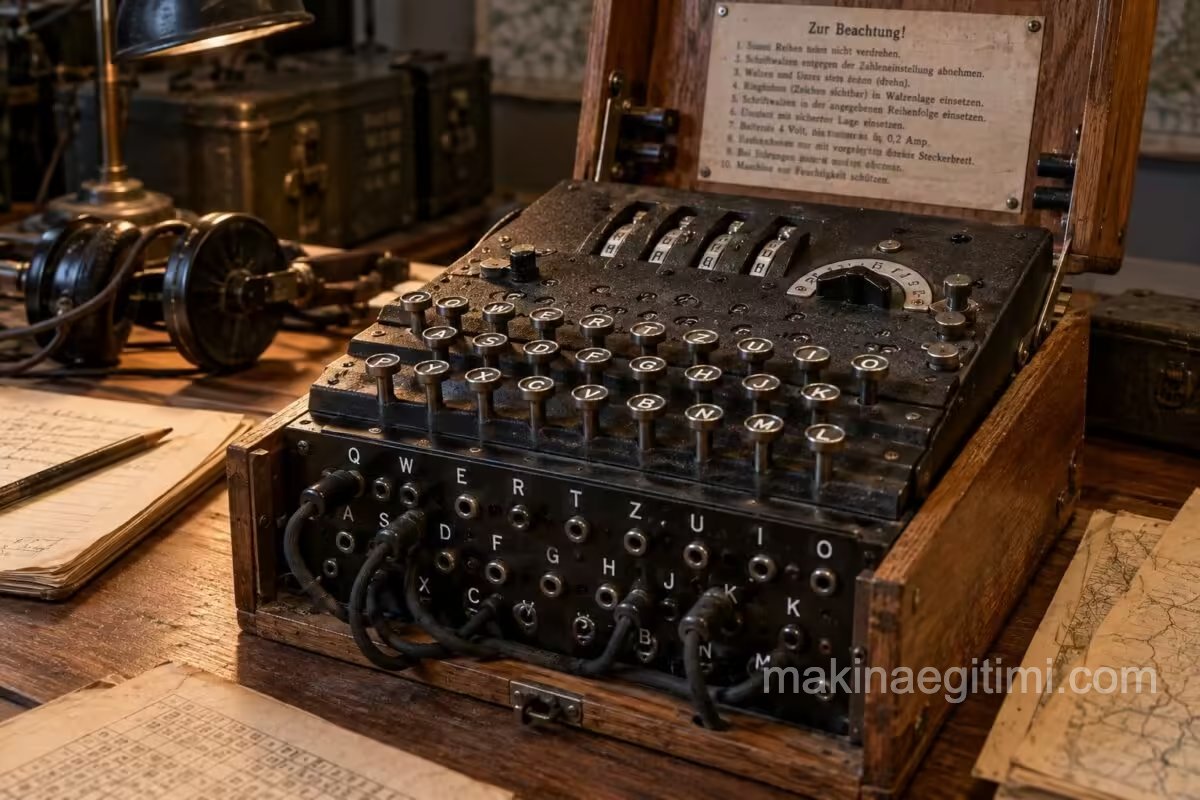
At first glance, Enigma looked like a typewriter, but inside it held a set of interconnected rotating rotors. Each time a key was pressed, an electrical signal passed through the rotors and converted the letter into a different one. Here is the critical part: after each keystroke, one of the rotors advanced a step, meaning the very same letter would be encoded differently the next time it was typed.
To decode a message correctly, you needed to know both the rotor settings and the starting position of the machine. The number of possible combinations was so vast that the Germans believed this cipher could never be cracked, not in days, not even in years of trying.
Poland’s Forgotten Contribution
The story of how Enigma was cracked is usually told as a tale about Britain and Alan Turing alone. But the real story began much earlier, in Poland. In the early 1930s, Polish mathematicians, most notably Marian Rejewski, managed to unravel the mathematical structure of Enigma and built a code breaking machine they called the “Bomba.”
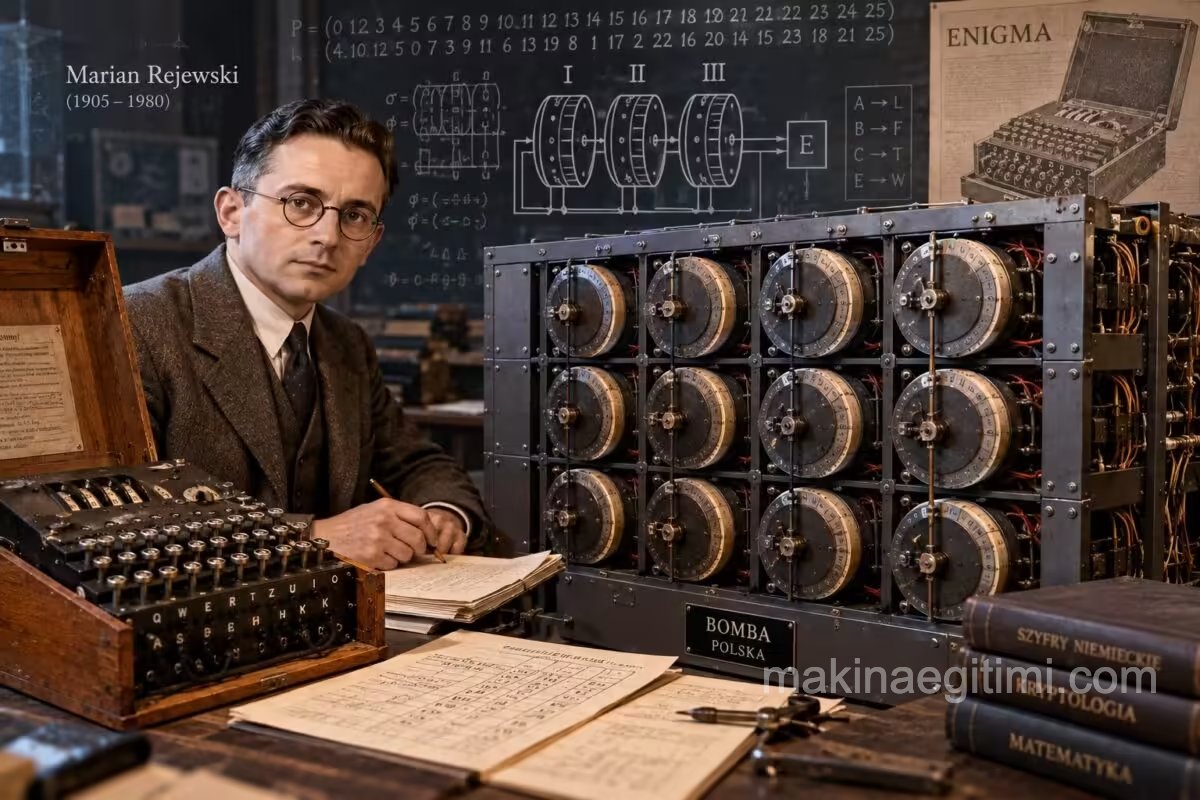
In 1939, shortly before Germany invaded Poland, Polish intelligence shared this accumulated knowledge with their British and French allies. This transfer of expertise became the foundation for the later success of Britain’s codebreaking center at Bletchley Park. In other words, breaking Enigma was not the achievement of a single genius, but the product of international collaboration.
Bletchley Park and Alan Turing
Bletchley Park in Britain was one of the war’s most closely guarded secrets. Thousands of mathematicians, linguists, and even chess champions worked there around the clock trying to crack Enigma. The most famous name on this team was a young mathematician named Alan Turing.
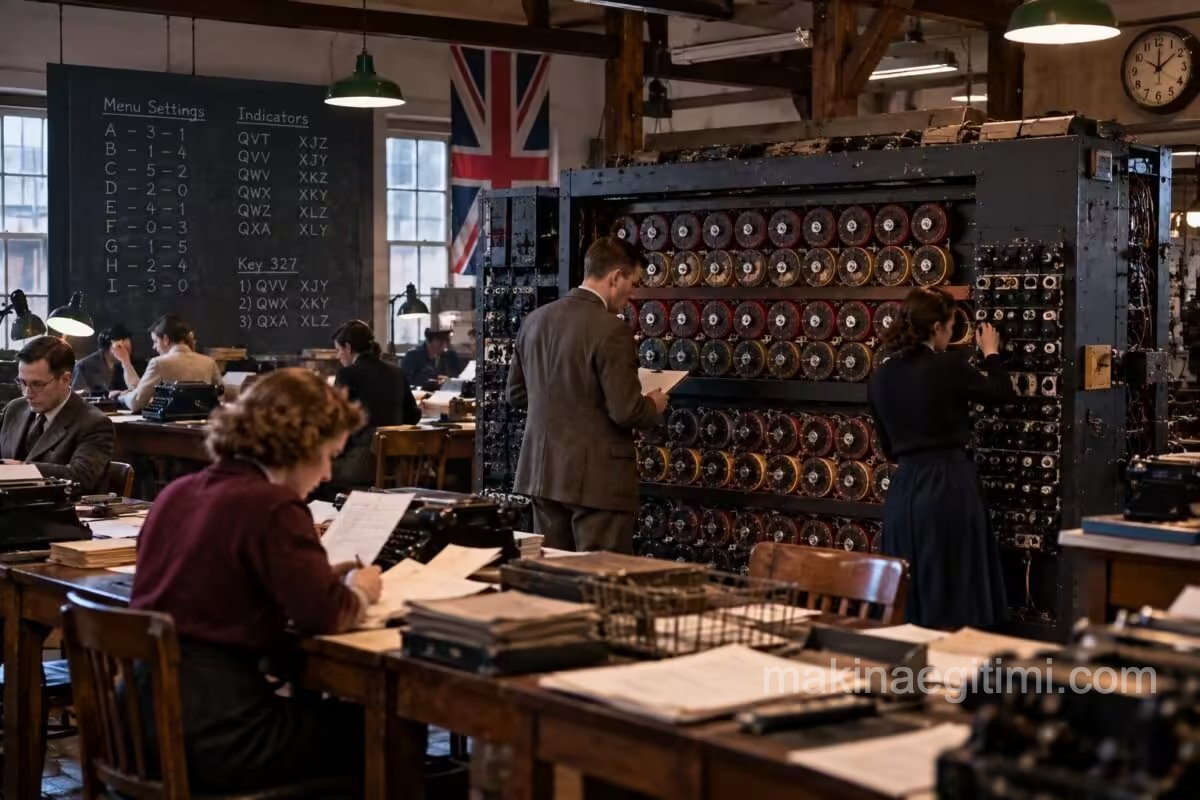
Building on the Polish work, Turing developed a far more advanced electromechanical machine he called the “Bombe.” This machine could test possible rotor settings at incredible speed, making it possible to find the correct combination.
The Physical Captures: The Forgotten Side of Codebreaking
Cracking Enigma was not purely a triumph of mathematics and engineering. Sometimes the most valuable intelligence came not from solving the cipher, but from physically capturing the machine itself or its codebooks. The British called these operations “pinches.”
In 1941, the Royal Navy managed to capture the German submarine U-110 before it sank, recovering its Enigma machine, rotor settings, and codebooks completely intact. This became one of the most valuable intelligence hauls of the entire war. In 1942, British sailors swam into the sinking submarine U-559 in the Mediterranean and recovered the codebooks for the far more complex German Naval Enigma system. Two British sailors lost their lives in that operation as the submarine actually went down.
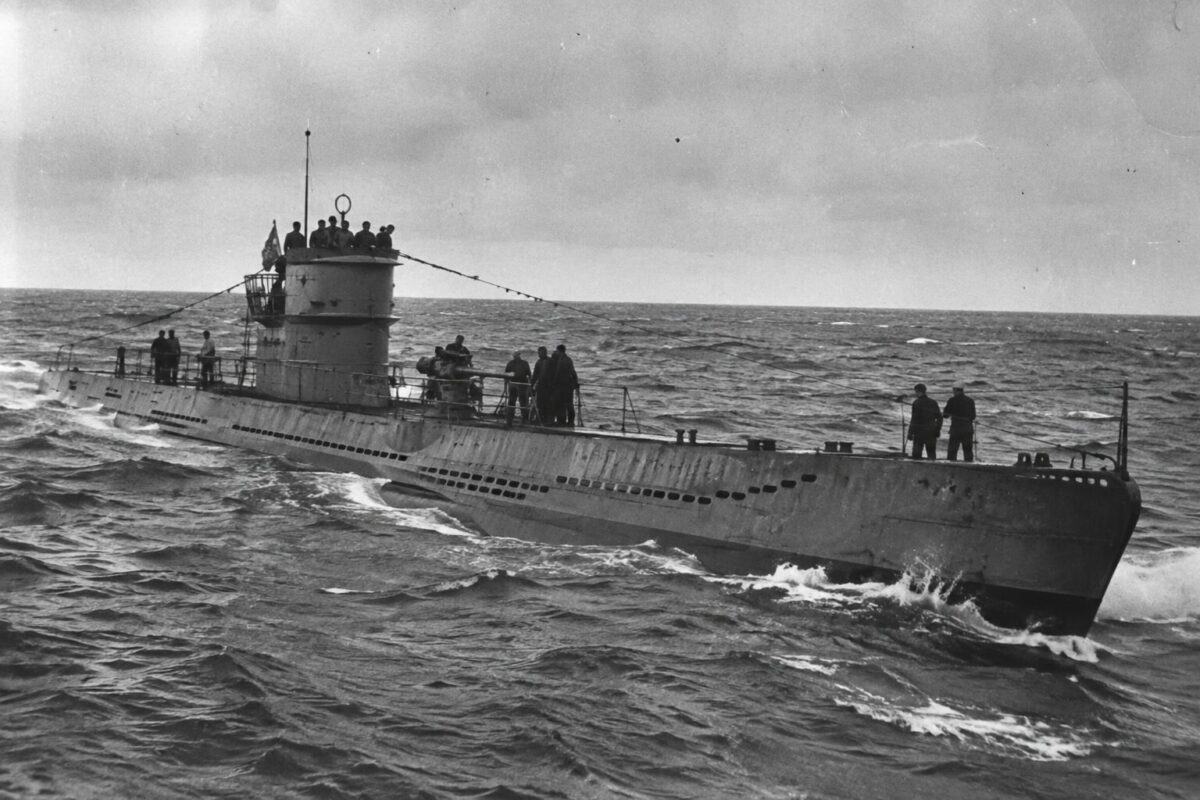
These physical captures dramatically accelerated the mathematical work being done at Bletchley Park. In other words, the story of cracking Enigma is not only the story of mathematicians working at their desks, but also of sailors risking their lives at sea.
What If Germany Had Changed Its System?
Let’s pause and consider this. Some operational mistakes made by the Germans played a major role in cracking Enigma. For example, some operators used predictable phrases at the start of each message, such as standard weather reports and greetings. This predictability gave codebreakers a significant advantage.
Had Germany enforced stricter messaging discipline and eliminated these predictable patterns, or changed the rotor system far more frequently, Bletchley Park’s task would have been far harder. The war might have dragged on much longer than it actually did. Sometimes what breaks the strongest systems is not a technical flaw, but the predictability of human habits.
A Secret Kept Until Long After the War
The fact that Enigma had been broken remained highly classified for years even after the war ended. The reason was simple: the Allies knew other countries still used similar encryption systems, and they did not want to lose that advantage. Because of this secrecy, the people who worked at Bletchley Park could not even tell their own families what they had done for years.
This secrecy was so effective that Alan Turing’s critical wartime contribution was still unknown to the public when he tragically died in 1954. His true achievements only became widely understood after the classification was lifted in the 1970s.
The Chain of Cause and Effect: From a Puzzle to a Victory
- Germany placed excessive confidence in Enigma’s mathematical complexity and used it to transmit its most critical messages.
- Polish mathematicians unraveled the system’s mathematical structure before the war began.
- This accumulated knowledge was shared with the Allies just before Germany’s invasion of Poland.
- Alan Turing’s team at Bletchley Park built a far more advanced solution (the Bombe) on this foundation.
- Germany’s predictable messaging habits made the codebreaking process easier.
- Machines and codebooks captured from submarines such as U-110 and U-559 directly accelerated the mathematical solution.
- Cracking Enigma gave the Allies vital intelligence on German naval and ground force movements.
- This intelligence advantage changed the course of the war and, according to historians, shortened it by roughly two years.
A Little Known Fact
Many of those who worked at Bletchley Park had actually been recruited through newspaper crossword puzzle competitions. British intelligence secretly used these puzzle contests as a way to identify talented codebreakers. In other words, some of the very people who changed the course of the war were recruited simply because they had won a crossword competition.
Related Videos
Breaking Enigma A World War II GameChanger | Full Documentary (2025)
How the Allies Cracked the Enigma Code | Bletchley Park with Dan Snow
They Cracked the Unbreakable Code — And Changed History
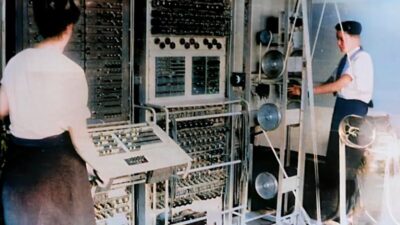
The Codebreakers Of Bletchley Park: WW2's Hidden War | Secrets Of WW2 Episode 7
Frequently Asked Questions
Enigma was cracked thanks to the pioneering work of Polish mathematicians, especially Marian Rejewski, followed by the “Bombe” machine developed by Alan Turing’s team at Bletchley Park in Britain.
It gave the Allies critical intelligence on German military movements and, according to historians, shortened the war by roughly two years, saving millions of lives.
The Allies did not want it known that similar encryption systems could be broken, since other countries continued using comparable systems after the war, so the work at Bletchley Park stayed classified for decades.
It was an electromechanical cipher machine that used rotating internal rotors to convert letters into different letters each time a key was pressed. Decoding a message correctly required knowing both the rotor settings and the starting position.
Related Posts
 The History and Evolution of Robotics: From Ancient Automata to AI-Powered Robots
  The Story of the Tiger I Tank. The War Machine That Became a Legend
  The History of the Automobile. The Evolution of Vehicle Technology From Then to Now
  Nazi Germany’s Mega Structures – Super Tanks
  The History of Electric Arc Welding
  The History of Weaving
  Leonardo da Vinci’s Machines: The Flying, Fighting and Walking Inventions of a Renaissance Genius
  From Rivet to Weld: How and Why an Era Ended