

This article, in our Vehicle Maintenance and Engine Knowledge category, will be about spark plug faults. Various spark plug faults and their causes. What does a spark plug fault lead to? Can a spark plug fault be the reason an engine won’t start, starts with difficulty, or has excessive fuel consumption? The engine struggles to start in cold winter weather. What’s the reason? We’ll look for answers to questions like these.
Spark Plug Faults
Even the simplest fault in the spark plugs, which ignite the fuel-air mixture compressed inside the engine’s cylinders with a spark, both increases fuel consumption and reduces performance. It’s also possible to diagnose many engine faults simply by looking at the spark plugs.
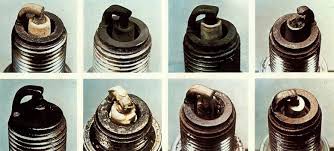
Using the information below, you can figure out whether your spark plug is faulty, and if so, what the causes are.
Various Spark Plug Faults
Incorrect Electrode Gap
If the electrode gap on the spark plugs isn’t at the ideal setting, the fuel-air mixture won’t ignite properly even if the spark plug is brand new. As a result, the combustion in the chamber weakens and the engine’s power decreases. In this case, most of the fuel in the vehicle exits through the exhaust unburned, and the car’s fuel consumption increases noticeably.

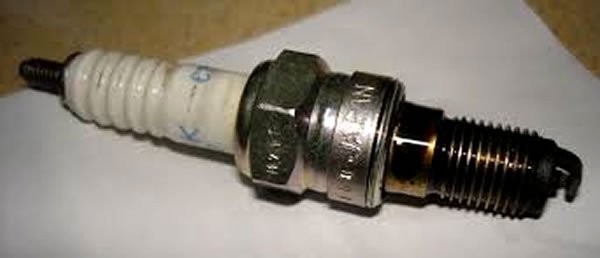
In the pictures above and below, you can see a tool (a feeler gauge) made for checking the spark plug electrode gap, which can check various different gap sizes.

When you buy a new spark plug, the electrode gap should be checked with a feeler gauge before installing it, and if it’s off, it should be adjusted according to the manufacturer’s specification.
Oil Buildup on the Spark Plugs
If the spark plugs are removed and checked and there’s oil buildup on them, it means too much oil is getting into the combustion chamber and coating the electrodes. In cases like this, since the spark plug is coated with oil, the spark occurs at a level far below normal. This increases fuel consumption and reduces performance. The solution is to have the engine overhauled.
When there’s oil buildup, the spark plugs should be removed and inspected; if there’s oil buildup, it means an excessive air-fuel mixture is getting into the engine and coating the electrodes. Since oil surrounds the spark plug, the spark event occurs at a level far below normal.
For our detailed article on this topic, see: Causes and symptoms of spark plug oil fouling
Carbon Buildup on the Spark Plugs
If carbon has built up on the spark plug’s insulator tip, electrodes, and body, this means the carburetor and injection settings are out of adjustment.
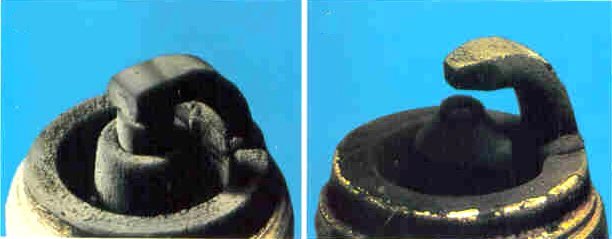
In cases like this, the engine has an ignition problem and starts with difficulty in cold weather. To solve the problem, the air filter should be checked and the carburetor and injection should be adjusted.
Spark Plug Electrodes Fused Together
If the spark plug’s electrodes have fused together and foreign matter has built up on them, it means there’s been excessive loading due to premature ignition.
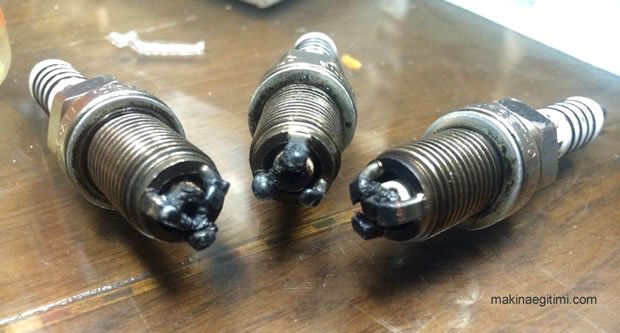
The cause of this problem can be incorrect ignition or valve timing, a faulty distributor, or using low-quality fuel. To solve the problem, engine ignition and fuel settings should be checked and a new spark plug should be installed.
Spark Plug Cracking
This is a fault rarely seen on spark plugs. It’s mechanical damage to the electrode as a result of the spark plug being dropped.

In cases like this, ignition is incomplete and the spark jumps somewhere else. For this reason, the faulty spark plug needs to be replaced.
What Do Spark Plug Faults Cause?
If one of the various spark plug faults described above occurs;
Your vehicle may misfire. The engine may start with difficulty in cold weather. Fuel consumption may increase. The vehicle’s performance may decrease. The engine may not even start at all.
Electrode Wear
A spark plug’s electrode gap widens with wear over time, which negatively affects ignition quality.
Wrong Heat Range
Spark plugs with a heat range that doesn’t suit the engine can cause premature ignition or carbon buildup.
Average Replacement Interval
Standard spark plugs are typically a part that needs replacing every 20,000-30,000 km.
Related Questions
Being new doesn’t mean the spark plug is correctly set; the electrode gap can be wrong due to manufacturing or packaging. An incorrect gap weakens the spark’s strength, preventing the fuel-air mixture from burning completely.
The ignition energy needed to start the engine in cold weather is higher than normal. A spark plug that’s already weakened can fail to meet this extra energy demand, causing the engine to start with difficulty, or not start at all, in the cold.
Related Posts
 Leather Seat Care
  How to Check Radiator Coolant
  What Happens If a Timing Belt Breaks? Breakage and Tooth-Skipping
  Is It Harmful to Drive Off Without Warming Up the Engine?
  Let’s Get to Know the Fluids Used in Vehicles
  Spark Plug Oil Fouling: Causes and Symptoms
  How to Prevent an Engine From Burning Too Much Oil
  Why Does a Car Tire Crack? Why Does It Rot?