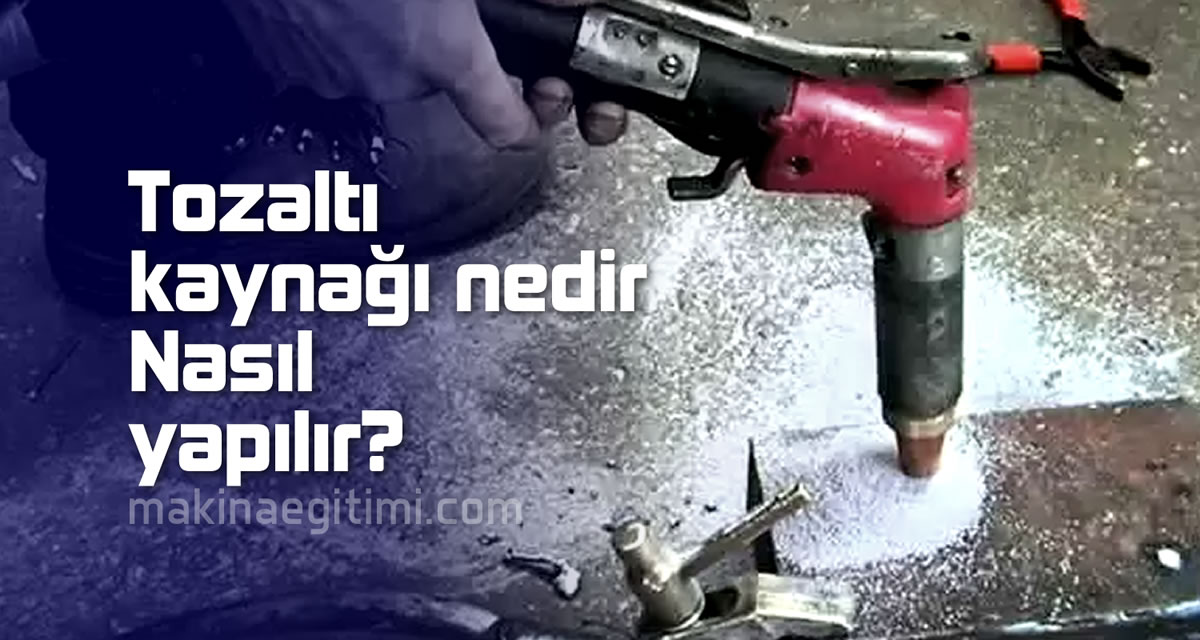
In this article on welding technology, we’ll explain what submerged arc welding is, and how submerged arc welding is done. What are the characteristics of submerged arc welding. What are its advantages and disadvantages. In which fields is it used. We’ll try to answer questions such as which materials can be welded with submerged arc welding.
You can reach our topic headings through the links below:
- What is submerged arc welding?
- How is submerged arc welding done?
- Characteristics of submerged arc welding
What Is Submerged Arc Welding
Submerged arc welding is a welding method in which the welding arc forms beneath a granular flux blanket made of elements such as silicate, lime, magnesite, and oxide. The flux is poured ahead of the electrode by its own weight. The electrode is a copper-coated wire wound onto a spool, continuously fed toward the weld zone.

Flux Blanket Protection
In submerged arc welding, the arc forms beneath a layer of granular flux and is protected from outside effects.
High Welding Speed
Thanks to its continuous wire feed system, submerged arc welding can reach a much higher welding speed than other methods.
Thick Plate Application
Thanks to its deep penetration, submerged arc welding is especially preferred for joining thick steel plates.
How is submerged arc welding done?
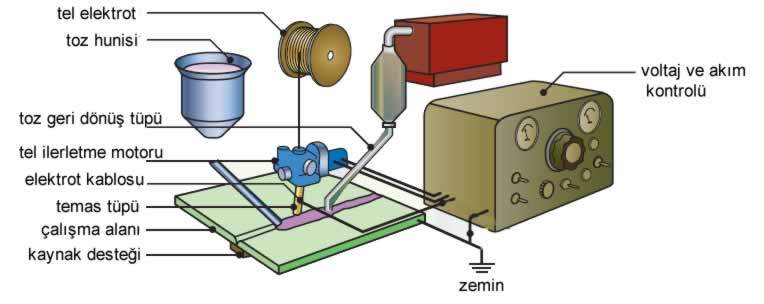
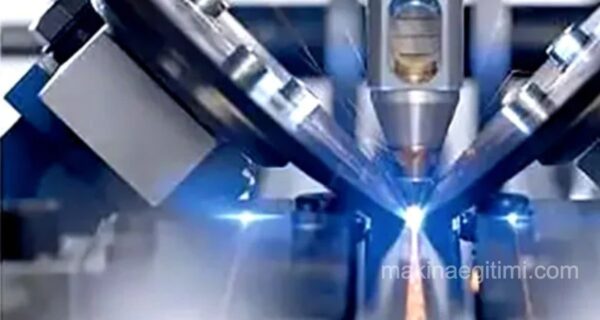
In submerged arc welding, a wire electrode is fed from above at a set rate into the weld zone, along with flux released from a flux hopper by free fall. This flux forms a protective layer over the weld zone, and the resulting slag is cleaned away at the same time by a flux-recovery tube.
Characteristics of submerged arc welding
The welding speed is 760 mm/min for 25 mm thick plates, or 300 mm/min for 40 mm thick plates. Welds up to 40 mm deep can be made in a single pass. Since welding requires fewer passes than other welding methods, there is less slag and cavity inclusion in the seam. The weld quality is higher.
Which materials can be welded with submerged arc welding?
Fillet or butt welds of low-carbon (<0.3% C) steels are commonly done with submerged arc welding. With preheating and post-weld heating, medium-carbon and alloy steels in sheet or plate form, as well as some copper alloys, can also be welded. However, it's not suitable for high-carbon tool steels, cast irons, or aluminum.

Advantages of submerged arc welding
High welding speed:
4-10 times more metal can be melted per hour compared to conventional arc welding, and its efficiency is high.
Deep Penetration:
The flux also allows the arc’s heat to act deeply. This results in a ductile and soft weld seam.
Very good cleanliness:
Thanks to the flux, the weld zone stays clean. Since the arc zone is covered by a thick layer of flux, spark generation and metal spatter are prevented.
High-quality seams:
Since the flux layer protects the molten metal very well, impurities in the liquid metal are removed. Part of the flux melts and solidifies as a covering over the weld. As a result, a very high-quality seam is produced. In addition, the solidified flux cracks and can be easily removed from the seam.
These are the advantages of submerged arc welding.
Disadvantages of submerged arc welding
The need for a large flux storage capacity, the possibility of the flux absorbing moisture (moisture in the flux causes porosity and cavities), the large amount of slag that needs to be removed, the high heat input that causes grain coarsening, and the slow cooling rate that increases the risk of segregation and hot cracking can be considered the negative sides of this method. We can also add that it’s not a suitable welding method for high-carbon tool steels, cast irons, and aluminum, as another weak point of submerged arc welding.

How submerged arc welding is performed
Unmelted flux that has resolidified can be sucked back with a vacuum system and reused. AC or DC current can be used as the power source. Currents of 600–2,000 A supplied by the power sources are used.
Where is submerged arc welding used
It’s used on straight-line horizontal seams, and especially on thick materials (at least 2 mm). It’s widely used for welding large-volume parts such as boilers, steel structures, ships, and vehicle and machine manufacturing. By taking various precautions, it’s also possible to weld in different positions.

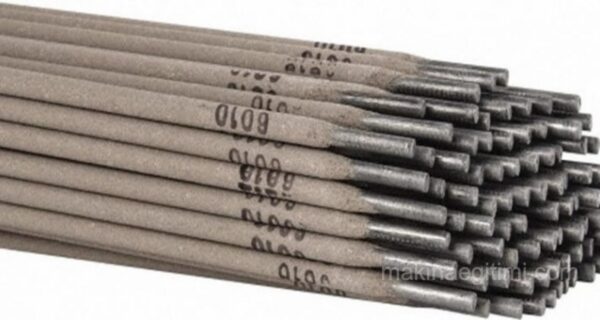
Since the electrode material makes up 70% of the molten weld zone, the chemical control of the electrode is important. Consumable electrodes are classified by composition, and come as a round wire 1.0-9.5 mm in diameter, automatically fed through a tube called a welding gun.

Submerged arc welding is especially preferred for large-diameter pipes and tanks.
Large-diameter electrodes carry high current and have high melting power, but they result in lower penetration (less deep reach). Electrode wires can be medium-carbon steel, solid alloy materials, or flux-cored electrodes containing alloying elements in their core.

Submerged arc welding equipment

There are semi-automatic and fully automatic machines built for submerged arc welding
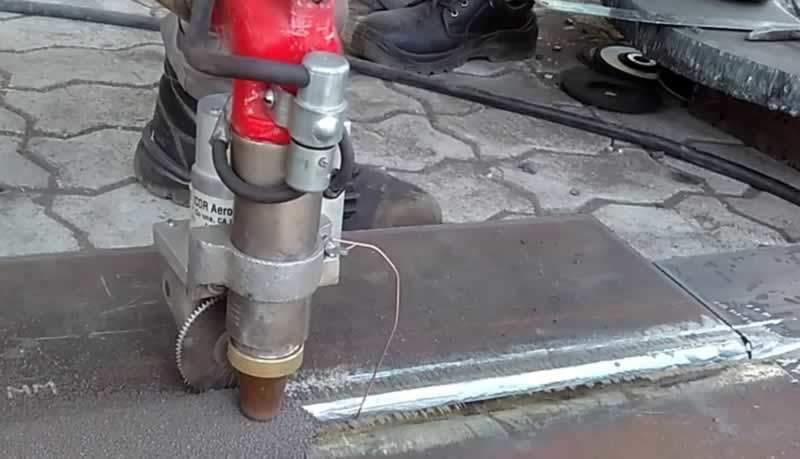
Submerged arc welding equipment can be semi-automatic (speed controlled by the operator) or fully automatic machines. It can be either a handheld welding gun, or a fixed gun with the workpiece passed underneath it.

Related Questions
The flux blanket protects the welding arc from the harmful effects of atmospheric oxygen and moisture. This protection both provides a cleaner weld seam and prevents the blinding light and spatter that would otherwise affect the welder.
Because the electrode is continuously fed from a spool, an uninterrupted and automatic welding process is achieved. This continuous feed offers a much faster production capability compared to methods that require pausing to change electrodes.
Related Posts