
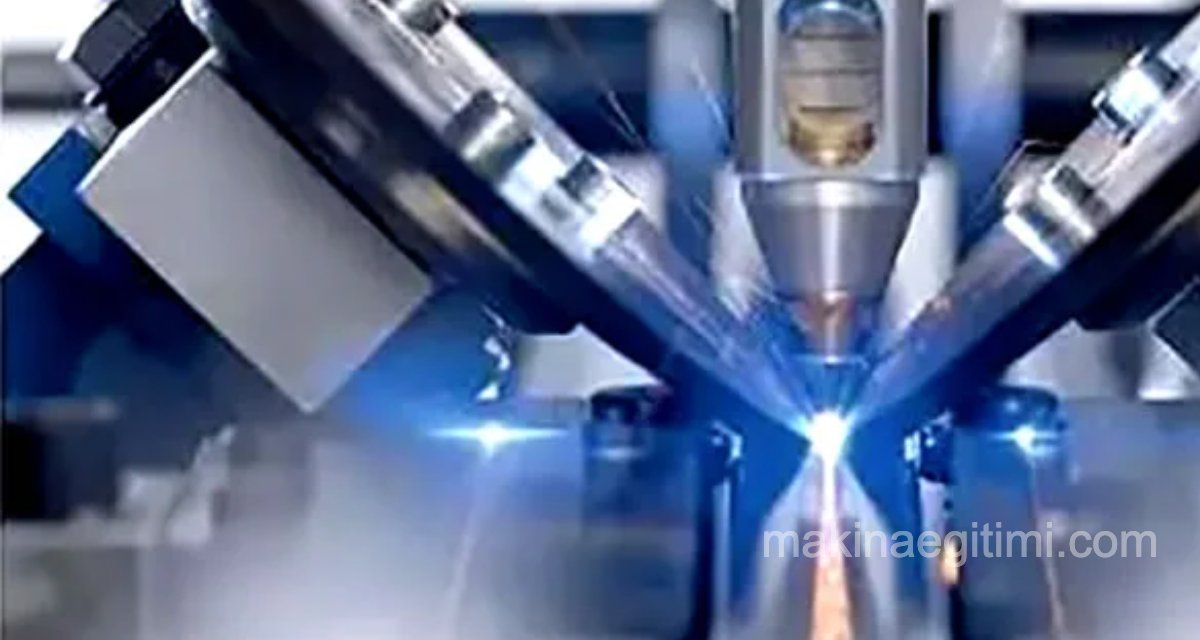
The topic of this article will be the advantages and disadvantages of laser welding. We’ll look at the strengths and weaknesses of laser welding. For general information about laser welding, see: Laser welding, its properties and working principle
Advantages of Laser Welding
- Laser welding can achieve high-quality joint strength and a wide depth-to-width ratio, and welding speed is relatively fast.
- Since laser welding doesn’t require a vacuum environment, remote control and automated production can be carried out through lenses and optical fibers.
- The laser has a large power density, which makes it possible to weld difficult materials such as titanium and quartz, as well as materials with differing properties.
- Micro-welding is possible. The laser beam can be focused down to a very small spot and positioned with precision, making it applicable for group welding of micro and small workpieces for high-volume automated production.
High Equipment Cost
Laser welding machines require significantly higher upfront investment than traditional welding equipment.
Need for Precise Alignment
For laser welding to be effective, the parts need to be aligned very precisely.
Low Gap Tolerance
Laser welding tolerates very little gap between the parts being joined; otherwise, weld quality drops.
Disadvantages of Laser Welding
- The laser and accessories for the welding system are more expensive, so the initial investment and maintenance costs are higher than for traditional welding, and its economic efficiency is lower.
- The conversion efficiency of laser welding is generally low (typically 5% to 30%), due to the low absorption of laser light by solid materials, especially after plasma forms (plasma has an absorption effect on laser light).
- Because of laser welding’s small focused spot, the accuracy of the workpiece fixturing equipment needs to be high, and a small equipment deviation can produce a large machining error.
- Laser welding requires high workpiece assembly accuracy due to its small laser-focused spot size and narrow weld seam.
The position of the welded part must be very precise, the position of the beam on the workpiece must not shift significantly, and it must remain within the laser beam’s focal range. If workpiece assembly or beam positioning accuracy doesn’t meet these requirements, weld defects easily occur.
Related Questions
Laser welding machines capable of operating at high power and precision contain complex optical and control systems. This advanced technology leads to a much higher initial investment cost than traditional welding machines.
Since the laser beam strikes a very small, focused spot, even a slight deviation between the parts can lower the weld quality or prevent a weld from forming at all. This is why precise positioning is essential for a successful result.
Related Posts
 The History of Electric Arc Welding
  Welding of Stainless Steels
  General Information About MIG Welding
  Welding Methods – Techniques – Types
  How Is Underwater Welding Done? Underwater Welding
  Roles and Benefits of the Electrode Coating General Information About TIG Welding
  Factors That Make Welding Stainless Steel Difficult