
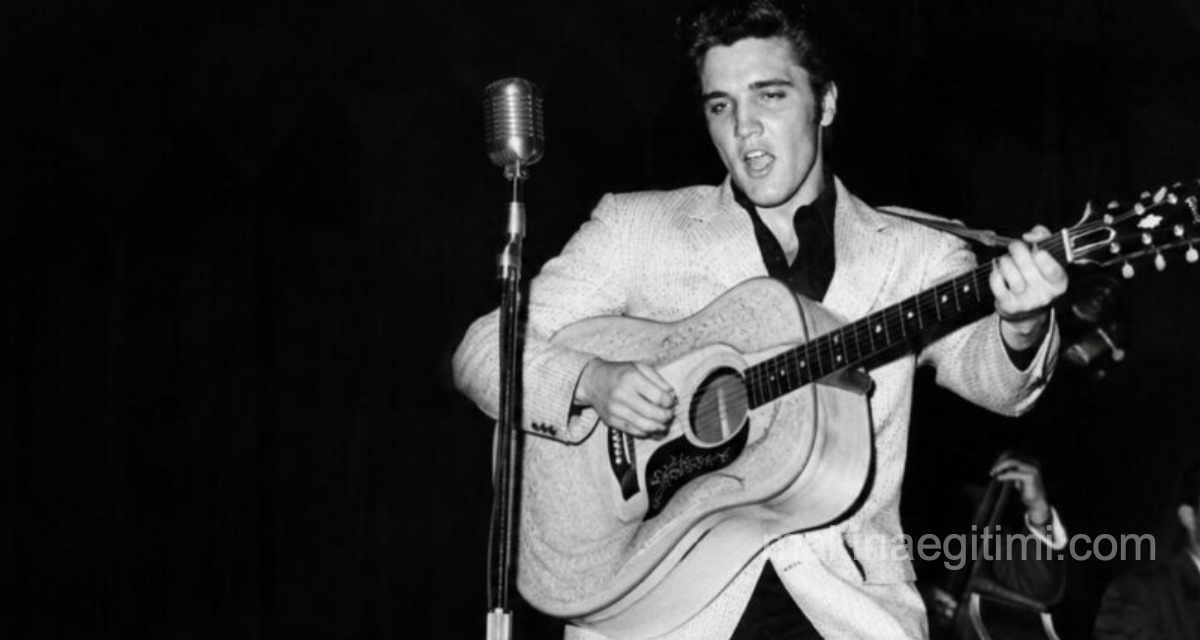
One day, before heading back to his day job, a young truck driver wanting to record a birthday present for his mother walked into a small studio in Memphis. He didn’t know it yet when he walked out that day, but a few months later, the voice in that recording would shake an entire country, and then the world. That young man was Elvis Presley, who would later earn the title “King of Rock’n Roll.”
In this article, we’ll explore Presley’s journey from his poor childhood in Mississippi, through his first recordings at Sun Records, to becoming a worldwide legend.
Childhood: From Mississippi to Memphis
Elvis Aaron Presley was born on January 8, 1935, in the town of Tupelo, Mississippi, into a very poor family. His twin brother, Jesse Garon, died shortly after birth; this loss left a deep mark on the Presley family’s life. Elvis spent much of his childhood listening to and singing gospel music at church; these musical roots formed the foundation of the distinctive voice he would go on to develop.

In 1948, the family moved to Memphis, Tennessee, in search of a better life. There, young Elvis began shaping his own musical identity, drawing on the blues clubs of the city’s Beale Street and the gospel programs on local radio stations.
Known in high school for being withdrawn and for his unusual appearance (long sideburns and flashy clothes), Presley would actually transform into a completely different character on stage.
Sun Records and “That’s All Right”: The Beginning of a Legend
In 1953, at just 18 years old, Elvis went to the Sun Records studio to record a birthday present for his mother. The studio owner, Sam Phillips, had long been searching for “a white voice that could carry the energy of Black musicians.” In the summer of 1954, during a recording session, Presley began casually playing “That’s All Right,” a track by blues singer Arthur “Big Boy” Crudup. Phillips immediately recorded this improvised moment; the sound that emerged was so new and so different that the moment it aired on the radio, the phones wouldn’t stop ringing.
This recording became one of the first sparks of the musical revolution that would later be called rock’n roll. Presley quickly became a regional star, and in 1955, signing with RCA Victor, he stepped onto the national stage.
A National Phenomenon: 1956 and Beyond
1956 was the turning point of Elvis Presley’s life. He landed his first number-one hit with “Heartbreak Hotel“; then, with “Hound Dog” and, a year later, “Jailhouse Rock,” he became the most recognizable face of rock’n roll.
His performances on television programs were extremely controversial for the time; his hip movements on stage were considered so “inappropriate” that some producers filmed him only from the waist up.
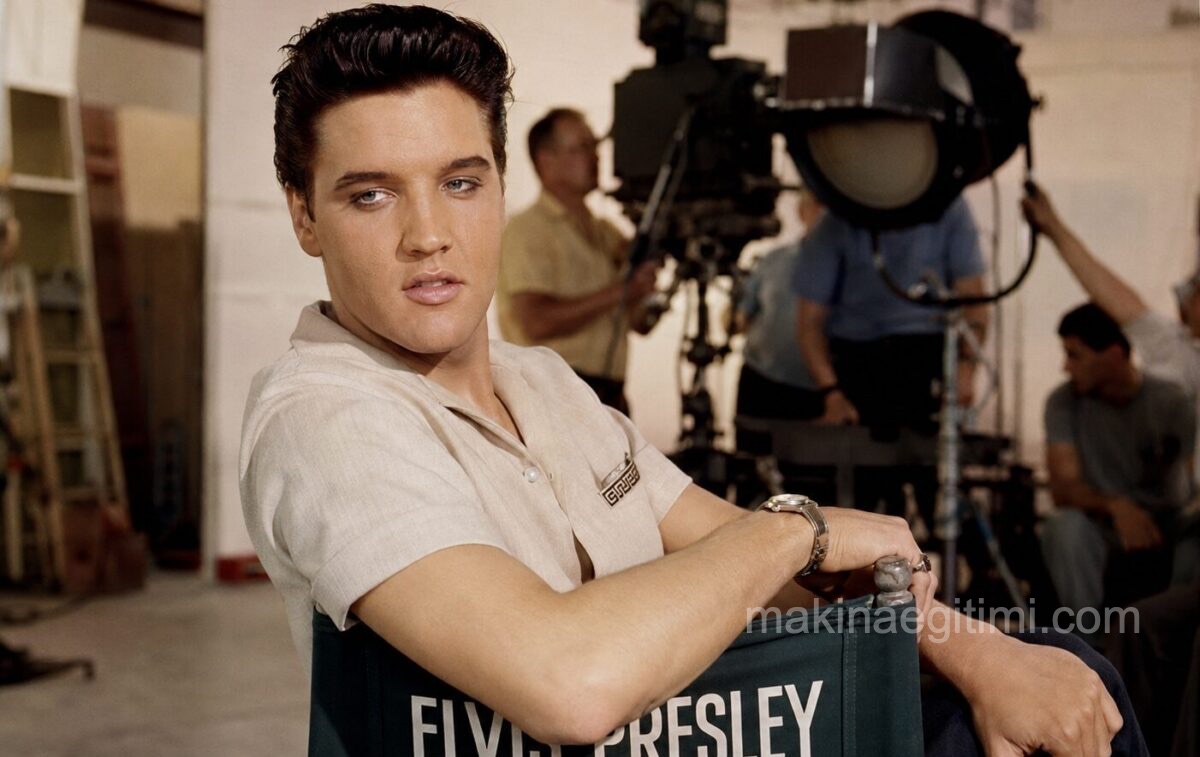
During this period, Presley’s music and film careers progressed in parallel. He starred in films such as Love Me Tender, Jailhouse Rock, and Blue Hawaii; his 1961 release “Can’t Help Falling in Love,” which appeared on the Blue Hawaii soundtrack, went on to become one of his most beloved ballads.
Military Service and a Break in His Career
In 1958, Presley joined the US Army and served for two years in Germany. While this period interrupted the flow of his career, it also repositioned him from an “extraordinary star” image into an ordinary young American serving his country. After returning from military service, he largely turned to his film career in the 1960s; but during these years, his music began to fall behind the changing rock’n roll scene of the era.
The ’68 Comeback Special: A King’s Return
In 1968, Presley experienced perhaps one of the most important turning points of his career: an NBC television special, now remembered as the ‘68 Comeback Special. Performing live on a small stage in black leather, Presley proved to viewers that he was still the most powerful name on stage.

“If I Can Dream,” which he performed at the show’s finale, was an emotional piece about peace and hope, written in the immediate aftermath of the assassinations of Martin Luther King Jr. and Robert Kennedy; Presley sang it with such passion that the performance is still remembered today as one of the most powerful moments in television history.
Following this comeback, Presley returned to Memphis in 1969 and made recordings such as “Suspicious Minds,” reflecting a new musical maturity; this song became the last number-one hit of his career.
The Las Vegas Years: A Glamorous but Exhausting Period
In the early 1970s, Presley began giving regular concerts in Las Vegas; this was a period in which he redefined his stage show with glamorous costumes, large orchestras, and dramatic performances. Energetic hits like “Burning Love” (1972) defined this era, while the three-song arrangement “An American Trilogy,” which he performed to close his concerts, came to symbolize the emotional intensity of his stage performances.
Behind this glamorous period, however, lay an exhausting concert schedule and increasing health problems.
After the Peak: Difficult Final Years
From the mid-1970s onward, Presley’s health began to visibly deteriorate. He is known to have become dependent on prescription medication to cope with an intense concert schedule, insomnia, and increasing weight problems. During this period his performances occasionally became inconsistent, and speculation about his health began to increase in the press.
On August 16, 1977, Presley died at his home, Graceland. His cause of death was officially announced as heart failure; but later examinations indicated that the use of multiple prescription drugs played a significant role in this process. Presley’s death at age 42 plunged millions of fans around the world into mourning, and it became etched in memory as one of the greatest losses in rock’n roll history.
A Curious Detail: Where Does the Title “King of Rock’n Roll” Come From?
This title was popularized by the press in the mid-1950s; both Presley’s commercial success and the performance style that carried rock’n roll into the mainstream made him the genre’s most recognizable face.
Presley himself never formally claimed this title, and in interviews he occasionally emphasized that the true roots of rock’n roll lay with blues and gospel musicians, and that he was simply someone who carried that tradition to a wide audience.
Hear Elvis Presley’s Voice (8 YouTube Recommendations)
Listening through eight tracks from different periods of Presley’s career in order, you can feel step by step his journey from truck driver to stage legend:

Elvis Presley – Heartbreak Hotel (Official Audio)

Elvis Presley – Hound Dog (Official Audio)

Elvis Presley – Jailhouse Rock (Official Audio)

Elvis Presley – Can't Help Falling In Love (Official Audio)
- Elvis Presley – Heartbreak Hotel (1956, first number-one hit)
- Elvis Presley – Hound Dog (1956, a stage revolution)
- Elvis Presley – Jailhouse Rock (1957, film and music meet)
- Elvis Presley – Can’t Help Falling in Love (1961)

Elvis Presley – If I Can Dream (Official Audio)
Elvis Presley – Suspicious Minds (Official Audio)

Elvis Presley – Burning Love (Official Audio)
Elvis Presley – An American Trilogy (From Aloha From Hawaii – Official Audio)
- Elvis Presley – If I Can Dream (1968, comeback special)
- Elvis Presley – Suspicious Minds (1969, return to Memphis)
- Elvis Presley – Burning Love (1972, Vegas-era energy)
- Elvis Presley – An American Trilogy (Aloha From Hawaii, 1973)
Listening through these eight tracks in order, you’ll notice how Presley’s voice and stage energy matured over the years, as a journey from youthful rebellion to emotional depth.
His Legacy: How It Reached Today

Elvis Presley’s influence isn’t limited to the records he sold. From his approach to stage performance to the visual language of popular music, he deeply influenced generations of artists that followed. Today, Graceland has become a museum welcoming hundreds of thousands of visitors from around the world every year; this shows that his legacy remains as alive as ever, decades after his death.
Frequently Asked Questions
Elvis Presley was born on January 8, 1935, in the town of Tupelo, Mississippi, in the United States.
Presley was discovered at the Sun Records studio, which he visited in 1953 to record a birthday present for his mother, and he began his career with “That’s All Right,” recorded in 1954.
This NBC special, aired in 1968, was a turning point at which Presley re-proved his live performance power after his 1960s film career, and redirected his career back toward music.
Presley died at his home, Graceland, on August 16, 1977, at age 42; the official cause of death was announced as heart failure, though the use of multiple prescription drugs is noted to have played a role in this process.
This title was popularized by the press in the mid-1950s and reflected Presley’s commercial success and stage impact in bringing rock’n roll into mainstream popular music.
Yes. Presley married Priscilla Beaulieu, whom he met when she was 14, in 1967; the couple had a daughter named Lisa Marie, but the marriage ended in divorce in 1973. Throughout his life, Presley also had other long-term relationships besides Priscilla; Linda Thompson, whom he was with in the mid-1970s, and Ginger Alden, his fiancée at the time of his death, were among the most publicly known names.
No, this is an entirely fictional scene invented for the film. In real life, Elvis developed his stage moves in the mid-1950s, partly while trying to hide his own nervousness, and by drawing inspiration from the gospel, country, and rhythm & blues artists he watched in Memphis. That charming scene in the film is based not on a historical event, but on a humorous invention by the screenwriters.
Related Posts
 What Is the Difference Between Classical Guitar and Acoustic Guitar?
  What Is Classical Music? Periods, Great Composers and History
  The Life Story of Michael Jackson: The Legendary Journey of the King of Pop
  The Birth and Golden Age of Jazz: From New Orleans to the World
  Music Terms: Tempo, Harmony, Chord, Syncopation and More
  Beethoven’s Battle With Deafness: An Incredible Story of Perseverance
  The Birth and Golden Age of Rock ‘n’ Roll: From Memphis to the World
  The Story of The Beatles: From Liverpool to a Worldwide Legend