
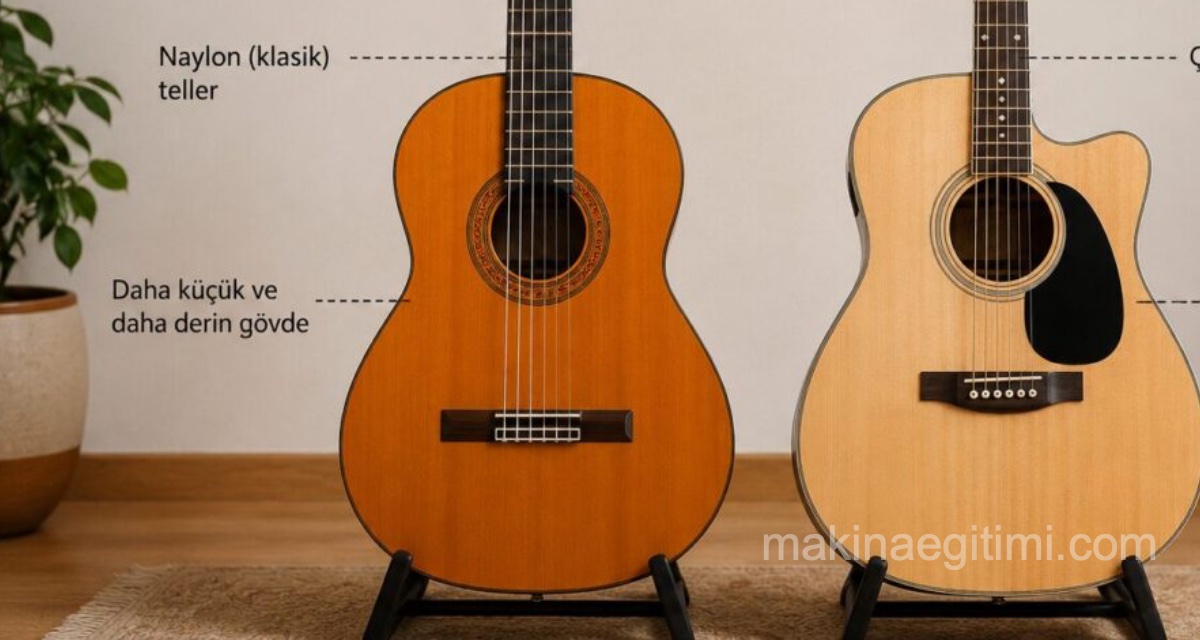
When you walk into a music shop and say “I’d like to buy a guitar,” the first question you’ll probably get is: “Classical or acoustic?” This question might seem confusing at first, because technically both are acoustic — that is, both are played without electronics. But there are quite distinct differences between the two, from the string material to the sound character, from the playing technique to which music genres they suit best. In this article, we’ll place these two sibling instruments side by side and look at when each one shines.
The Difference in Sound Between Classical and Acoustic Guitars
The Fundamental Difference: The Strings
The most obvious difference between the two guitars lies in the string material used. The classical guitar uses nylon strings — soft, flexible, and gentle on the fingertips. The acoustic guitar, on the other hand, has steel strings — tenser, producing a brighter sound, but they can also cause a little soreness on a beginner’s fingers during the first few weeks.
This difference in strings also directly determines the character of the sound. Nylon strings give a soft, warm, “round” tone, while steel strings produce a sharper, more metallic, and “brighter” sound. A classical guitar speaks almost like a whisper in a quiet room, while an acoustic guitar is heard much more powerfully and clearly in that same room.
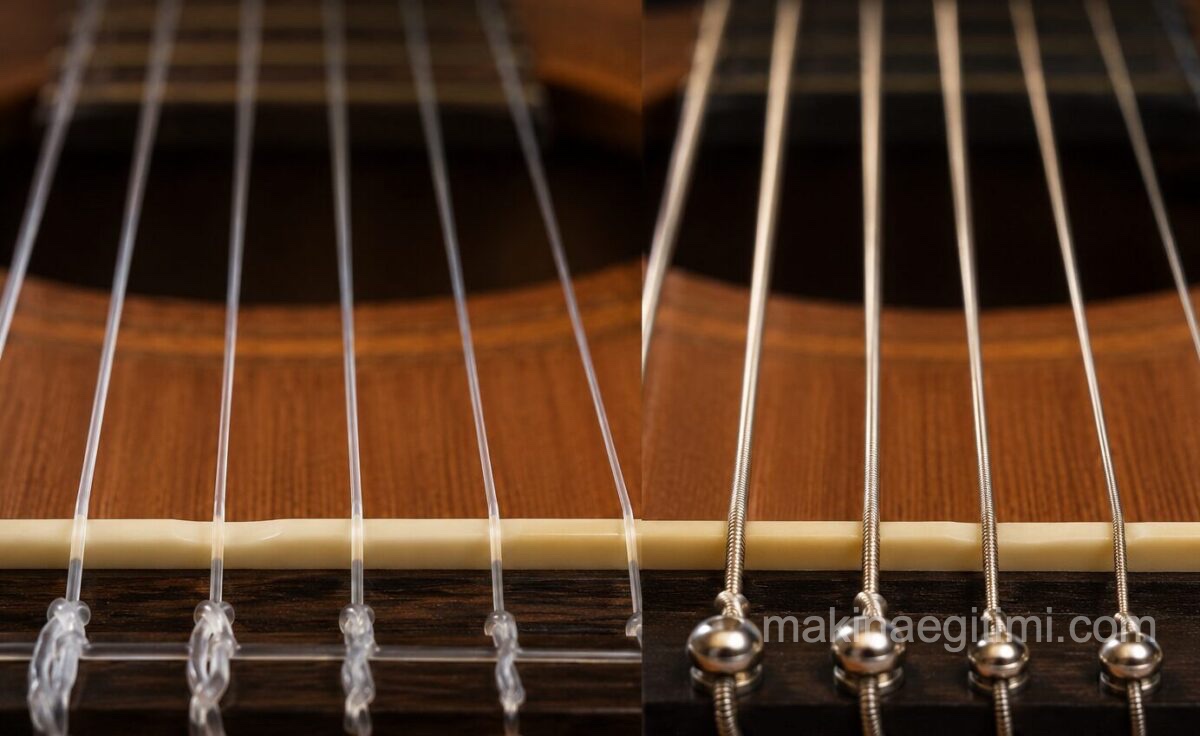
Acoustic guitars generally have higher tension (string tautness), which is why their necks are built more sturdily.
Differences in Body and Neck Structure
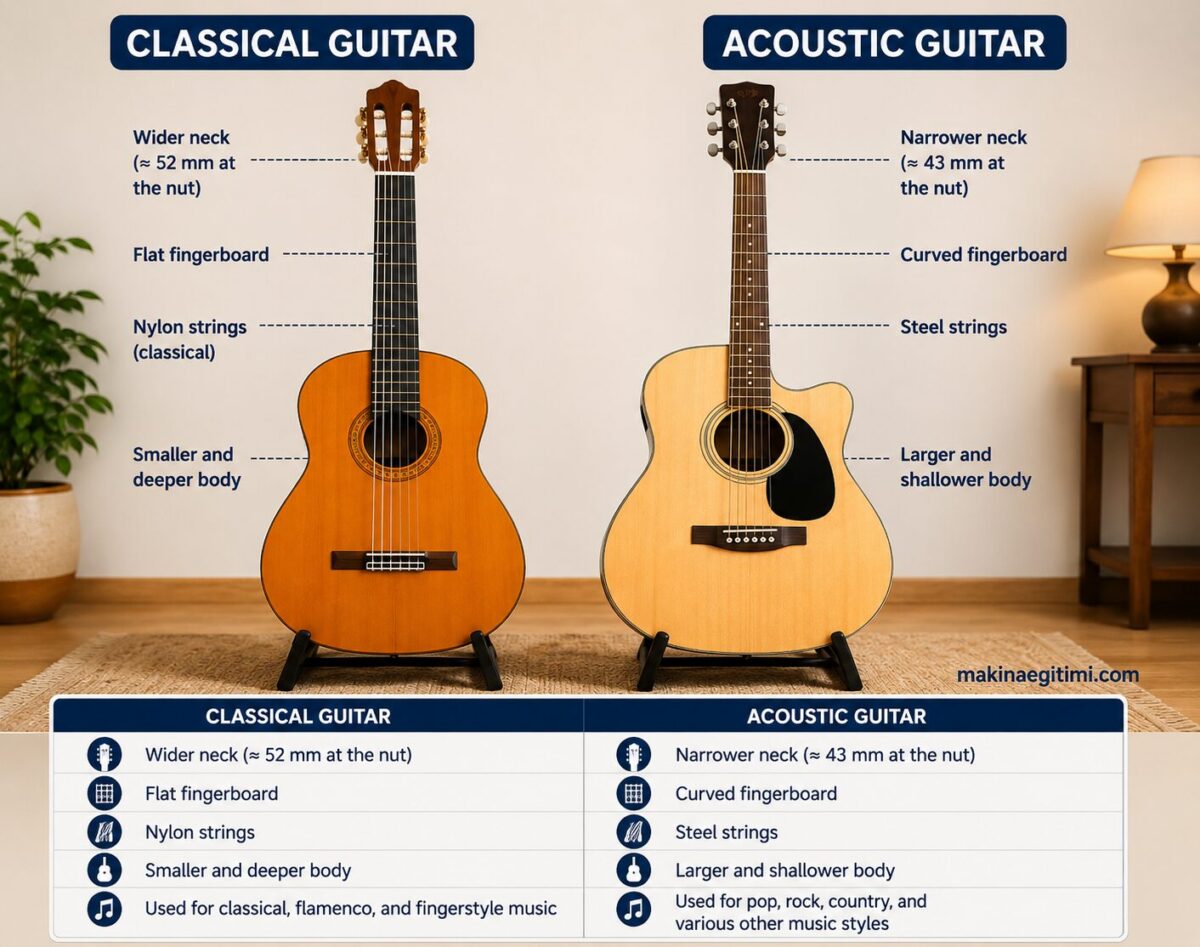
The classical guitar’s neck is generally wider; this is designed so the fingers can reach chords more comfortably and to make the precise finger movements required by complex classical pieces easier. The acoustic guitar’s neck, on the other hand, is thinner and smaller, which is more practical especially for song accompaniment where chord changes happen quickly.
The body shape also differs. Acoustic guitars generally have larger and deeper bodies, which gives them a stronger and fuller volume. Classical guitars, with their somewhat smaller and lighter bodies, are designed to prioritize delicacy and clarity over loudness.
| Feature | Classical Guitar | Acoustic Guitar (Steel-String) |
|---|---|---|
| String type | Nylon (or carbon) | Steel |
| Touch feel | Soft, suited to fingerstyle | Firmer, better suited to pick playing |
| Sound character | Warm, soft, round | Bright, clear, powerful |
Playing Technique: Fingers or Pick?
The classical guitar is traditionally played with the fingertips (fingerstyle); the nails or fingertips touch the strings with precision. This technique makes it possible to play multiple voice lines at once (bass, harmony, melody).
The acoustic guitar, on the other hand, can be played both with the fingers and with a pick (plectrum). Playing with a pick is especially ideal for rhythmic strumming in song accompaniment, and it’s the most common way we encounter guitar in everyday life; that “jangly” sound you hear around a campfire, from a street musician, or while singing along in a classroom usually comes from an acoustic guitar.

Which Genre Uses Which?
As its name suggests, the classical guitar was designed for the classical music repertoire, but it also appears frequently in genres such as flamenco and bossa nova. The acoustic guitar, on the other hand, is preferred for song accompaniment and solo performances in genres such as folk, country, pop, and rock.
We can summarize it like this:
| Feature | Classical Guitar | Acoustic Guitar |
|---|---|---|
| String type | Nylon | Steel |
| Neck width | Wide | Narrow |
| Playing technique | Usually fingers | Fingers or pick |
| Sound character | Soft, warm | Bright, powerful |
| Common genres | Classical music, flamenco | Folk, country, pop, rock |
A Common Question: Which One Is Easier to Start On?
Even music teachers disagree on this. The classical guitar’s nylon strings cause less pain to the fingers, offering a physically more comfortable start. However, the acoustic guitar’s thinner neck can make pressing down chords easier, especially for beginners with smaller hands.
In the end, the choice mostly depends on which music genre interests you: if you’re drawn to classical and Spanish music, the classical guitar; if you want to accompany songs and play popular music, the acoustic guitar may be the more sensible starting point.
Tell the Two Guitars Apart by Ear (8 YouTube Recommendations)
The best way to really understand the difference in sound is to listen to both back to back. Here are eight recommendations showing the different faces of the classical guitar and the acoustic guitar:
- Francisco Tárrega – Recuerdos de la Alhambra (classical guitar, nylon string)
- Andrés Segovia – Asturias (Albéniz, classical guitar tradition)
- Paco de Lucía – Entre Dos Aguas (flamenco, a different face of the nylon string)
- Tommy Emmanuel – Classical Gas (steel-string acoustic, fingerstyle technique)

Recuerdos de la Alhambra by Francisco Tárrega • Goran Krivokapić – classical guitar

Isaac Albeniz: Asturias (Leyenda) op.47 No5 (1886) Andres Segovia, guitar

Entre Dos Aguas

Tommy Emmanuel – Classical Gas
- Andy McKee – Drifting (steel-string acoustic, percussive fingerstyle)
- Simon & Garfunkel – The Sound of Silence (acoustic guitar-backed folk)
- John Denver – Take Me Home, Country Roads (country with acoustic guitar)
- Ed Sheeran – Perfect (modern acoustic pop)

Andy McKee – Drifting
Simon & Garfunkel – The Sounds of Silence (Audio)

Take Me Home, Country Roads (Original Version)
![Ed Sheeran - Perfect [Official Audio]](https://www.makinaegitimi.com/wp-content/uploads/2026/08/yt-CWG-GDfejmY-scaled.jpg)
Ed Sheeran – Perfect [Official Audio]
As you listen to the first three tracks, you’ll notice that soft, warm tone of the nylon string; in the following five tracks, you’ll hear the brighter, more powerful character of the steel string. Experiencing the difference with your own ears like this creates far more lasting learning than any definition could.
Which Guitar Should You Choose?
In the end, the classical guitar and the acoustic guitar aren’t rivals — they’re two sibling instruments that answer different needs. If you want to play classical music, learn complex finger techniques, or explore flamenco, the classical guitar is the right starting point for you.
If you want to accompany songs, play popular music, or play together with a band, the acoustic guitar is probably the more practical choice. Both are worth learning; in fact, many guitarists eventually add both to their repertoire.
Quick Summary
- Classical guitar → Nylon strings, wide neck, soft and warm sound, fingerstyle.
- Acoustic guitar → Steel strings, narrow neck, bright and powerful sound, pick + finger style.
Frequently Asked Questions
The most fundamental difference is the string material; classical guitars use nylon strings, while acoustic guitars use steel strings, and this difference directly determines the sound character, playing feel, and effect on the fingers.
This mostly depends on which music genre interests you; nylon strings cause less pain to the fingers and can offer a physically more comfortable start, but the acoustic guitar’s thinner neck can make pressing down chords easier.
Technically it can, but since the classical repertoire is usually composed for the soft tone of nylon strings and the wide neck of the classical guitar, it sounds most natural on a classical guitar.
It can be used, but the classical guitar is traditionally designed to be played with fingerstyle technique, and using a pick doesn’t really suit the genre’s natural playing style.
Yes, an electro-acoustic guitar is a version that can be connected to an amplifier thanks to a pickup system built into an acoustic guitar, but its string structure and basic playing technique remain the same as a standard acoustic guitar.
Related Posts
 The Birth and Golden Age of Jazz: From New Orleans to the World
  The Life Story of Michael Jackson: The Legendary Journey of the King of Pop
  Beethoven’s Battle With Deafness: An Incredible Story of Perseverance
  The History of the Guitar: The Journey from Its Origins to the Electric Guitar
  The Birth and Golden Age of Rock ‘n’ Roll: From Memphis to the World
  What Is Classical Music? Periods, Great Composers and History
  The Birth and Golden Age of Reggae: From Jamaica to the World
  The Most Famous Film Scores and Their Composers: Themes That Shaped Cinema History