
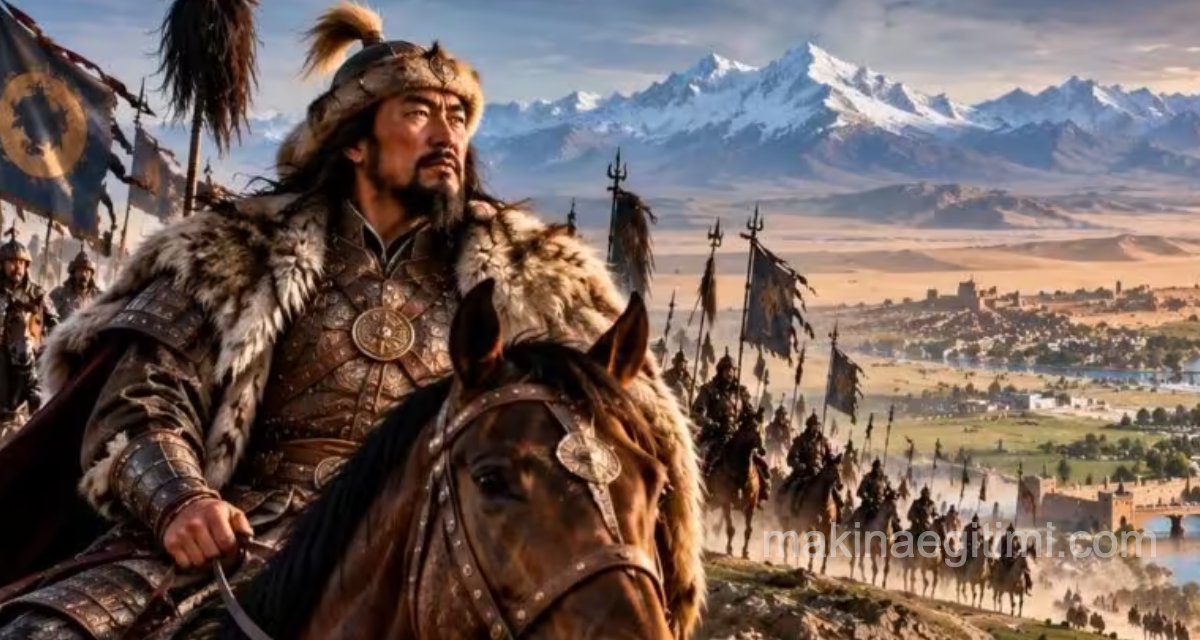
Dear readers, today we are going to tell you the story of a boy abandoned on the steppe by his own tribe, and of how he went on to build the largest contiguous land empire history has ever seen. The story is so extraordinary that some historians describe it as “the impossible made real”.
At its height, the empire Genghis Khan founded stretched from the Pacific Ocean to the middle of Europe. Yet the story began nowhere near a magnificent palace. It began in the middle of the steppe, with an abandoned family struggling to stay alive.
Temüjin’s Harsh Childhood
Genghis Khan was given the name “Temüjin” at birth. His father was a tribal chief, but he was poisoned and killed while Temüjin was still only nine years old. With his father’s death, the tribe abandoned Temüjin and his family completely. His mother and his brothers tried to survive on the steppe with almost no support at all, living on roots and small animals.
During this period Temüjin was captured and enslaved by a rival tribe, and a wooden collar was fastened around his neck. But he managed to escape, and step by step he began to make a name for himself in the merciless world of the steppe. That early experience of betrayal and abandonment shaped in him a search not for trust, but for absolute loyalty and for power.
Uniting a Fractured Steppe
At that time the Mongolian steppe was split into small tribes in constant conflict with one another. Temüjin managed to bring these tribes together under his own banner, first by forming alliances and then by eliminating his rivals one by one. What set him apart from other leaders was that he rewarded loyalty on the basis of ability and commitment rather than blood ties. In other words, not only the son of a tribal chief but even an ordinary shepherd could rise to high rank through what he achieved on the battlefield.
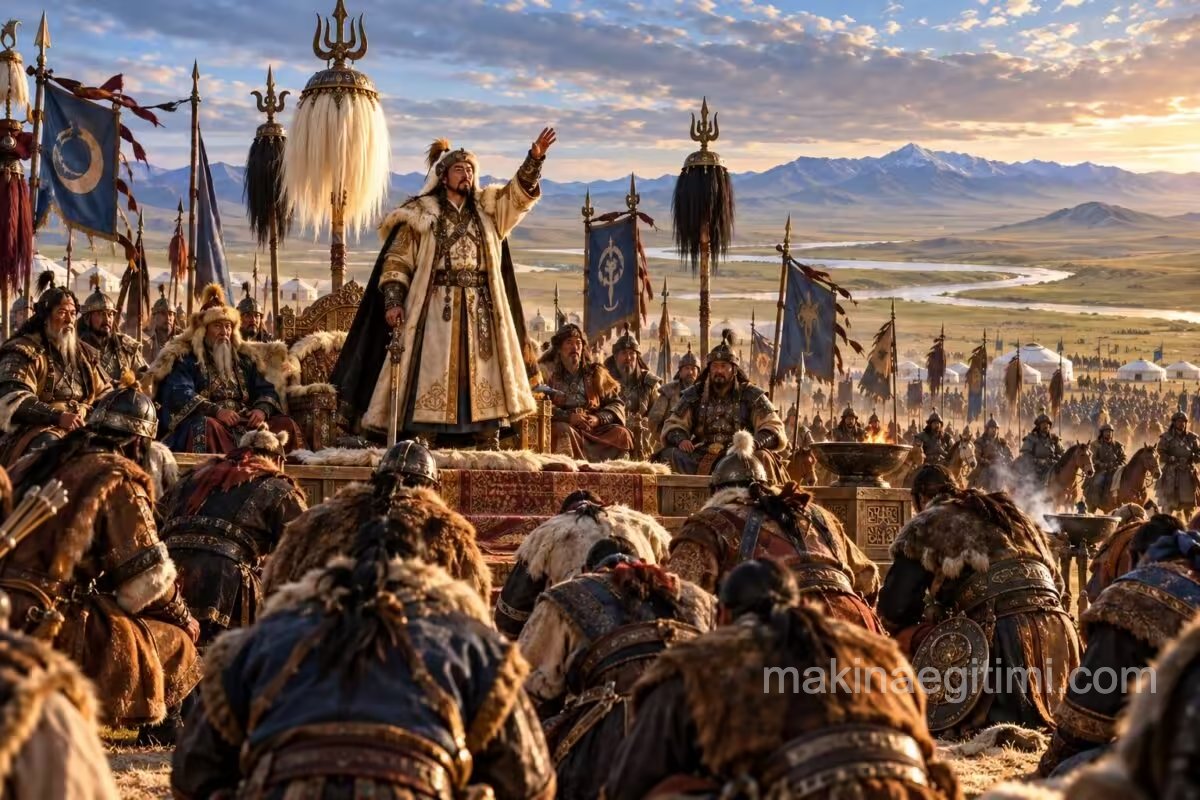
In 1206, now the leader of all the Mongol tribes, Temüjin took the title “Genghis Khan” (Universal Ruler) at a great kurultai. This was not merely a change of name; it was the declaration of the moment in which a fractured steppe became a single army with a single purpose.
What If the Tribal Wars Had Never Ended?
Let us pause and think for a moment. The Mongol tribes had been fighting one another for centuries, and that fragmentation made them an insignificant threat to the great empires around them (China, the Khwarazmian Empire). Had Temüjin failed to unite these tribes, the Mongols would in all likelihood have remained no more than a footnote in history.
But the ability of one man to turn scattered, mutually hostile tribes into a single disciplined army changed the course of world history completely. Sometimes the greatest transformations in history begin not with a great army, but with a single leader capable of bringing scattered pieces together.
The Conquests: How Did a Steppe Army Shake the World?
Genghis Khan’s armies were usually outnumbered by their opponents. But in discipline, speed and intelligence gathering they held an advantage that was almost unthinkable for the time. Mongol cavalry could cover close to a hundred kilometres in a single day, catching the enemy unprepared. The Mongols also learned new techniques and technologies from every society they conquered (siege engines, communication networks) and integrated them into their own forces.
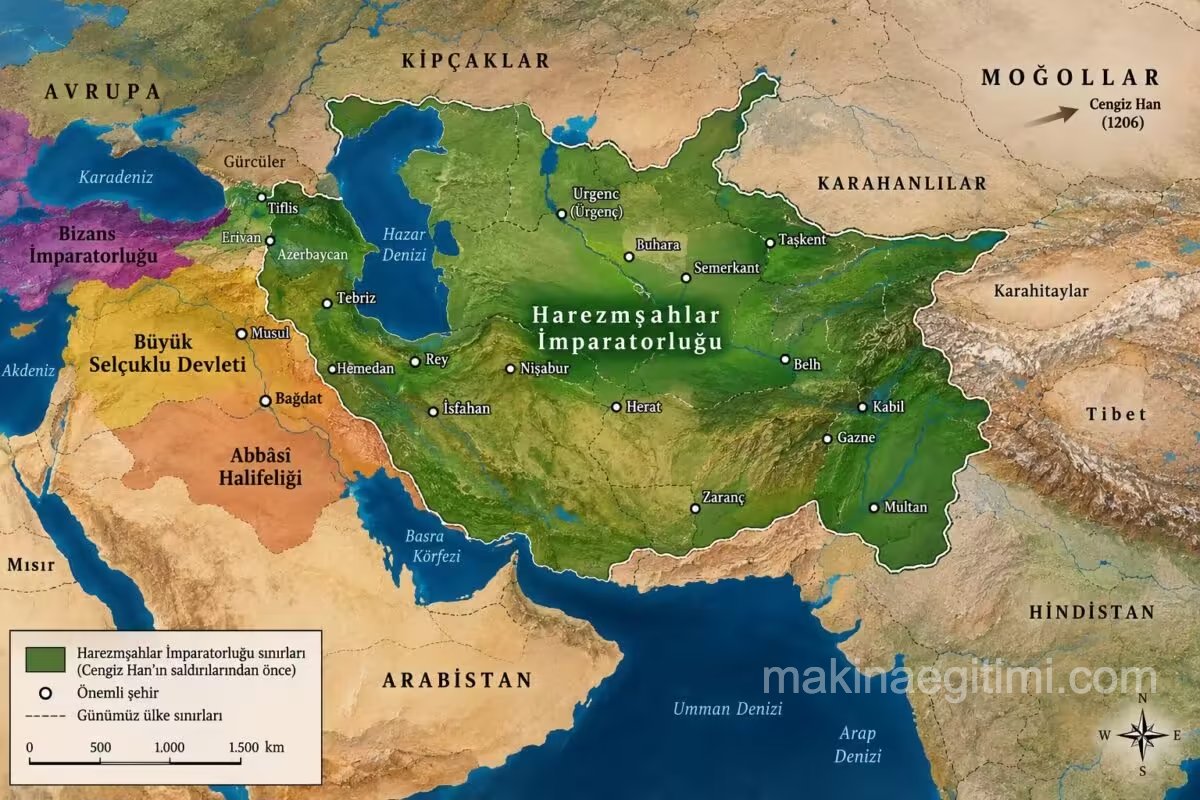
In 1219 Genghis Khan attacked the Khwarazmian Empire, one of the wealthy and powerful Islamic states of the period. The reason for that war is interesting in itself: the Khwarazmian ruler had massacred a trade caravan sent by Genghis Khan, suspecting its members of being spies. Genghis Khan’s answer to this betrayal turned into one of the most destructive military campaigns in history; within a few years the Khwarazmian Empire had ceased to exist entirely.
The image that usually comes to mind at the mention of Genghis Khan is that of a merciless conqueror who razed cities to the ground. And that is true; according to the records of the period, the violence shown towards cities that resisted was genuinely terrible. But there is another side to the coin: the empire Genghis Khan founded also brought an order that came to be known as the “Pax Mongolica”, the Mongol Peace.
Under that order the trade routes along the Silk Road became safe, a surprisingly tolerant policy was followed towards different religions, and a postal system (the Yam) was established that speeded up communication across the whole empire. Thanks to Mongol rule, the exchange of ideas, technology and goods between East and West accelerated as never before in history.
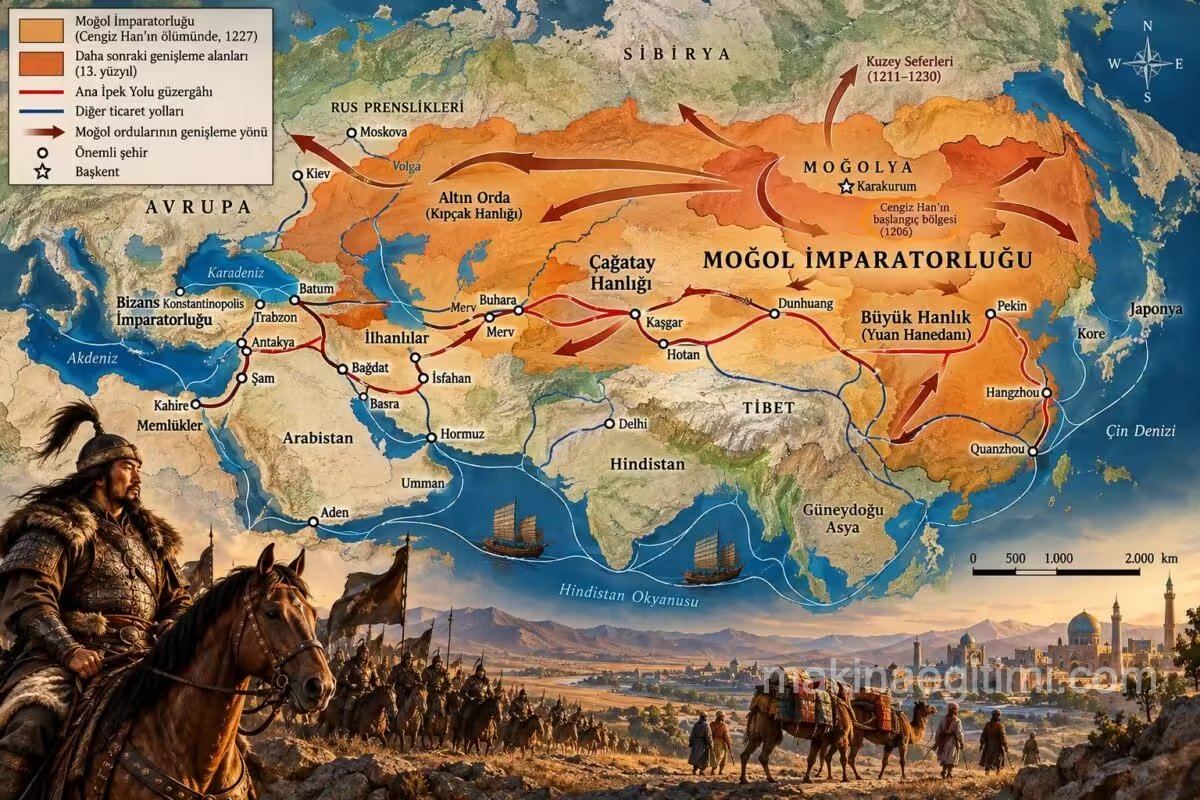
The Chain of Cause and Effect: From a Child to an Empire
- His father’s death and the tribe’s abandonment drove Temüjin to seek power and loyalty.
- Alliances between tribes and a merit-based understanding of leadership united the scattered Mongol clans.
- The unification of 1206 made a disciplined, centralised army possible.
- The Khwarazmian massacre of the trade caravan lit the fuse of the great western conquests.
- Speed, discipline and the transfer of technology made the Mongol armies the most effective force of their age.
- The “Pax Mongolica” that followed the conquests accelerated East-West trade and cultural exchange.
- Although the empire was divided in the time of his grandsons, it shaped the political and cultural map of Eurasia for centuries.
Was Genghis Khan a Turk?
According to the historical sources, Genghis Khan was not a Turk but of Mongol origin. Temüjin belonged to the Borjigin lineage of one of the Mongol tribes living in what is now north-eastern Mongolia at the end of the 12th century. At the kurultai of 1206 he united the other Mongol tribes and took the title of Genghis Khan.
When the question is put as “did he have any connection with the Turks?”, however, the picture becomes more complicated:
- The steppe world of Genghis Khan’s day did not consist of Mongols alone; a great many Turkic-speaking tribes and communities also lived in Mongolia and Central Asia.
- While building his power, Genghis Khan fought, allied with, or absorbed into his own army communities such as the Keraites, Naimans, Merkits and Tatars. The sources note in particular that communities such as the Keraites and the Naimans contained Turkic elements.
- As the Mongol Empire expanded, Turkic communities came to occupy a very important place in its population and its armies. For that reason, in later periods the Turkic and Mongol political and cultural worlds became deeply intertwined.
So why do people say “Genghis Khan was a Turk”?
What arises here is the problem of applying modern concepts of nationality directly to the 13th century. In that period there were no national identities such as “Turk”, “Mongol”, “Kazakh” or “Uzbek” in today’s sense. Tribe, lineage, political allegiance and language were far more decisive.
Historically, then, the most accurate statement is this:
Genghis Khan was a ruler of Mongol origin; but he rose in a world in which Turkic and Mongol steppe communities were deeply intermingled, and the empire he founded took on a strongly Turco-Mongol character.
Saying “Genghis Khan was a Turk” is therefore not the mainstream view supported by the available historical sources. By the same token, thinking of him simply as a “citizen of Mongolia” in today’s sense would be anachronistic.
Anachronistic: judging an event or a person by a concept, a piece of knowledge or a
characteristic that did not exist in their own period.
A Little-Known Fact
According to some genetic studies, around eight per cent of men living in Central Asia today carry a shared genetic marker on the Y chromosome that may belong to a single man who lived eight hundred years ago. Researchers think this trace may belong to Genghis Khan and his descendants. If that is correct, it would mean that roughly sixteen million men alive in the world today could be descended from Genghis Khan.
Related Videos
Genghis Khan: The Ruthless Rise of the Mongol Empire | Full Documentary
The Rise Of Genghis Khan (Full Episode) | Genghis Khan: Secret History of the Mongols | Nat Geo
How did Genghis Khan rule through fear and loyalty? | Full History Documentary
Frequently Asked Questions
He was given the name “Temüjin” at birth. He took the title “Genghis Khan” in 1206, when he was proclaimed leader of all the Mongol tribes.
At its height it was the largest contiguous land empire in history, stretching from the shores of the Pacific Ocean to Central Europe.
No. The violence shown towards cities that resisted was real, but the empire also established an order known as the “Pax Mongolica”, which made trade along the Silk Road safe and followed a tolerant policy towards different religions.
The direct trigger of that great campaign was the Khwarazmian ruler’s massacre of a trade caravan sent by Genghis Khan, whose members he suspected of being spies.
According to the historical sources, Genghis Khan was not a Turk but of Mongol origin. Temüjin belonged to the Borjigin lineage of one of the Mongol tribes living in what is now north-eastern Mongolia at the end of the 12th century. He was a ruler of Mongol origin; but he rose in a world in which Turkic and Mongol steppe communities were deeply intermingled, and the empire he founded took on a strongly Turco-Mongol character.
Related Posts
 The Black Death: How Did a Pandemic Bring About the End of the Middle Ages?
  The Sarajevo Assassination: How One Bullet Dragged the World Into War
  The Battle of Stalingrad: the Legend of Invincibility Broken in a City’s Ruins
  The Fall of Constantinople: A City’s Downfall, an Era’s Dawn
  The October Revolution: How a Tsardom Fell Overnight
  The Public Debt Administration: How an Empire Became a Foreigner in Its Own Country
  The Boston Tea Party: How a Crate of Tea Gave Birth to a Nation
  The Tulip Mania: The Story of History’s First Financial Bubble and Manipulative Scheme