Close Menu
  • MAKİNELER ve İMALAT
    • Tools & Equipment
    • Computer-Aided Drawing
    • CAD/CAM Education
    • CNC Machine Programming
    • Casting Technologies
    • Electrical & Electronics Technologies
    • Hydraulics & Pneumatics
    • Manufacturing Processes
    • Manufacturing Technologies
    • Occupational Safety
    • Mold & Die Design
    • Solid Modeling
    • Welding Technology
    • Machine Elements
    • Mechanical Trade Drawing
    • Materials Science
    • Automotive & Vehicle Technologies
    • Robotics Technologies
    • Health Technologies
    • Defense & Aerospace Technologies
    • Descriptive Geometry
    • Technical Drawing
    • Software & Hardware Technologies
    • Innovative Manufacturing Methods
  • TEKNOLOJİ ve YAŞAM
    • OTOMOBİLLER ve TAŞIT
      • Vehicle & Engine Knowledge
      • Safe Driving
      • Sürüş Destek Sistemleri
    • Genel Kültür
      • Movies & TV Shows
      • Görsel ve Grafik Sanat
      • Books & Literature
      • Music
      • Sports
      • History
      • History of Technology
    • GÜNDELİK YAŞAM TEKNOLOJİLERİ
    • Hobbies & Entertainment
    • Internet Technologies
    • Health
    • Mobile Technologies
Makine Eğitimi
  • Machines & Manufacturing
    Machine Elements
    Hydraulics & Pneumatics
    Technical Drawing
    Computer-Aided Design & Manufacturing
    Basic Manufacturing Processes
    Manufacturing Processes
    Industry Technologies
    Other Technical Courses
    Motion & Power Transmission
    Simple Machines
    Chains & Sprockets
    Shafts & Journals
    Gears
    Cams
    Couplings
    Belts & Pulleys
    Springs
    Bearings
    Keys
    Fastening Joining
    Retaining Rings
    Screws, Bolts & Nuts
    Cotter Pins
    Flanges
    Welding
    Rivets
    Pins & Bolts
    Washers
    Calculators
    Gear Ratio Calculator
    Spring Constant Calculator
    Belt Pulley Ratio Calculator
    Other Machine Elements
    Slides & Linear Guides
    Brakes
    Flywheels
    Clamps
    Shock Absorbers
    Gaskets & O-Rings
    Seals & Sealing Elements
    Hydraulics
    Introduction to Hydraulics & Principles
    Hydraulic Systems & Applications
    Accumulators
    Filters
    Motors
    Pumps
    Valves
    Pneumatics
    Introduction to Pneumatics & Principles
    Pneumatic Systems & Applications
    Pneumatic Circuit Components
    Valves
    Cylinders
    Silencers
    Motors
    Compressors
    Dryers
    Conditioning Units
    Common Topics & Maintenance
    Hydraulic & Pneumatic Maintenance
    Study Notes, Exams & Tests
    Technical Drawing
    Introduction to Technical Drawing
    Geometric Drawings
    Perspective & Projection
    Orthographic Views
    Dimensioning
    Sectioning
    Assembly & Detail Drawings
    Tolerances
    Surface Finish Symbols
    Mechanical Engineering Drawing
    Screws, Bolts & Nuts
    Pulley Drawings
    Gear Drawings
    Shafts & Journals
    Bearing Drawings
    Pins & Bolts
    Spring Drawings
    Welds in Technical Drawing
    Washers
    Cotter Pins
    Technical Drawing Exercises
    Mechanical Drawing Exercises
    Gear Exercises
    View Extraction Exercises
    Pulley Exercises
    Pin & Bolt Exercises
    Threaded Fastening Exercises
    Descriptive Geometry
    Computer-Aided Drawing
    AutoCAD Drawing Lessons
    Computer-Aided Drawing Exams
    Solid Modeling & Animation
    Solid Model Drawing Files
    Solid Model Assembly Examples
    Solid Model Drawing Lessons
    3D CAD Software Reviews
    Solid Modeling Exercises
    CNC Programming
    CAM
    Measurement & Inspection
    Dial Indicators
    Calipers
    Gauges
    Micrometers
    Materials Science
    Steels
    Cast Iron
    Aluminum
    Plastics
    Material Testing & Hardness Measurement
    Occupational Safety
    Workshop Safety
    Safety When Working With Electricity
    Machine Safety Rules
    Hand Operations
    Filing
    Marking
    Cutting Operations
    Reaming
    Tapping
    Threading With a Die
    Drill Bit Sharpening
    Working With Machines
    Basic Turning Operations
    Basic Milling Operations
    Shaper Machine
    Machining
    Turning
    Milling
    Grinding
    Innovative Manufacturing Methods
    EDM (Electrical Discharge Machining)
    Laser Machining
    Waterjet Machining
    3D Printing
    3D Scanners
    Welding
    Rolling
    Casting
    Mold & Die Design
    Mechanical & Hydraulic Presses
    Blanking & Piercing Dies
    Bending Dies
    Drawing Dies
    Plastic Injection Molds
    Extrusion Dies
    Compound Dies
    Progressive Dies
    Blow Molds
    Spinning Dies
    Spray Molds
    Manufacturing of Machine Parts
    Automotive & Vehicle Technologies
    Motor Vehicle Manufacturing
    Raw Material Production
    History of Technology
    Health & Medical Technologies
    Defense & Aerospace
    Robotics Technologies
    Software & Hardware Technologies
    Mechanics - Strength of Materials
    Physics Topics
  • Technology & Life
    Hobbies & Entertainment
    Sports
    Music
    Vehicle & Engine Knowledge
    Vehicle Maintenance & Repair
    Safe Driving
    Driver Assistance Systems
    History
    Movies & TV Shows
    Books & Literature
    Computers & Internet
    Computer Tips
    Software Reviews
    Hardware & Peripherals
    Practical & Safe Internet Use
    Visual & Graphic Art
    Mobile Technologies
    Travel
    Science
    Health
    First Aid Knowledge
    Everyday Technologies
Makine Eğitimi
Home»History of Technology»Leonardo da Vinci’s Machines: The Flying, Fighting and Walking Inventions of a Renaissance Genius
11 September 2026

Leonardo da Vinci’s Machines: The Flying, Fighting and Walking Inventions of a Renaissance Genius

Leonardo da Vinci’nin Makineleri: Rönesans Dehasının Uçan, Savaşan ve Yürüyen İcatları

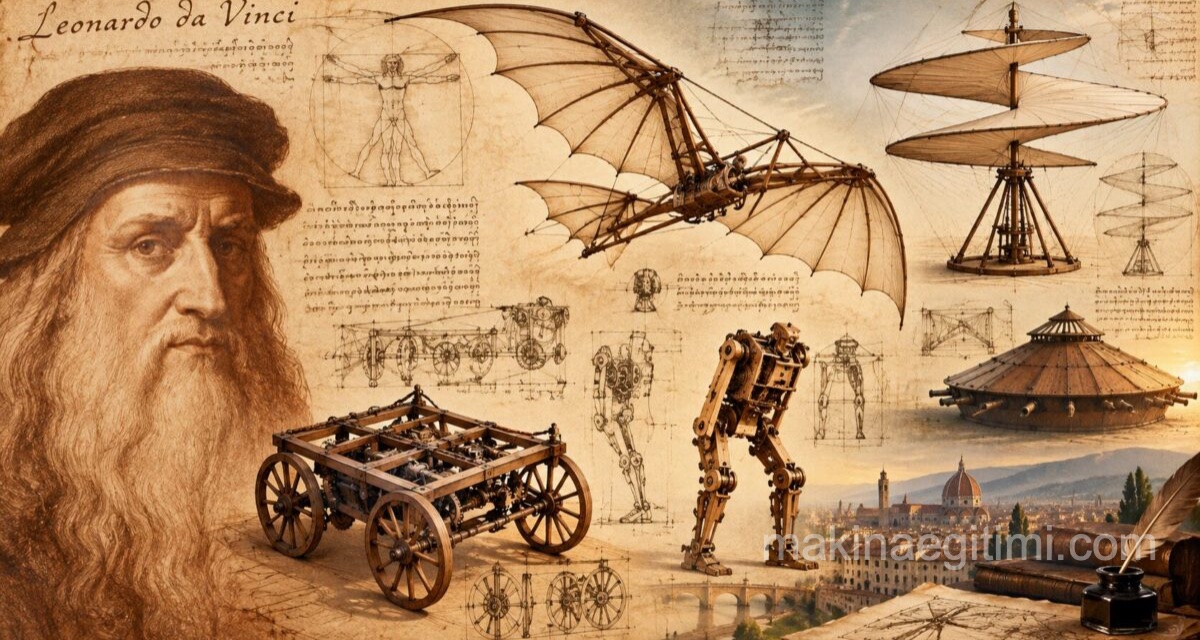
Dear readers, today we are telling the story of just how great an engineer a certain painter really was. Mention Leonardo da Vinci and the first things that come to mind are the Mona Lisa or The Last Supper. Yet his real legacy is hidden in the notebooks that laid the foundations of what we now call mechanical engineering some 500 years early. Anyone who researches da Vinci’s machines and inventions finds a genuine Renaissance engineer in front of them.

  • A Passion for the Sky: Flying Machines
  • A Dream of the Battlefield: The Armoured Fighting Vehicle
  • The Self-Propelled Cart
  • The Mechanical Knight: The First Idea of a Robot
  • The Diving Suit and Underwater Ideas
  • So Why Was None of It Built at the Time?
  • Related Videos
  • The Influence That Reaches Us Today
  • Frequently Asked Questions

A Passion for the Sky: Flying Machines

Leonardo da Vinci’s flying machines are among his best-known works. After watching birds and bats for hours on end, da Vinci drew on those observations to design a craft he called the “ornithopter”, which aimed to fly by flapping its wings. With a wingspan of roughly 10 metres, the machine was to be built from pine covered in raw silk and powered by the pilot’s arms and legs.

Ornithopter and aerial screw drawings from the Codex Atlanticus

The “aerial screw” he drew in the same period is regarded as the ancestor of today’s helicopter. This spiral-shaped device was meant to rise by “drilling” through the air like a screw. In 2022 an engineering team from the University of Maryland actually managed to fly the design at small scale. Da Vinci’s parachute design showed similar foresight, built around a pyramid-shaped wooden frame, and centuries later it was tested and proved to work.

crimson spin
The University of Maryland’s aerial screw prototype, named “Crimson Spin”.

A Dream of the Battlefield: The Armoured Fighting Vehicle

Leonardo da Vinci’s tank design grew out of a letter he prepared in 1487 for Ludovico Sforza, Duke of Milan. Cone-shaped and reminiscent of a tortoise shell, the vehicle was to be clad in wood and metal plates and able to fire in every direction from cannons placed around its rim. Four men inside would move it by turning a crank mechanism.

There is an intriguing detail. In the original drawings the gears are arranged the wrong way round, so the vehicle would not have worked had it been built exactly as drawn. Some historians think this was a deliberate safeguard: da Vinci may have wanted his designs to be useless in the wrong hands if they were ever stolen.

The Self-Propelled Cart

This design, also referred to as da Vinci’s automobile, was conceived as a stage effect for theatrical performances.

Driven by energy stored in a spring mechanism, the cart had a steering system that could be set in advance. The Institute and Museum of the History of Science in Italy managed to build a working model of the vehicle based on the original drawings.

Da Vinci'nin Makineleri Araba (Türkçe Belgesel) Da Vinci'nin Makineleri Araba (Türkçe Belgesel)

The Mechanical Knight: The First Idea of a Robot

The mechanical knight, known as Leonardo da Vinci’s robot design, was the idea of a human-shaped automaton built into a suit of armour with a system of pulleys and cables, able to sit down, move its arms and even open and close its jaw. Looking at the history of robotics, this design is regarded as one of the earliest examples of the humanoid robot concept.

The Diving Suit and Underwater Ideas

Da Vinci designed a leather diving suit so that divers could approach enemy ships unseen from below during naval battles. Allowing the wearer to breathe through air tubes connected to a float on the surface, the system is considered a distant ancestor of today’s diving equipment.

So Why Was None of It Built at the Time?

The answer is actually quite simple. Anyone looking into why Leonardo da Vinci’s machines did not work generally runs into two basic obstacles. The first is that the materials of the era (wood, leather, simple metals) could not deliver the balance of lightness and strength these designs demanded. The second is that a powerful, compact source of energy had not yet been invented. Da Vinci’s ideas were the product of a mind living far ahead of the technology around it.

Related Videos

Discovery Channel Da Vinci’nin Makineleri – Helikopter

Discovery Channel Da Vinci’nin Makineleri – Helikopter

Leonardo da Vinci: ZAMANIN ÖTESİ | Belgeseller | B01

Leonardo da Vinci: ZAMANIN ÖTESİ | Belgeseller | B01

Da Vinci'nin Helipkopteri || Da Vinci'nin Makineleri
Da Vinci'nin Helipkopteri || Da Vinci'nin Makineleri

Leonardo Da Vinci'nin İcatları

Leonardo Da Vinci'nin İcatları

LEONARDO DA VİNCİ VE İCATLARI

LEONARDO DA VİNCİ VE İCATLARI

Gerçek Bir Deha - LEONARDO DA VİNCİ ve Müthiş Hikayesi

Gerçek Bir Deha – LEONARDO DA VİNCİ ve Müthiş Hikayesi

The Influence That Reaches Us Today

Da Vinci’s drawings are still studied in engineering faculties today. Igor Sikorsky said himself that he drew inspiration from da Vinci’s aerial screw drawing while developing the first practical helicopter in the 1920s. In Rome, in Milan and in museums around the world, working models built from these drawings are on display. That goes some way to explaining why the subject of Leonardo da Vinci’s machines still attracts so much curiosity.

Frequently Asked Questions

An exact figure is hard to give, because his notebooks contain thousands of pages of drawings and notes. Dozens of original machine designs have been identified, however, including flying machines, war vehicles, hydraulic systems and automata.

None of them was fully built and tested in his lifetime. Modern engineers, however, have rebuilt designs such as the aerial screw, the parachute and the self-propelled cart with contemporary materials and proved that they work.

The original design never flew, because reaching the necessary rotational speed with human power was impossible. In 2022 the University of Maryland’s small-scale powered prototype achieved short flights.

Most of the drawings are part of the compilation known as the Codex Atlanticus, held at the Biblioteca Ambrosiana in Milan. Other notes are scattered across Windsor Castle and various museums.

Related Posts
The History of Electric Arc Welding The History of Electric Arc Welding The History of Weaving The History of Weaving Tiger I tank World War II The Story of the Tiger I Tank. The War Machine That Became a Legend History of automobile technology evolution The History of the Automobile. The Evolution of Vehicle Technology From Then to Now the history and evolution of robotics The History and Evolution of Robotics: From Ancient Automata to AI-Powered Robots Nazi Germany WWII super tanks Nazi Germany’s Mega Structures – Super Tanks
Share. Facebook Twitter WhatsApp Tumblr Email Telegram Copy Link

Leave A Reply Cancel Reply


How to Check Radiator Coolant
Steering Wheel Grip and Turning Techniques
  • Contact
  • Terms of Service
  • Privacy & Cookie Policy

Type above and press Enter to search. Press Esc to cancel.