
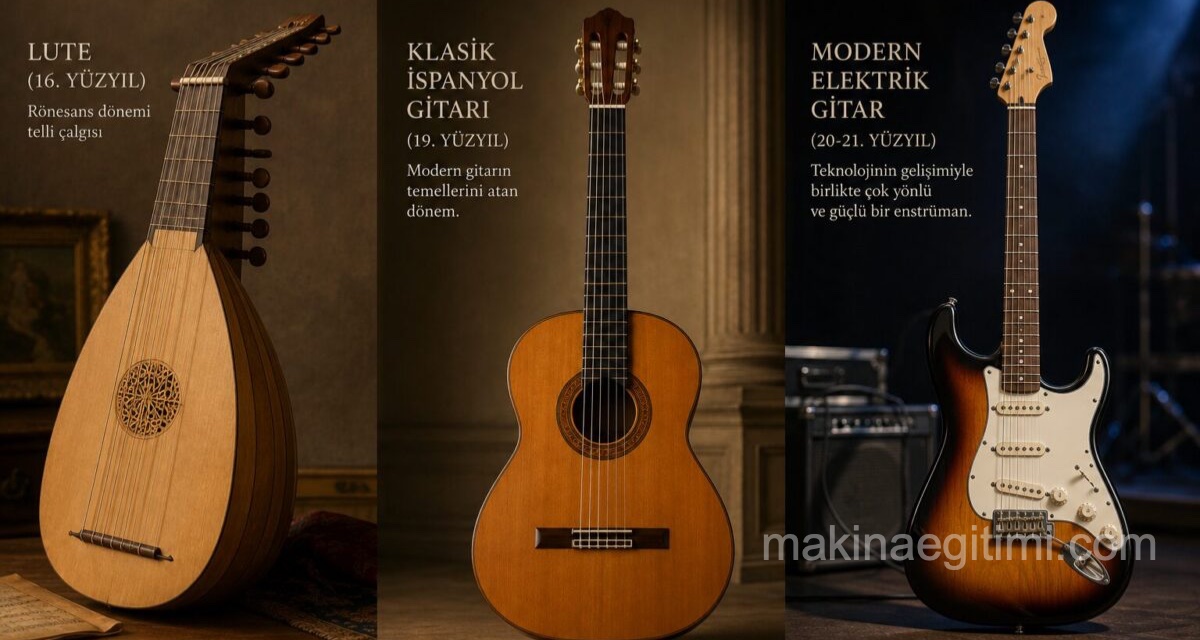
When you pick up a guitar today, you’re actually holding the last link in a chain thousands of years long. This instrument wasn’t invented by a single person. It’s the product of a heritage that slowly took shape over centuries, across different continents and cultures. This story—which stretches from the stringed instruments of ancient Egypt to the medieval European lute, from there to the Spanish flamenco guitar, and finally to the electric guitar that shook rock stages—is also a mirror of humanity’s relationship with music.
In this article, we’ll explore the guitar’s journey from its origins to today, along with the famous players of each era and the pieces that define them.
Origins: What Came Before the Guitar?
The stringed instruments that can be considered the guitar’s ancestors actually date back thousands of years. In ancient Mesopotamia and Egypt, primitive stringed instruments with a body and neck were already in use. Over time, these instruments traveled through the Middle East to Europe and evolved into an instrument known as the “lute,” recognized by its pear-shaped body.

In medieval Spain, two different traditions developed side by side: the “vihuela” of Christian Europe, and the “oud” brought by the Moors (Muslim communities of North African origin). The meeting of these two traditions on the Iberian Peninsula laid the foundations of the modern guitar. The four- or five-course “guitarra,” which emerged in the 16th century, is considered the direct ancestor of today’s guitar.
The Birth of the Modern Guitar: The Antonio de Torres Revolution
The guitar reached its modern form thanks to Spanish luthier Antonio de Torres Jurado in the 19th century. In the 1850s and 1860s, Torres fundamentally transformed the instrument’s volume and tone by enlarging the guitar’s body, thinning and strengthening the soundboard, and developing the “fan bracing” technique for the internal structure. The classical guitar form he designed is still considered the worldwide standard today.
An interesting detail: Torres was working during a period when the guitar was still seen as a “second-class” parlor instrument. Thanks to his innovations, the guitar gained enough volume to share the concert-hall stage with serious instruments like the piano and violin.
Steel Strings and Electricity: The Guitar Goes to America
At the start of the twentieth century, when the guitar arrived in America, it underwent two major transformations. First, steel strings began to be used instead of nylon; this gave the guitar a brighter, sharper sound and helped pave the way for the development of genres like country and blues.
The second and larger transformation took place in the 1930s. Guitarists playing in big band orchestras couldn’t be heard over loud instruments like trumpets and saxophones. Inventors looking for a solution to this problem developed a system that converted the vibration of the guitar’s strings into an electrical signal. In 1931, the model nicknamed the “Frying Pan,” produced by George Beauchamp and Adolph Rickenbacker, was one of the first commercial electric guitars. In the 1950s, with Leo Fender and Gibson‘s Les Paul model, the electric guitar took its place at the center of popular music.

Guitars by Genre: One Instrument, Hundreds of Sounds
The most fascinating thing about the guitar is that a single instrument can be home to so many different musical worlds:
The classical guitar, with its nylon strings, produces a soft, warm tone; names like Spanish composer Francisco Tárrega left behind timeless works in this style.
The flamenco guitar, although similar to the classical guitar, has a sharper tone and a fast strumming technique called “rasgueado”; Paco de Lucía is considered one of the greatest masters of this genre.
Blues and rock guitar is known for its steel strings, usually paired with electric amplification, and emotional “bending” (string-bending) techniques; B.B. King and Jimi Hendrix are among the legends of this style.
Jazz guitar is typically played on “hollow body” electric guitars and stands out for its complex chord structures; Wes Montgomery’s warm tone, played with his thumb, is one of the genre’s signature sounds.
Discover the History of the Guitar by Ear (8 YouTube Picks)
If you’d like to hear the range of sounds the guitar has produced across different genres and eras, here are eight suggestions:
- Francisco Tárrega – Recuerdos de la Alhambra (classical guitar)
- Paco de Lucía – Entre Dos Aguas (flamenco guitar)
- Chuck Berry – Johnny B. Goode (the guitar language of rock ‘n’ roll)
- B.B. King – The Thrill Is Gone (the emotion of blues guitar)
- The Jimi Hendrix Experience – Purple Haze (a revolution in electric guitar)
- Wes Montgomery – Four On Six (the elegance of jazz guitar)
- Van Halen – Eruption (the birth of the tapping technique)
- Dire Straits – Sultans of Swing (the storytelling of modern rock guitar)

Recuerdos de la Alhambra by Francisco Tárrega • Goran Krivokapić – classical guitar

Entre Dos Aguas

Johnny B. Goode

The Thrill Is Gone

The Jimi Hendrix Experience – Purple Haze (Official Audio)

Wes Montgomery – Four On Six (Official Audio)

Eruption (2015 Remaster)

Dire Straits – Sultans of Swing (Official Audio)
When you listen to these eight tracks in order, you’ll clearly notice how the same six strings can carry such vastly different emotions and cultures.
A Detail People Often Wonder About: How Many Strings Should a Guitar Have?
While the standard guitar has six strings today, this wasn’t always the case. Early vihuelas and lutes had five, or sometimes even fewer, courses of strings. The single six-string layout began to spread toward the end of the 18th century and became permanent in the 19th century with the design standardized by Torres.
So the “6-string guitar” concept we use today is actually a relatively recent development in the instrument’s long history.
The Guitar’s Legacy: How It Reached Today
Today, the guitar is one of the most widely played instruments in the world. A big reason for this is its accessibility: it doesn’t take up a lot of space like a piano, it doesn’t require years of technical training like a violin, and it can be obtained at relatively affordable prices.
This accessibility has made the guitar a shared instrument for both professional stages and amateur musicians at home. Finding a place for itself in nearly every genre—from classical music to flamenco, from blues to rock, from jazz to pop—the guitar continues its thousand-year journey to this day.
Frequently Asked Questions
The stringed instruments considered the guitar’s ancestors date back to ancient Mesopotamia and Egypt; a form resembling today’s guitar emerged in the 16th century in medieval Spain, from the merging of the vihuela and oud traditions.
The modern classical guitar’s form was developed in the 19th century by Spanish luthier Antonio de Torres Jurado, and it’s still considered the standard today.
One of the first commercial electric guitars was the model known as the “Frying Pan,” produced in 1931 by George Beauchamp and Adolph Rickenbacker; the instrument took its place at the center of popular music in the 1950s with Fender and Gibson.
Early ancestors of the guitar had fewer strings; the single six-string layout began to spread at the end of the 18th century and became a permanent standard in the 19th century.
The classical guitar has nylon strings and produces a soft acoustic tone, while the electric guitar has steel strings and is played with its sound amplified through an amplifier.
Related Posts
 What Is the Difference Between Classical Guitar and Acoustic Guitar?
  The Life Story of Elvis Presley: The Journey of the King of Rock’n Roll
  Music Terms: Tempo, Harmony, Chord, Syncopation and More
  The Life Story of Michael Jackson: The Legendary Journey of the King of Pop
  Beethoven’s Battle With Deafness: An Incredible Story of Perseverance
  The Birth and Golden Age of Jazz: From New Orleans to the World
  The Story of The Beatles: From Liverpool to a Worldwide Legend
  What Is Classical Music? Periods, Great Composers and History