Close Menu
  • MAKİNELER ve İMALAT
    • Tools & Equipment
    • Computer-Aided Drawing
    • CAD/CAM Education
    • CNC Machine Programming
    • Casting Technologies
    • Electrical & Electronics Technologies
    • Hydraulics & Pneumatics
    • Manufacturing Processes
    • Manufacturing Technologies
    • Occupational Safety
    • Mold & Die Design
    • Solid Modeling
    • Welding Technology
    • Machine Elements
    • Mechanical Trade Drawing
    • Materials Science
    • Automotive & Vehicle Technologies
    • Robotics Technologies
    • Health Technologies
    • Defense & Aerospace Technologies
    • Descriptive Geometry
    • Technical Drawing
    • Software & Hardware Technologies
    • Innovative Manufacturing Methods
  • TEKNOLOJİ ve YAŞAM
    • OTOMOBİLLER ve TAŞIT
      • Vehicle & Engine Knowledge
      • Safe Driving
      • Sürüş Destek Sistemleri
    • Genel Kültür
      • Movies & TV Shows
      • Görsel ve Grafik Sanat
      • Books & Literature
      • Music
      • Sports
      • History
      • History of Technology
    • GÜNDELİK YAŞAM TEKNOLOJİLERİ
    • Hobbies & Entertainment
    • Internet Technologies
    • Health
    • Mobile Technologies
Makine Eğitimi
  • Machines & Manufacturing
    Machine Elements
    Hydraulics & Pneumatics
    Technical Drawing
    Computer-Aided Design & Manufacturing
    Basic Manufacturing Processes
    Manufacturing Processes
    Industry Technologies
    Other Technical Courses
    Motion & Power Transmission
    Simple Machines
    Chains & Sprockets
    Shafts & Journals
    Gears
    Cams
    Couplings
    Belts & Pulleys
    Springs
    Bearings
    Keys
    Fastening Joining
    Retaining Rings
    Screws, Bolts & Nuts
    Cotter Pins
    Flanges
    Welding
    Rivets
    Pins & Bolts
    Washers
    Calculators
    Gear Ratio Calculator
    Spring Constant Calculator
    Belt Pulley Ratio Calculator
    Other Machine Elements
    Slides & Linear Guides
    Brakes
    Flywheels
    Clamps
    Shock Absorbers
    Gaskets & O-Rings
    Seals & Sealing Elements
    Hydraulics
    Introduction to Hydraulics & Principles
    Hydraulic Systems & Applications
    Accumulators
    Filters
    Motors
    Pumps
    Valves
    Pneumatics
    Introduction to Pneumatics & Principles
    Pneumatic Systems & Applications
    Pneumatic Circuit Components
    Valves
    Cylinders
    Silencers
    Motors
    Compressors
    Dryers
    Conditioning Units
    Common Topics & Maintenance
    Hydraulic & Pneumatic Maintenance
    Study Notes, Exams & Tests
    Technical Drawing
    Introduction to Technical Drawing
    Geometric Drawings
    Perspective & Projection
    Orthographic Views
    Dimensioning
    Sectioning
    Assembly & Detail Drawings
    Tolerances
    Surface Finish Symbols
    Mechanical Engineering Drawing
    Screws, Bolts & Nuts
    Pulley Drawings
    Gear Drawings
    Shafts & Journals
    Bearing Drawings
    Pins & Bolts
    Spring Drawings
    Welds in Technical Drawing
    Washers
    Cotter Pins
    Technical Drawing Exercises
    Mechanical Drawing Exercises
    Gear Exercises
    View Extraction Exercises
    Pulley Exercises
    Pin & Bolt Exercises
    Threaded Fastening Exercises
    Descriptive Geometry
    Computer-Aided Drawing
    AutoCAD Drawing Lessons
    Solid Modeling & Animation
    Solid Model Drawing Files
    Solid Model Assembly Examples
    Solid Model Drawing Lessons
    3D CAD Software Reviews
    Solid Modeling Exercises
    CNC Programming
    CAM
    Measurement & Inspection
    Dial Indicators
    Calipers
    Gauges
    Micrometers
    Materials Science
    Steels
    Cast Iron
    Aluminum
    Plastics
    Material Testing & Hardness Measurement
    Occupational Safety
    Workshop Safety
    Safety When Working With Electricity
    Machine Safety Rules
    Hand Operations
    Filing
    Marking
    Cutting Operations
    Reaming
    Tapping
    Threading With a Die
    Drill Bit Sharpening
    Working With Machines
    Basic Turning Operations
    Basic Milling Operations
    Shaper Machine
    Machining
    Turning
    Milling
    Grinding
    Innovative Manufacturing Methods
    EDM (Electrical Discharge Machining)
    Laser Machining
    Waterjet Machining
    3D Printing
    3D Scanners
    Welding
    Rolling
    Casting
    Mold & Die Design
    Mechanical & Hydraulic Presses
    Blanking & Piercing Dies
    Bending Dies
    Drawing Dies
    Plastic Injection Molds
    Extrusion Dies
    Compound Dies
    Progressive Dies
    Blow Molds
    Spinning Dies
    Spray Molds
    Manufacturing of Machine Parts
    Automotive & Vehicle Technologies
    Motor Vehicle Manufacturing
    Raw Material Production
    History of Technology
    Health & Medical Technologies
    Defense & Aerospace
    Robotics Technologies
    Software & Hardware Technologies
    Mechanics - Strength of Materials
    Physics Topics
  • Technology & Life
    Hobbies & Entertainment
    Sports
    Music
    Vehicle & Engine Knowledge
    Vehicle Maintenance & Repair
    Safe Driving
    Driver Assistance Systems
    History
    Movies & TV Shows
    Books & Literature
    Computers & Internet
    Computer Tips
    Software Reviews
    Hardware & Peripherals
    Practical & Safe Internet Use
    Visual & Graphic Art
    Mobile Technologies
    Travel
    Science
    Health
    First Aid Knowledge
    Everyday Technologies
Makine Eğitimi
Home»Manufacturing Processes»Safety Rules for Working on a Lathe
29 August 2026Updated:18 September 2026

Safety Rules for Working on a Lathe

Safety Rules for Working on a Lathe

In this article we will cover the safety rules for working on a lathe, and the workplace accidents that can happen when those rules are not followed.

  • Enclosing Moving Parts in Dedicated Guards
  • Emergency Stop Brake
  • Correct Stance and Work Clothing
    • Wear suitable work clothing
  • Clamping the Work Securely and Centrifugal Force
  • Changing the Spindle Speed on a Lathe
  • Removing Chips from the Machine
  • Measuring and Checking Operations
    • Why grounding the lathe matters, and how to prevent electrical accidents
    • Why an orderly lathe is a safer lathe
  • Related Videos
  • Related Questions

Enclosing Moving Parts in Dedicated Guards

Rotating and moving machine elements can injure any part of the operator’s body. That is why it is vitally important that moving parts such as gears, pulleys and belts are enclosed in guards. Where possible, choose next-generation chip guards fitted with an interlock switch that prevents the chuck from turning while the guard is open. Guards of this kind protect against flying chips and also stop the machine from being started by accident if the guard has been left open.

When the interlocked chip guards described above are not used, leaving the chuck key in the chuck can lead to workplace accidents.

Emergency Stop Brake
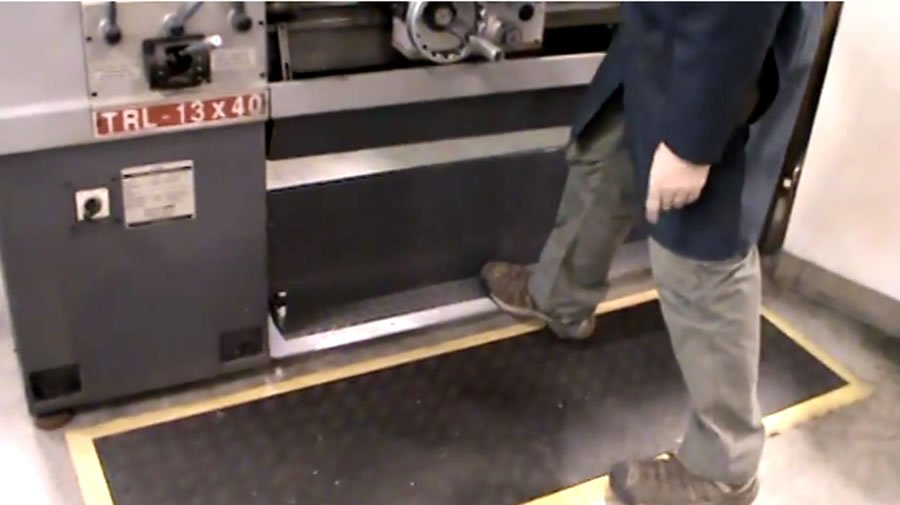
lathe emergency stop foot brake pedal

Choose lathes fitted with a foot pedal that works as an emergency brake. Make sure nothing — a piece of wood, for example — has slipped underneath the pedal. You never know when you will need it. And do not forget: this pedal is for emergencies only. Using the foot brake for routine stops will shorten its service life.

Correct Stance and Work Clothing

From a safety point of view, the following points about your stance deserve attention:

  • Stand balanced in front of the machine.
  • Take up a position that keeps the machine’s control levers within easy reach.
  • Do not lean over the lathe chuck while working.

A balanced stance lets you react quickly if something suddenly goes wrong, and it also lets you keep working through long jobs without tiring.
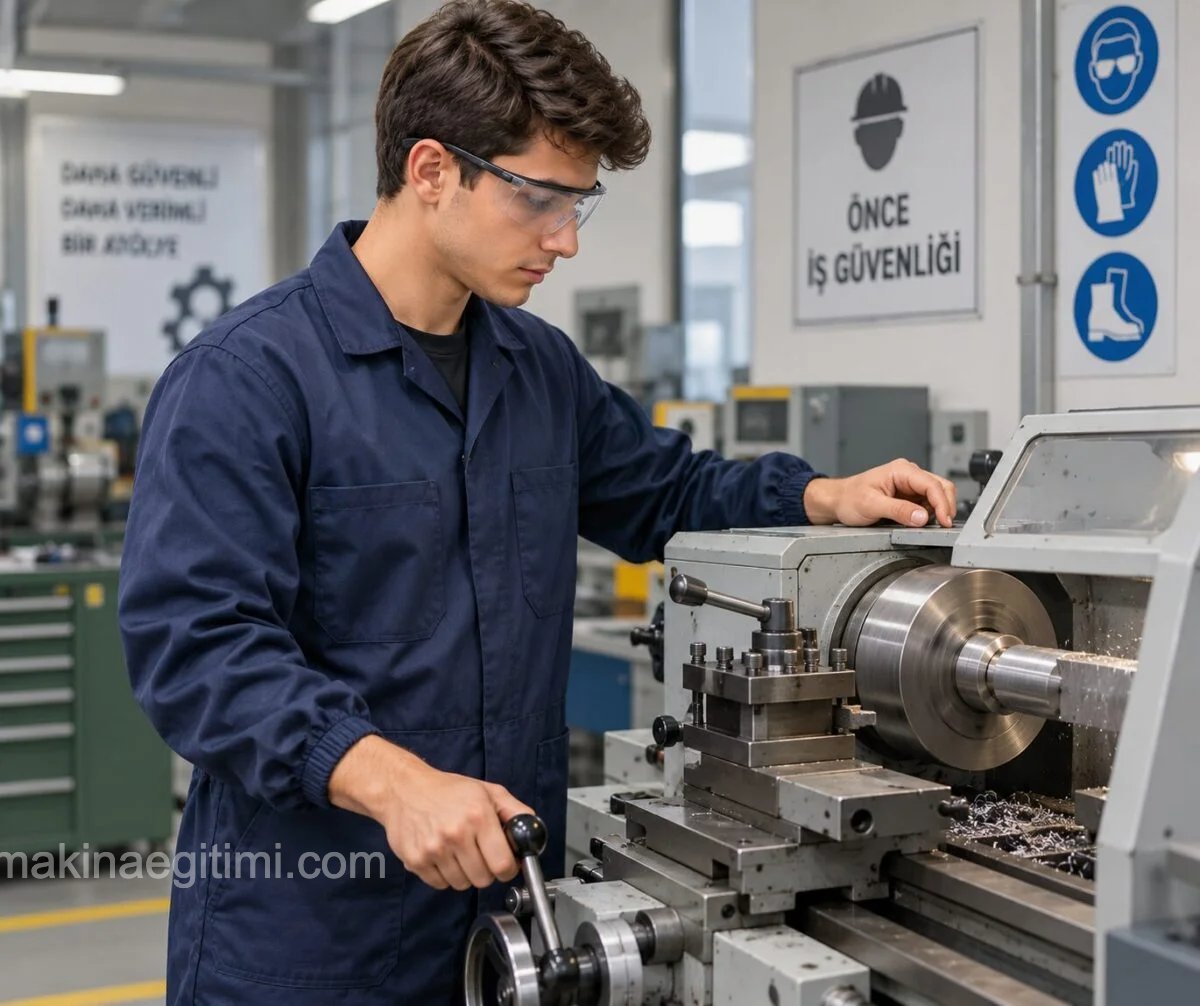
safety clothing at the lathe: a student wearing a workshop coat

Wear suitable work clothing

What you wear at the lathe is a factor that directly affects your safety.

Apron and coveralls: The safest clothing for this work is an apron or a set of coveralls. The sleeves of your work clothing should be closed at the wrist or rolled up.

Cuffs and ties: Cuffs and ties should be avoided on work clothing, because they can be caught by the rotating parts of the machine.

Hair, watches, rings and the like: Keeping hair short and taking off items such as watches and rings is good practice for safety.

The risks of torn and loose clothing: Torn or loose sections are easily caught by the machine’s moving parts and put the operator in serious danger.

Are gloves used on a lathe? If the job involves handling sharp or pointed edges, gloves may be worn. However, they must be taken off before the machine is started.

Why safety glasses matter on a lathe: Always wear safety glasses or a face shield against flying swarf and oil droplets. Bearing in mind that this swarf is often very hot, protecting your eyes is vitally important.

Clamping the Work Securely and Centrifugal Force

The following points deserve attention when it comes to clamping the work and choosing the spindle speed:

  • Bear in mind that a very long workpiece overhanging the back of the spindle can whip around and create a hazard.
  • When the work is supported with a centre, the centre must seat fully in its socket.
  • The chuck jaws must grip the work evenly and fully. The chuck key must never be left in the chuck.
  • Remember that as the spindle speed rises, so does the centrifugal force trying to throw the work out of the chuck.

Leaving the chuck key in the chuck is one of the most common and most dangerous mistakes made on lathes. The moment the machine is started, the key is flung out at high speed and can cause serious injury.

Changing the Spindle Speed on a Lathe

If the speed of the lathe chuck has to be set or changed, this must never be done while the machine is running. While the speed is being set, the chuck is turned slowly by hand to check whether the gears have engaged properly. Once you are sure, the lathe can be started.
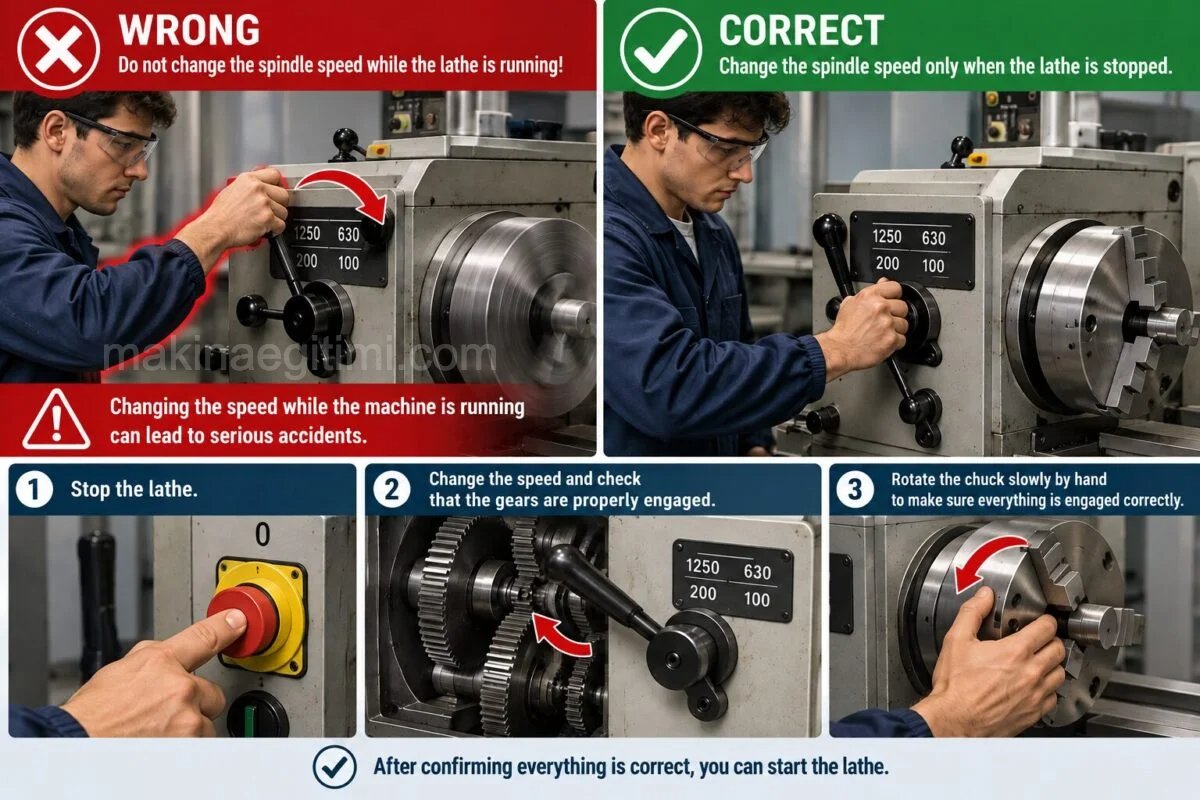
lathe working safety

Removing Chips from the Machine

Chips caught between the work and the tool are removed with a hand hook. Chips should be cleared as follows: long spiral chips are pulled clear with a hook and never held by hand, while splintered chips are swept up with a brush.

These jobs should only be done once the machine has come to a stop, and never by hand.

Measuring and Checking Operations

All adjustment, calibration and measuring work should be done after the machine has stopped.

Why grounding the lathe matters, and how to prevent electrical accidents

Grounding is carried out in advance so that leakage in the machine’s body cannot give anyone an electric shock. When the machine’s electrical equipment is sound and of good quality, faults such as short circuits, switch failures, earth leakage and motor burnout become far less likely.

Why an orderly lathe is a safer lathe

The tools and accessories you use while turning should be kept in a set order. Tools you have finished with should be returned to their place. Working in an orderly way at the lathe also heads off the accidents that clutter causes.

an orderly lathe workstation with measuring tools laid out

Related Videos

Lathe: An Introduction to Safety and Terms
Lathe: An Introduction to Safety and Terms

Basic safety tips when using a manual lathe

Basic safety tips when using a manual lathe

Lathe Safety
Lathe Safety

Lathe Fundamentals 101 Lathe Safety

Lathe Fundamentals 101 Lathe Safety

Related Questions

Although the guard catches most flying chips, it may not give full protection from every angle. Safety glasses add a second layer of protection against the small particles the guard misses.

That pedal is designed for a sudden, hard stop; if it is used continuously the mechanism wears out and may not deliver the performance you expect in a real emergency. Using the regular foot brake for routine stops preserves the service life of this pedal.

Do not forget that a long workpiece overhanging the back of the spindle can whip around and become dangerous. Work of this kind should be supported with a steady rest, or run at a lower spindle speed.

As a general rule gloves should not be worn while the machine is running, because they carry the risk of being caught by rotating parts. If gloves are being used to handle sharp or pointed workpieces, they must be taken off before the machine is started.


Related Posts

5S Management in Workshops and Factories 5S Management in Workshops and Factories Workplace Safety in Welding Work Occupational Health and Safety in Welding Work hydraulic pneumatic machine safety rules Safety Rules for Workers on Hydraulic and Pneumatic Machines Workplace Safety with Hand Tools Workplace Safety and Misuse of Hand Tools Safe Forklift Use Safe Forklift Use. Forklift Safety Rules Set of personal protective equipment including helmet, gloves, and safety shoes What Is Personal Protective Equipment (PPE)? What Are Its Types? Elektrik İç Tesislerinde Güvenlik Safety in Electrical Interior Installations Occupational Safety on Press Machines Occupational Safety on Press Machines

Machine Safety Rules Basic Turning Operations
Share. Facebook Twitter WhatsApp Tumblr Email Telegram Copy Link

Leave A Reply Cancel Reply

What Does the Noise from the Valves Mean?
How Hydraulic Brakes Work
  • Contact
  • Terms of Service
  • Privacy & Cookie Policy

Type above and press Enter to search. Press Esc to cancel.