
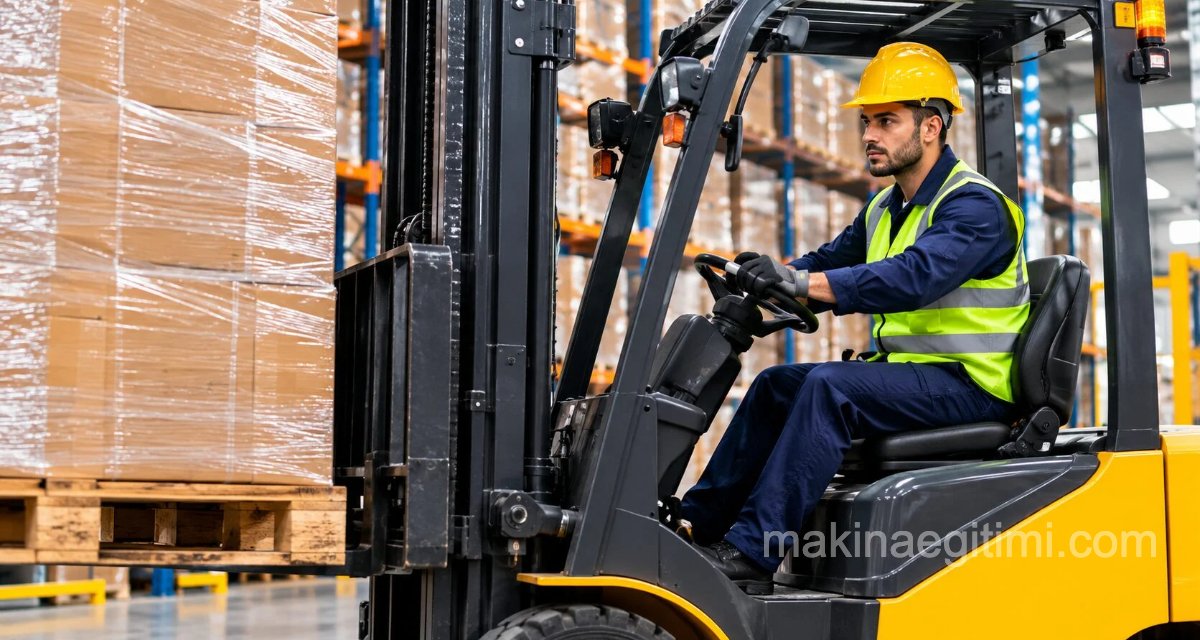
In our motor vehicles section, this article’s topic will be forklift safety rules and the fundamentals of safe forklift use. In this article, where we cover the fundamentals of workplace safety with forklifts, we’ve tried to explain forklift workplace safety in detail with illustrated examples.
Forklift Safety Rules
Perhaps the most fundamental forklift safety rule is that a forklift must not be operated by people who have not received training and certification in this area.
A forklift must only be left in areas designated as parking areas. When parked, the forks must be fully lowered, all levers set to neutral, the parking brake applied, and the engine turned off. When the forklift is not in use, the engine must be shut off, the key removed from the vehicle, and wheel chocks placed in front of and behind the tires. Daily vehicle maintenance checks must not be neglected.

The engine must be turned off while refueling a forklift. Smoking and having flammable materials present at the refueling site must be strictly forbidden during refueling. This also applies when swapping an LPG tank. Before restarting the engine, the fuel tank cap must be closed and any spilled fuel must be cleaned up.
Forklift safety rules include some important rules regarding the use of the forklift. Let’s take a look at those as well.
Safe Forklift Use
Appropriate conditions for safe forklift use
For safe forklift use, workplace safety rules must be followed. The forklift operator must wear a hard hat and safety shoes, and should prefer a one-piece coverall as work clothing.
A forklift must not be used in areas unsuitable for safe forklift operation. A forklift must not be operated without the operator seated in the operator’s seat. Arms, legs, and head must not be extended outside the operator’s cabin.
A forklift must not be operated with wet hands or wet shoes. If operated with wet hands or shoes, you can lose control of the forklift and cause an accident.
A forklift must not be used on loose or slippery ground, or on sandy, gravelly, icy, or muddy surfaces. If use is unavoidable, it must be operated slowly.
A forklift must never be used without an operator overhead guard and a load backrest.
Speed and maneuver control for forklift workplace safety
Sudden maneuvers at high speed with the forklift must be avoided, and sudden stops and starts must not be performed. Such movements can cause the vehicle to tip over. Sound the horn as a warning at turns, at building entrances and exits, and near people. Speed should be kept low.
If you feel the forklift is about to tip over, do not try to jump out. To survive, stay seated and hold on tightly.

Always drive forward when going up ramps, and drive in reverse when going down. Never lift a load while on an inclined surface. Do not maneuver on inclined surfaces. When going up or down a ramp, especially while carrying large loads, have a spotter guide you from outside the vehicle.

Loading and unloading must not be performed on a slope. Turning on a slope must not be done, and the forklift must not be operated parallel to the slope.

Considering that forklifts are used in work environments, you should think as though a worker could appear in front of you at any moment. Nobody being behind you 3 seconds ago doesn’t mean nobody will be there 3 seconds from now. The operator must remain alert at all times for forklift workplace safety.

If the load obstructs your view, driving the forklift forward will be problematic. For forklift workplace safety, if you’re not going uphill, driving the vehicle in reverse in such situations will improve your visibility.

One of the forklift workplace safety rules is that if loading will be done onto another vehicle, wheel chocks must be placed on that vehicle’s wheels to prevent it from moving.

Do not use your forklift to tow or push another forklift. Do not allow other forklifts to push or tow your vehicle either. If your forklift isn’t working, notify service.
Load control for forklift workplace safety

Workplace safety rules for forklift operation also include load control. Do not overload. A heavy load can cause the forklift to tip over. Excessive stacking or raising the load will also obstruct visibility. A forklift must not be operated with the load raised or the mast tilted up.

For forklift workplace safety, do not carry anyone on the forklift’s forks. You could cause accidents you couldn’t have anticipated. Safe forklift use depends on the rules not being neglected.
The load must be carried with the mast tilted back. Do not raise a loaded forklift while the mast is tilted forward, and do not tilt the mast forward while the load is raised. Doing so can cause the forklift to tip forward.

Do not move the forklift if the load is higher than the load backrest. Be careful of the possibility of the load falling during loading. Carry the load with the forks lowered as much as possible and the mast tilted back. This will help stabilize the forklift and give you better visibility.
Unbalanced loads must not be carried for forklift workplace safety. If this is unavoidable, loading must be done by balancing the load’s center of gravity. Pallets used must be of an appropriate size. The load must be distributed equally across both forks, and carrying with only one fork must not be done.
Environmental conditions for safe forklift use

For forklift workplace safety, do not let anyone walk under or stand under the forklift’s load or lifting mechanism. The load could fall, causing injuries or death.

Extreme caution must be exercised when operating a forklift near dock and ramp edges. In particular, a safety distance must be kept between the forklift and the edges of docks, ramps, and platforms. A small lapse in attention can lead to accidents, injuries, and deaths.
A forklift must not be operated within another forklift’s work area. A safe working distance must be maintained between you and other forklifts.
In this article, we covered forklift workplace safety and forklift safety rules. Until we meet again in new articles.
Related Posts
 What Is a Forklift. What Are the Types of Forklifts
 Definitions Related to Traffic, Highways, and Vehicles
 Steering Wheel Grip and Turning Techniques
 How to Drive a Manual Transmission Car
 Why Is It Dangerous to Rest Your Feet on the Dashboard?
 Vehicle Dashboard Panel Symbols and Their Meanings
 5 Tips for Fuel Economy
 Traffic Regulatory Signs and Their Meanings. Restriction and Command Signs