

The potential for personal injury in the hands of a punch press, an injection molding press, or a forging press is extreme. Presses can range from 5 to 100,000 tons or more, and even a 5-ton press can crush skin and bone like butter. Additionally, a punch press, for example, can operate at high speeds, leaving operators no time to move their hands or bodies if a cycle is accidentally initiated. Because of the hazardous nature of the hydraulic press, various government or regulatory bodies have detailed press safety requirements to ensure the prevention of press-related injuries in automotive and other manufacturing environments.
For example, it’s common practice to use a light curtain to signal the machine to shut down when a hand reaches into a forging press, but even after an e-stop is triggered, it’s harder to make sure the machine is safe. To be safe, the press must not only stop the load or platen from falling, but must also prevent the press from accidentally restarting while the machine is in safe mode.
Two-Hand Control Device
This is a safety measure especially preferred on press machines. It’s also used on some machine tools (for example, a surface grinder) to prevent the cutting tool from crashing into the table due to operator inattention.
Two buttons are provided for the press to operate. It won’t run unless both are pressed at the same time. These buttons are not placed next to each other, so that the operator is forced to use both hands to press them, ensuring both hands are safe.
Presence Sensing Device Initiation (PSDI) Technology. Photoelectric and Laser Sensors
Thanks to the PSDI (Presence Sensing Device Initiation) function, it’s possible to control the press cycle as a flexible, soft safety control using a type-4 safety light curtain in PSDI mode. As soon as the worker withdraws their hand from the danger point, the press automatically restarts. This not only eliminates the need for two-hand control devices, but also offers clear benefits in providing workers with ergonomic, safe workstations and allows for greater use of machine capacity.
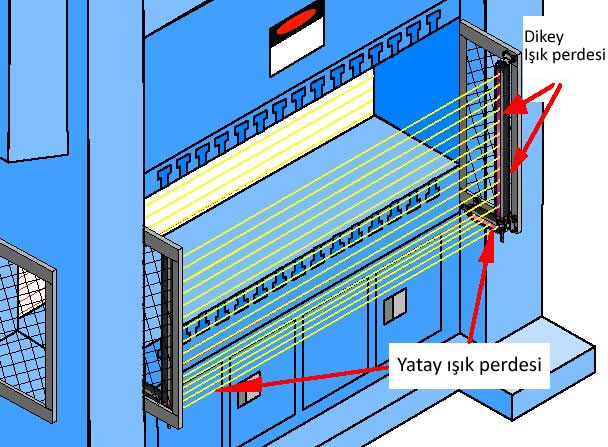
Presence sensing devices include guards such as radio-frequency field sensors and laser scanners. However, by far the most common presence sensing devices are photoelectric transmitter/receiver pairs, more commonly known as “light curtains.”
When using a traditional two-hand control device, workers need to operate two control elements simultaneously with both hands to trigger motion. The circuit must remain active until the press cycle — and therefore the hazardous motion — is complete. Only then can the worker pick up the next workpiece. This procedure can have a negative impact on workstation ergonomics and, as a result, can lead to more errors and a drop in productivity. There’s also a risk of accident if a worker accidentally comes into contact with the circuit.
Since both of the workers’ hands are free, they can pick up the next workpiece as soon as they place the first one into the press. There’s no need for the press cycle — or the hazardous motion — to be fully completed. For this reason, although simple, the PSDI function represents a step that allows for much greater use of machine capacity and, as a result, a significant increase in efficiency.
Two-Hand Control Logic
The two-hand control device requires the operator to keep both hands on the control buttons, preventing hands from being in the danger zone.
Photoelectric Sensing Range
Light curtain (photoelectric) systems detect an object entering the danger zone within milliseconds and stop the press.
Emergency Stop Button
Easily accessible emergency stop buttons on press machines must be able to stop the machine instantly in a potential emergency.
Points to Consider for Occupational Safety on Press Machines
1. Adjustment, maintenance, and repair work on presses should only be done by authorized personnel, with all energy connections disconnected.
2. When pressing small parts, these parts should be held with special clamps, pliers, or tongs and fed into the machine.
3. Before mounting a die on mechanical presses, the motor must be stopped; on hydraulic and pneumatic presses, the pressure connection must be disconnected, and sufficiently sturdy blocks should also be placed between the press head and the table.
4. Presses should be operated within their normal capacity and in accordance with their specifications.
5. The guards protecting the work point, the two-hand control device, and the photoelectric device (if present) must not be tampered with or disabled.
6. Double-strike from any cause must be prevented on presses, and the necessary corrections should be made in this regard.
7. There should be enough clearance around the operator at the machine for them to work comfortably.
8. All guards required for the work being done must be in place and in working order.

9. No one other than maintenance and repair personnel should be allowed to interfere with the clutch, brake pedal, or starting mechanism.
10. The press should be stopped whenever lubrication, adjustment, or repair is being performed, or in situations requiring the operator to step away from the machine.
11. After stopping the machine and stepping away, and returning to work, it should be checked again to confirm it’s operating safely.
12. Events that could distract the machine operator should be prevented.
13. The press should not be operated by an unqualified person.
Occupational Safety on Press Machines Video
Documents on Occupational Safety on Press Machines
Related Questions
This system requires the operator to press both specific buttons at the same time for the press to operate. This physically makes it impossible for the operator’s hand to be in the die area, preventing serious hand injuries.
The machine stopping doesn’t mean it won’t accidentally restart; a fault or incorrect intervention could reactivate the system. This is why an additional mechanism is needed to prevent the press from restarting on its own or by mistake while safe mode is active.
Related Posts
 Safety Rules for Working on a Lathe
  Safety Rules for Workers on Hydraulic and Pneumatic Machines
  Safety in Electrical Interior Installations
  5S Management in Workshops and Factories
  Occupational Health and Safety in Welding Work
  Occupational Safety When Working With Electricity
  Workplace Safety and Misuse of Hand Tools
  Safe Forklift Use. Forklift Safety Rules