
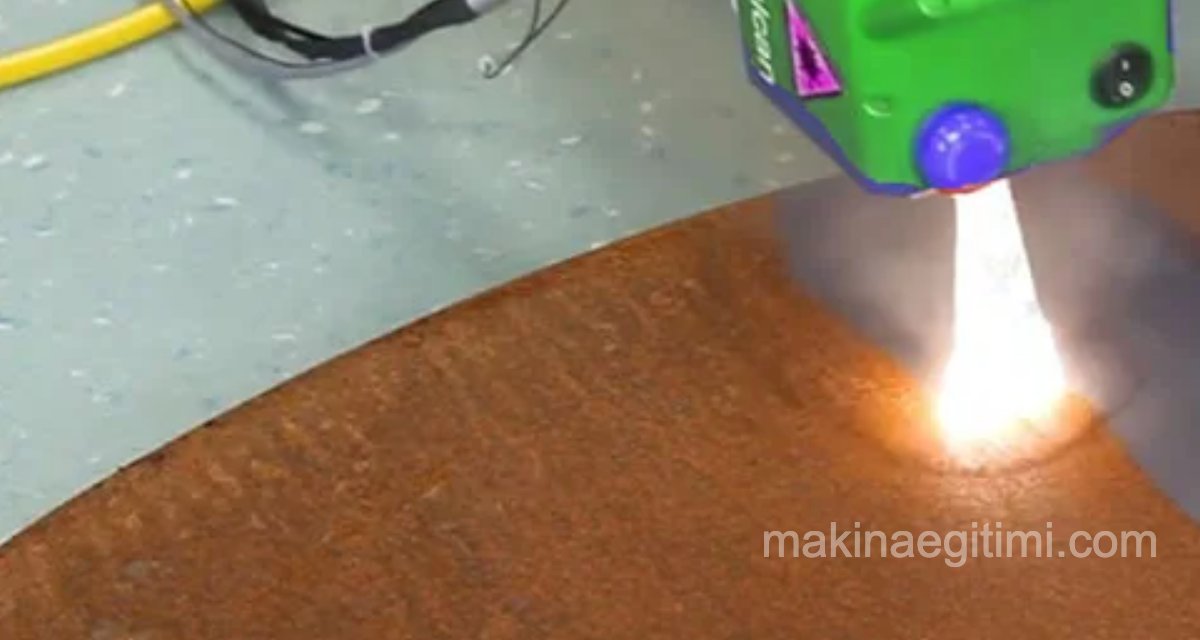
Known scientifically in academic circles as laser ablation, laser cleaning is the process of removing/dissolving microscopic particles from solid (or sometimes liquid) surfaces using a laser beam.
At high laser fluence, materials are generally converted into plasma. In general, laser ablation refers to removing materials with a pulsed laser, but if the laser intensity is high enough, materials can also be removed with a continuous-wave laser beam.

Laser cleaning doesn’t abrade, doesn’t make contact, has no thermal effect, and is suitable for all kinds of objects. It’s considered the most reliable and effective solution.
Laser cleaning can also solve problems that traditional cleaning methods can’t. In addition, because the laser cleans the workpiece without contact, it’s very safe for cleaning sensitive workpieces or thin parts. For this reason, laser cleaning has unique advantages in the cleaning industry.
Laser Cleaning Principle
The bonding force between contaminants and the substrate can be categorized as covalent bonds, dipole-dipole interactions, capillary action, and Van der Waals forces. If this bonding force can be overcome or eliminated, a decontamination (removal) effect will be achieved.
When contaminants absorb laser energy, the bond between the contaminant and the substrate surface breaks after rapid vaporization or instantaneous thermal expansion. Due to the increase in heating energy, the contaminant particles vibrate and fall away from the substrate surface.
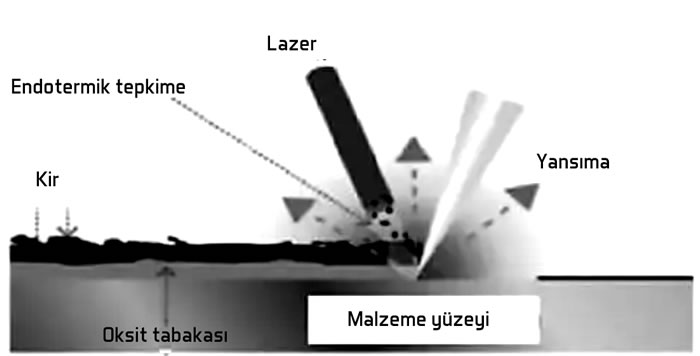
Laser cleaning works as follows: using the properties of the laser beam, which has controllable direction and strong focusing ability, a large energy density is applied to the material either to destroy the bonding force between contaminants and the substrate, or to directly vaporize the contaminants. This way, the material is cleaned.
Contact-Free Cleaning
Since laser cleaning works without physical contact with the surface, the risk of damaging the material is very low.
No Chemicals Used
Laser cleaning offers an environmentally friendly alternative to traditional chemical or sandblasting methods.
Selective Cleaning Power
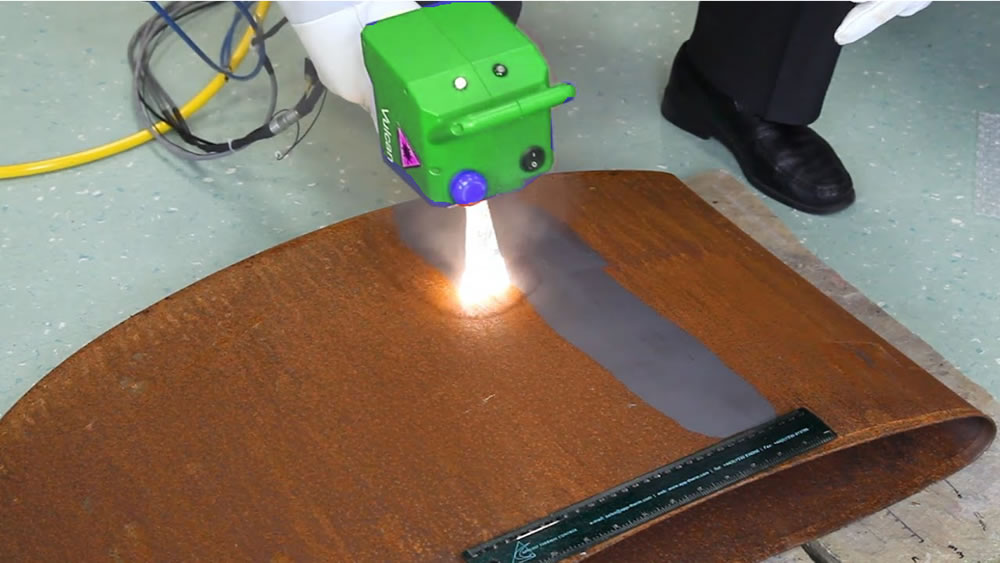
By adjusting the laser power, only the dirt/rust layer is removed, while the underlying base material is preserved.
Applications of Laser Cleaning
Laser cleaning can be used not only to clean organic contaminants, but also to clean inorganic substances, including metal corrosion, metal particles, dust, etc. Some practical applications are introduced below.
Mold Cleaning
Traditional cleaning methods include sandblasting, ultrasonic, or carbon dioxide cleaning, but these methods usually require the hot mold to be cooled for several hours before being transported to cleaning equipment. Cleaning takes a long time and can easily damage the mold’s precision.
The laser cleaning method is convenient to use, since the light can be directed into the mold’s dead corners or parts that aren’t easily reachable with other cleaning methods, and can be coupled through fiber optics.
Although the initial investment cost is high, it’s superior in terms of saving downtime, preventing mold damage, working safety, and raw material savings.

According to a cleaning test of laser cleaning equipment on a tire company’s production line, it can clean a series of large truck tire molds online in just 2 hours.
Cleaning Weapons and Equipment:
Laser cleaning technology is widely used in weapon maintenance. When laser cleaning is used, not only is cleanliness higher than with chemical cleaning, but there’s also almost no damage to the object’s surface.
By adjusting different parameters, a dense protective oxide film or metal-melted layer can also be formed on the surface of metal objects to improve surface strength and corrosion resistance.
Removing Old Aircraft Paint
Laser cleaning systems have long been used in the aviation industry in Europe. An aircraft’s surface needs to be repainted after a certain period, but before repainting, the original old paint needs to be completely removed.
The traditional mechanical paint removal method can damage the aircraft’s metal surface. If multiple laser cleaning systems are used, the paint layer on the surface of an Airbus A320 can be completely removed within two days without damaging the metal surface.
Building Exterior Wall Cleaning:
The laser cleaning system offers a good solution for cleaning building exterior walls, especially in tall skyscrapers, via fiber optics up to 70 meters long. It can effectively clean all kinds of contaminants on any type of stone, metal, and glass. Cleaning efficiency is much higher than traditional cleaning.
It can also remove black spots and colored stains on various stone materials on buildings.
Cleaning in the Electronics Industry
The electronics industry uses lasers to remove oxides: the electronics industry needs a high-precision separator that is especially suitable for the laser to remove oxides.
Before soldering a circuit board, the oxide on the component pins must be removed to ensure the best electrical conduction, and the pins must not be damaged during the decontamination process.
Precision Degreasing Cleaning in the Precision Machinery Industry
In the precision machinery industry, the esters and mineral oils used on parts for lubrication and corrosion resistance generally need to be removed using chemical methods, and chemical cleaning usually leaves residues.
Laser ester removal can completely remove esters and mineral oil without damaging the surface of the parts. Contaminant removal is accomplished by a shock wave.
Pipeline Cleaning in Nuclear Power Plant Reactors:
The laser cleaning system is also used to clean pipes in a nuclear power plant’s reactor. Fiber optics are used to deliver a high-power laser beam into the reactor to directly remove radioactive dust. Personnel safety can also be ensured thanks to remote operation.
To summarize, laser cleaning plays an important role in many fields, and can play a significant role in automobile manufacturing, semiconductor wafer cleaning, precision part machining and manufacturing, military equipment cleaning, building exterior wall cleaning, preservation of cultural relics, and circuit board cleaning.
Related Questions
The laser works without touching the surface and without using any abrasive substance, so the risk of damaging the material itself is very low. This makes it especially safe for cleaning thin or delicate parts.
The laser beam weakens the bond between the contaminant and the surface, causing it to break. At a sufficiently high intensity, the contaminant particles evaporate or break into small pieces that separate from the surface.
Related Posts
 Professional 3D Scanners and Their Applications
  What Is Electrical Discharge Machining (EDM). Machining with EDM
  Properties of Laser and Laser Devices Used in Medicine
  The Best Free CAD Software for 3D Print Design
  3D-Print-Ready Cat & Mouse Automaton Toy
  Applications of Lasers
  Advantages and Disadvantages of EDM