

Laser
(Laser: Light Amplification by Stimulated Emission of Radiation) means light amplification by stimulated emission of radiation.
This is a term used for devices that can produce light at a specific wavelength and direction, with especially high energy and very high brightness, within an optical system. We know this sounds complicated. You can find a simplified explanation further down in this article, in the section titled How Are Laser Beams Produced?
What Are the Properties of Laser Beams?
- It Produces Monochromatic, Ordered Light
Laser light has only a single wavelength (a single color). In addition, all the waves that make up the light move in the same direction and in phase with one another. This is why laser light is highly ordered. - It Travels in a Straight Line
Laser light doesn’t scatter in every direction like ordinary bulb light. It travels in an almost parallel manner. This allows it to largely retain its direction even over long distances. - It Is a Very Bright Light
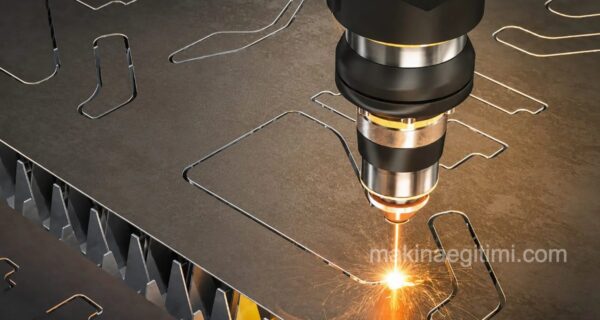
Laser light appears very bright because it concentrates its energy into a small area. This high brightness allows the laser to be used in processes such as cutting and welding. - Its Energy Is Very Concentrated
A laser beam can be focused onto a very small point. This way, it creates very high energy in a small area. This property allows it to cut metal, drill holes, or weld. - Its Waves Move in Harmony with Each Other
All the light waves that make up laser light move at the same time and in the same order. This property is called coherence. This makes laser light very stable and powerful. - It Spreads Very Little
As laser light travels, it spreads at a very small angle. This is why the beam can remain thin and powerful even when it reaches long distances. Ordinary light, on the other hand, spreads over a wide area even at short distances. - It Can Be Controlled (Modulated)
The intensity, duration, and operating mode of laser light can be easily controlled. This property allows it to be safely used in fiber-optic internet, barcode readers, laser printers, and communication systems.
What Are the Differences Between Laser and Ordinary Light?
- Laser light consists of a single wavelength. This is why its color is extremely pure. Ordinary light, on the other hand, contains many different wavelengths simultaneously, from red to violet.
- A laser beam travels almost parallel and spreads very little. This allows it to largely retain its direction even over long distances. Ordinary light, since it spreads in every direction, disperses over a wide area even at short distances.
- All the light waves that make up laser light move in the same phase. This property is called coherence. In ordinary light, the waves are independent of each other and move in different phases.
- Since laser light can be concentrated into a very small area, the amount of energy per unit area is quite high. This is why it can perform processes such as cutting, welding, and drilling metal. In ordinary light, since the energy is spread over a wide area, the energy density is low.
- A laser beam can be focused, with the help of lenses, onto a point as small as a few micrometers. This property provides a major advantage in applications requiring high precision. Ordinary light cannot be focused to the same degree.
- Laser light can be produced to vibrate in a specific plane. This property provides an important advantage in optical measurement systems, communications, and scientific experiments. Ordinary light, on the other hand, generally vibrates in different planes.
- The brightness of laser light is much higher than that of ordinary light. Compared to a light source of the same power, a laser beam appears much brighter because it concentrates its energy into a narrow area.
- Since a laser beam scatters very little, it can largely retain its effectiveness even when it reaches distances of kilometers. This is why it’s preferred in distance measurement, targeting, and optical communication systems. Ordinary light, on the other hand, weakens rapidly as distance increases.
- Since a laser beam can be applied to very small areas, cutting, drilling, marking, and welding can be performed at the micron level. Ordinary light cannot provide this level of precision.
- Laser light is used in many fields, such as metal cutting, welding, marking, medicine, optical communications, the defense industry, measurement systems, and scientific research. Ordinary light, on the other hand, is mostly used for lighting and imaging purposes.

Monochromatic Light
A laser beam is emitted at a single wavelength; this property increases the beam’s focusability and precision.
Coherence Property
Laser photons move in the same phase and direction (coherence), which allows the beam to travel long distances without scattering.
Industrial Cutting Power
Industrial CO2 or fiber laser cutting systems operate at power levels ranging from 1-12 kW, depending on the material.
What Are the Types of Lasers?
The types of lasers are as follows:
- Solid-State Lasers – Use solid media such as crystal or glass.
- Gas Lasers – Use gas mixtures as the active medium (CO₂, He-Ne, etc.).
- Fiber Lasers – Use doped optical fiber as the active medium.
- Semiconductor (Diode) Lasers – Produce light using semiconductor materials.
- Liquid (Dye) Lasers – Use special liquid dyes as the active medium.
- Chemical Lasers – Operate using energy obtained from chemical reactions.
- Excimer Lasers – Produce ultraviolet (UV) beams using mixtures of noble gases and halogen gases.
- Free-Electron Lasers (FEL) – Produce a laser beam using accelerated electron beams.
Looking at this from a metal-cutting perspective, the lasers used in industry are the following:
- CO₂ Laser (Gas laser) → Used especially on non-metal materials and thin sheet metal.
- Fiber Laser → Today, this is the most commonly used laser type for cutting metal.
- Nd:YAG Laser (Solid-state laser) → Used in welding, marking, and some specialty cutting operations.
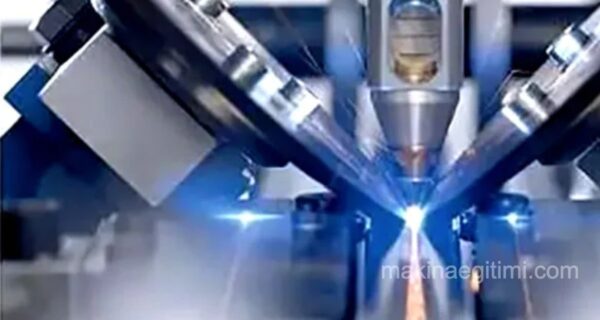
- Diode Laser → Mostly used in welding and marking applications.
How Much Electricity Does a Laser Use?
The electricity consumption of laser devices can vary depending on the device’s type, size, power, and intended use. For example, a diode laser device may consume just a few watts of electricity when operating at very low power, but can consume several hundred watts when operating at high power. A gas laser device, on the other hand, can consume thousands of watts when operating at much higher power. Plasma laser devices, being generally the highest-energy laser devices, can consume hundreds of thousands of watts of electricity.
How Are Laser Beams Produced?

A laser consists of a lasing medium — for example, a gas — an energy source, and two mirrors, one of which is partially transmissive. The steps involved in producing laser beams are as follows:
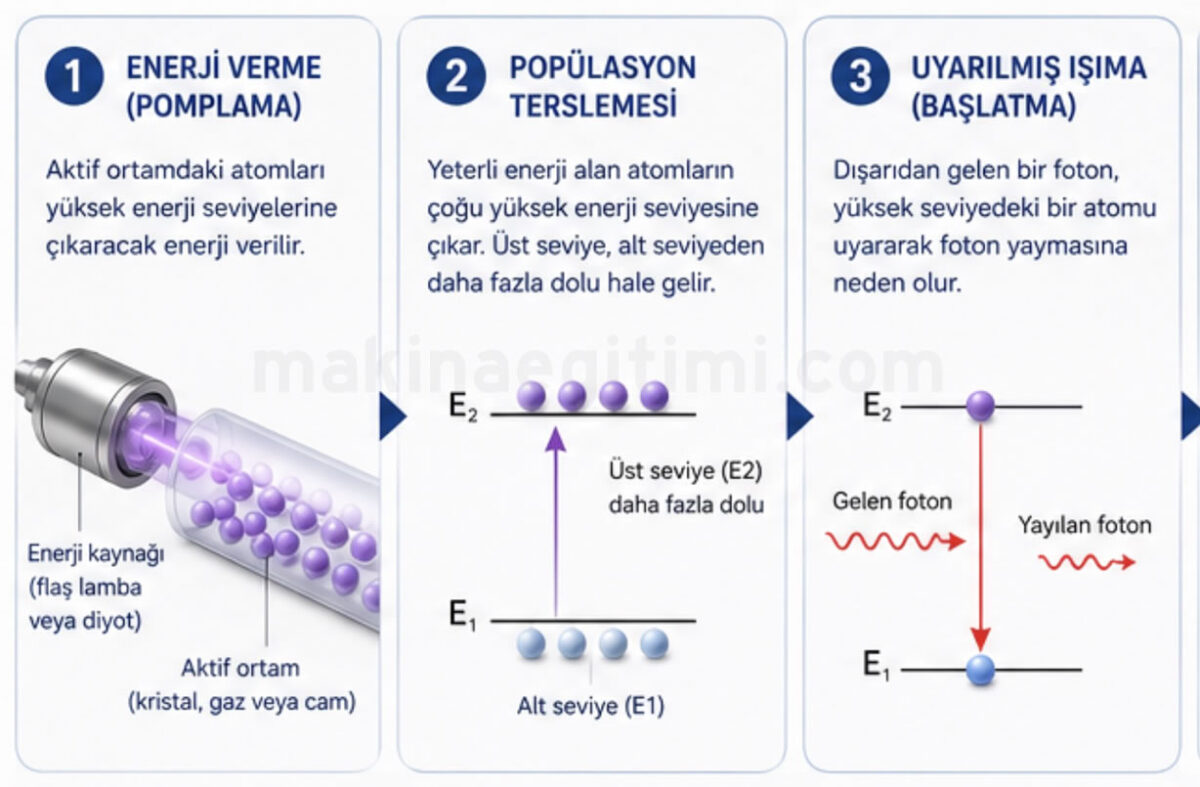
1. Energizing (Pumping)
In the first stage of laser production, external energy is supplied to the active medium (crystal, gas, liquid, or semiconductor). This energy is provided by an electric current, a flash lamp, or laser diodes. The goal is to raise the atoms from their normal energy levels to higher energy levels.
2. Population Inversion
Most of the energized atoms transition to the upper energy level. As a result, the number of atoms in the upper energy level becomes greater than the number of atoms in the lower level. This situation is called population inversion and is the fundamental condition required for laser formation.
3. Stimulated Emission Begins
A photon passing through the medium collides with an atom in the high energy level. The atom releases its energy, emitting a second photon. This newly formed photon has the same wavelength, the same phase, and the same direction as the first photon.
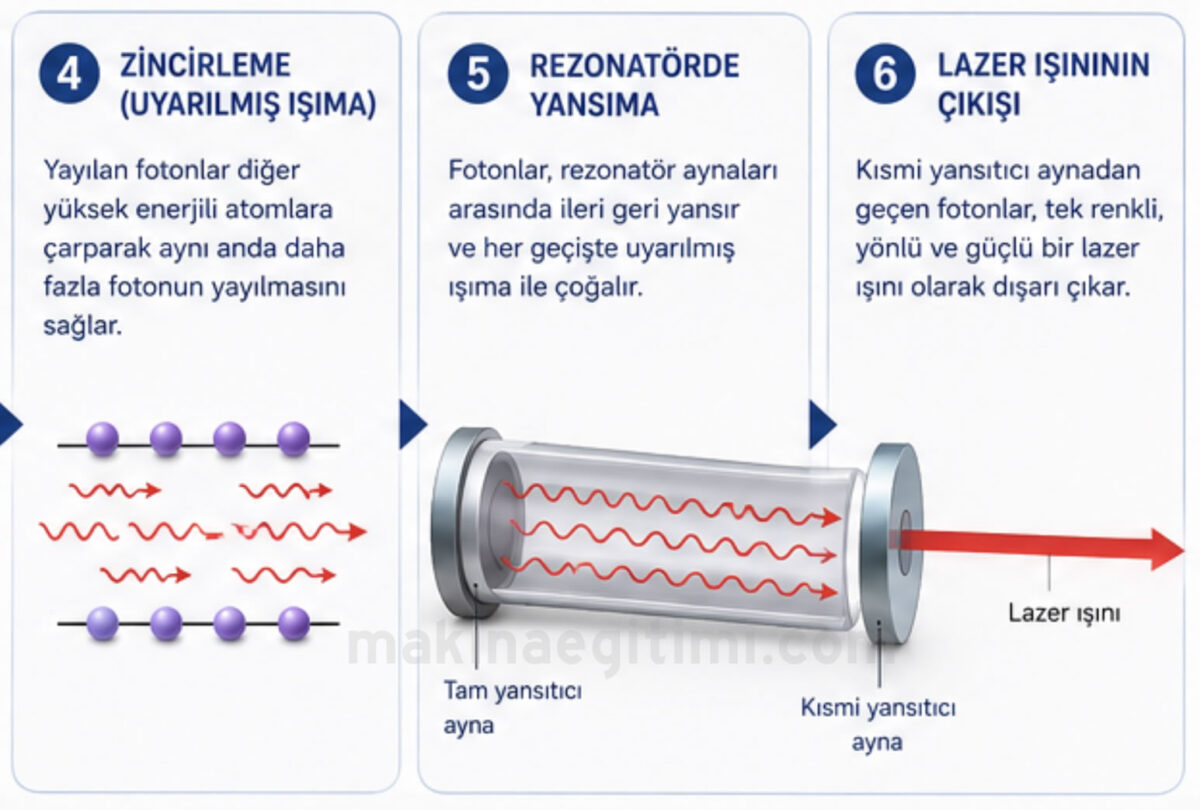
4. Chain Stimulated Emission
The newly formed photons also interact with other excited atoms, causing more photons to form. As a result of this chain reaction, the light intensity rapidly increases and the laser beam gains power.
5. Reflection in the Resonator
The photons continuously bounce back and forth between the mirrors at the two ends of the laser tube. During these reflections, stimulated emission continues, and the light gradually becomes more powerful. This process inside the resonator causes the laser beam to become stable and concentrated.
6. Laser Beam Output
Some of the light exits through the semi-transparent mirror at one end of the resonator. This emitted light is a monochromatic, directional, coherent, and high-energy laser beam. This beam is used in many fields, such as cutting, welding, drilling, measurement, communications, and medical applications.
Various materials can be used as a laser source. These include laser diodes, gas lasers, liquid lasers, crystal lasers, or plasma lasers. Each has a different operating principle.
Related Questions
While ordinary light spreads in every direction, a laser concentrates its energy into a very small point. Since the same energy is gathered into a narrower area, the brightness is perceived as much higher.
Because laser light has both very concentrated energy and can be focused onto a small point, it can quickly heat and melt material. This makes precise cutting and welding operations possible.
Related Posts
 What Is Wire EDM, How Does It Work?
  Laser or Waterjet, Which Is Better?
  What Is 3D Printing – How Do 3D Printers Work?
  Industrial 3D Scanners
  Professional 3D Scanners and Their Applications
  Laser Cutting Working Principle, Advantages and Disadvantages
  Laser Welding, Its Properties and Working Principle
  Advantages and Disadvantages of 3D Printers