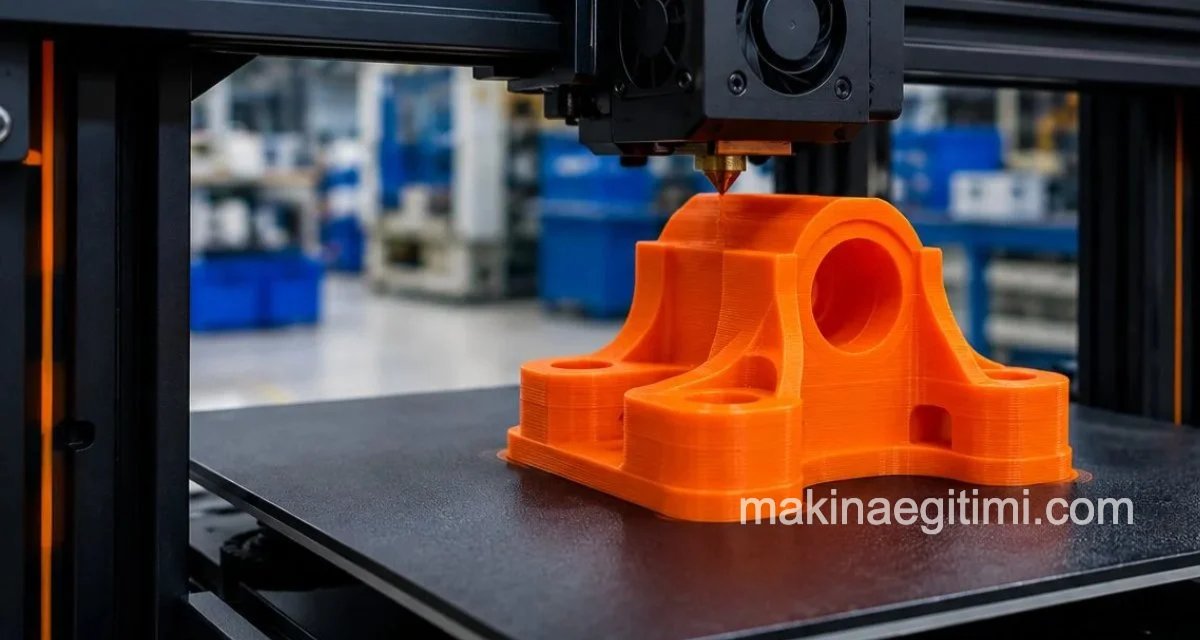
When selecting material for 3D printing, it’s important to consider mechanical properties, surface quality, manufacturability characteristics, and cost. A wide variety of materials can be used in 3D printing, each best suited to specific printing methods.
3D Printing Materials
| Plastics | Metals | Resins |
|---|---|---|
| PLA | Aluminum | Standard |
| ABS | Titanium | High strength |
| Nylon | Stainless steel | Transparent |
| POM | Brass | Tough |
| Flexible TPU | Bronze | Rubber-like |
| PET-G | Inconel 625 | Flexible |
Plastics
Plastics are the most commonly used materials in 3D printing due to their low cost, durability, versatility, and ease of production. They’re most commonly available as a filament used in FDM, though they come in other forms as well. This combination of material type and manufacturing method is often used for prototyping due to its low cost. Plastics are also available in powder form for SLS, which is more suitable for end-use products since it offers better accuracy and part detail. The other two additive manufacturing methods that use plastics are material jetting and binder jetting. The most commonly used plastics are listed below:
ABS
Acrylonitrile Butadiene Styrene (ABS) in filament form is the most commonly used plastic in 3D printing. It also comes in powder form for SLS and liquid form for SLA. The material has high tensile strength, with excellent resistance to physical impact and chemical corrosion. It has a nice glossy surface and is used across a wide range of industries. Its downsides are that it’s not biodegradable and it tends to warp when printed without careful consideration.
✅ High strength
✅ Resistant to chemical corrosion
❌ Not suitable for high-temperature environments
❌ Poor fatigue resistance
Nylon
Nylon is available in filament and powder form; the latter is more popular with SLS. The material has excellent mechanical strength and wear performance despite being lightweight, making it a great choice for moving parts such as gears and bearings. It has good resistance to most chemicals. However, it has a high moisture absorption rate, which affects dimensional stability over time.
✅ Good strength-to-weight ratio
✅ Excellent wear performance
❌ Poor UV resistance
❌ Heat sensitive
PLA
Polylactic acid (PLA) is used with FDM and is becoming very popular for rapid prototyping thanks to an incredible advantage: it’s biodegradable! Most plastics are made from synthetic compounds (petrochemicals); however, PLA is made from organic sources like corn starch. It’s easy to print and comes in a wide range of colors. Its downsides are low mechanical strength and part detail.
✅ Biodegradable, unlike most 3D printing materials
✅ Wide range of colors available
❌ Not suitable for highly detailed parts.
❌ Poor mechanical properties
Metals
3D-printed metals hold a unique position in manufacturing, as they combine the design flexibility of 3D printing with the mechanical properties of metal. They’re used for fully functional prototypes intended for end-use products. In metal, SLS is often the most suitable choice when a design is complex, since it can simplify the manufacturing process and reduce waste. For example, the aerospace industry has embraced SLS in metal because parts can be designed with an internal lattice, giving them an excellent strength-to-weight ratio. The most commonly used metals are summarized below:
Aluminum
Aluminum is the most commonly used metal in 3D printing because it offers a great strength-to-weight ratio, is non-abrasive, non-magnetic, and has good thermal/electrical conductivity. It’s also the most affordable metal. Parts printed in this material can undergo a wide range of finishing methods such as machining, heat treatment, welding, sandblasting, polishing, and plating.
✅ Good mechanical properties and can be anodized
✅ Cost-effective material
❌ Heat sensitive
❌ Not as strong as stainless steel
Titanium
Titanium is lightweight and has high tensile strength, offering an improved strength-to-weight ratio compared to aluminum. It’s biocompatible, and combined with the ability to produce small, detailed parts, this makes 3D-printed titanium popular in the medical industry for implants. The material is also popular in the aerospace industry due to its lightweight properties and stability at high temperatures.
✅ Highest strength-to-weight ratio
✅ Corrosion resistant
❌ Expensive
❌ Not suitable for environments above 400°C.
Stainless Steel
Printing in stainless steel creates parts with excellent corrosion resistance, high strength, and good ductility. Its corrosion resistance properties make it well suited to the food industry. Parts can undergo various finishing processes such as machining, sandblasting, polishing, plating, and welding.
✅ Excellent mechanical properties
✅ Corrosion resistant
❌ More expensive than aluminum
❌ Cannot be anodized
Resins
Resins used in 3D printing are liquid photopolymers that solidify when exposed to a light source, usually in the form of a laser or LCD screen. The two most common methods using resin are SLA and Material Jetting. Parts made from resins characteristically have high detail along with a pleasingly smooth surface finish. The downsides of resins are that they don’t have the best mechanical properties and color options are still quite limited. Additionally, recent research has shown that some resins may be toxic to aquatic ecosystems, though eco-friendly resins are available.
Standard Resin
A standard resin has excellent dimensional stability, a smooth surface finish, and considerable rigidity. The combination of the manufacturing method (SLA) and the material provides very cost-effective parts. This type of material is best suited to non-load-bearing prototypes with high feature detail.
If walls are printed very thin, they can be soft and flexible.
Parts are mostly white and may show a slight yellow tint.
✅ Cheaper than other resins
✅ Good part detail
❌ Part walls can be soft
❌ expensive
High-Strength Resin
This has great strength and durability, along with heat tolerance up to 60°C. It also exhibits isotropic mechanical properties, meaning it has the same material properties in every direction — a rare trait in 3D printing. These properties make this resin a popular choice for demanding functional prototypes and end-use products. The downside of this resin is that it’s not very effective for printing small, detailed features.
✅ Excellent mechanical properties
✅ High temperature resistance for a resin
❌ Not suitable for highly detailed parts
❌ expensive
Transparent Resin
Transparent resin can go through post-processing steps such as sanding, polishing, and UV treatment to achieve a very smooth, optically clear surface. It also has great dimensional stability and water resistance. The material is commonly used for model validation for transparent parts, and can also be used for final products. The main downsides are that small bubbles can be present in parts, and complex designs can’t be polished to be optically clear.
✅ Optically transparent finish
✅ Water resistant
❌ More expensive than other resins
❌ Material may have small bubbles
Carbon Fiber
Carbon fibers can be incorporated into an FDM filament material like ABS to improve its mechanical properties. The fibers increase a part’s strength-to-weight ratio, stiffness, and dimensional stability, making them more suitable for end-use products. However, added carbon fibers can cause printing complications that increase cost. Parts printed using this material are often found in UAVs/drones due to their excellent mechanical properties.
PLA Filament
Thanks to its biodegradable nature and ease of printing, PLA (polylactic acid) is the most commonly used material in 3D printing.
ABS Durability
ABS material offers higher heat and impact resistance than PLA, which is why it’s preferred for functional parts.
Metal Powder Printing
In metal 3D printing methods like SLM/DMLS, laser-melted metal powders build real metal parts layer by layer.
Related Questions
The choice depends on the part’s final intended use. Plastic is sufficient for prototypes or low-cost parts, while metals such as aluminum or stainless steel are preferred for parts requiring high strength.
ABS is both durable and relatively inexpensive, and is easily processed with common printing methods like FDM. This practicality makes it the most preferred option for prototyping and everyday use.
Related Posts