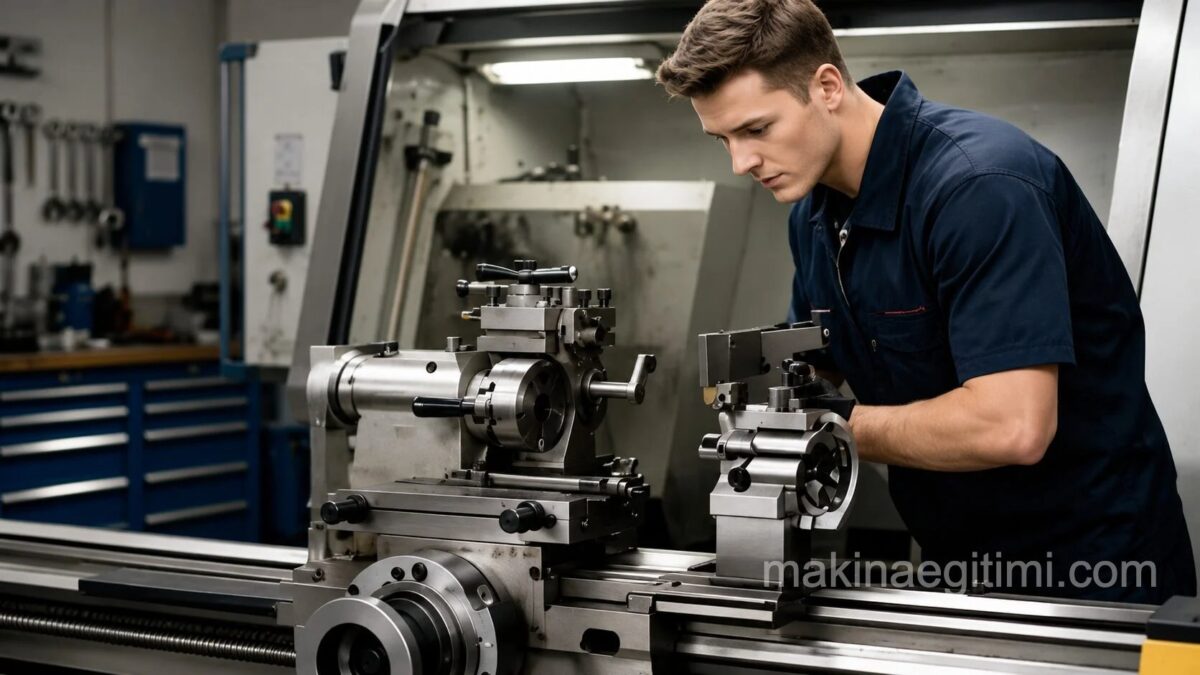
Weekly, monthly, and yearly periodic maintenance of the lathe must be carried out. During lathe maintenance, the operation of the equipment and accessories is checked. The lathe is cleaned. The bed and slides are lubricated. When lathe maintenance is mentioned, the following should come to mind:
- Lubricating the Lathe
- Cleaning the Lathe
- Maintenance of the Bed and Slides
- Keeping the Lathe’s Auxiliary Parts and Attachments Organized
Lubricating the Lathe
The most important areas requiring lubrication on lathes are the gearboxes, bearings, journals, bed, and similar moving parts. Depending on the type and features of the lathe, the equipment that provides lubrication consists of various systems. The main lubrication systems are as follows:
Manual lubrication
This is done by pouring or pumping oil with hand-held oilers into the reservoirs (lubrication holes) on the machine. On lathes, manual lubrication is most commonly used on the bed and slides. If grease is to be used for lubrication, it is pumped in with a grease gun through the nipple. Since the nipple (grease fitting) is fitted to the mouth of the oil hole, it delivers the pumped grease to the area to be lubricated.

Manual lubrication does not achieve full lubrication; that is, a fluid-friction lubrication film does not form.
Automatic lubrication:
This is done with either non-pressurized or pressurized systems. The effect of the lubrication is small in a non-pressurized system and greater in a pressurized system.
Automatic non-pressurized lubrication
This is self-lubrication achieved through elements such as oil rings and felt wipers fitted on rotating machine parts, which absorb and fling the oil.
After oil is filled up to the gauge level in the lathe’s headstock gearbox, when the machine is run the gears fling the oil, producing automatic non-pressurized lubrication.
Automatic pressurized lubrication
Since the effect of manual or automatic non-pressurized lubrication is limited, oil does not reach the desired locations. For this reason, the oil is made to reach the required points through pressure. In automatic pressurized lubrication on a lathe, oil drawn from a reservoir by a pump is pumped through thin tubes to the necessary locations (such as the spindle bearings, gears, bed, and slides).
Importance of lubrication
Whether a machine operates efficiently and has a long service life depends on whether lubrication is carried out fully. The importance of lubrication can be illustrated in terms of the benefits it provides:
- Reduces friction.
- Reduces heating.
- Extends the service life of parts.
- Protects parts from corrosion.
- Facilitates the movement of parts.
- Saves energy.
Points to Consider When Lubricating the Lathe
Lubrication is of great importance for increasing the service life and efficiency of the lathe. The following points should be observed for proper lubrication:
- The amount of oil in the machine’s speed gearbox is checked from the level gauge. When the machine is stopped, the oil level must not fall below the gauge.
- When the oil in the headstock gearbox decreases, it must be topped up.
- Care must be taken that the oil put into the machine is of the type specified in its own catalog.
- Whether the oil has aged should be checked. Oil in use becomes dirty and thickens over time as it ages; since aged oil can no longer perform its function, it must be changed.
- When topping up or changing the oil, care must be taken to prevent foreign objects or substances from entering the gearbox.
- Inspection of the lubrication equipment must be carried out thoroughly, taking the machine’s specifications into account.
- The oil holes provided on the machine for manual lubrication should be checked for blockages, and any blocked holes should be cleared.
- Both the inspection of the lubrication equipment and the lubrication operations themselves should be carried out periodically (at set time intervals).
Cleaning the Lathe
For the lathe to operate efficiently, it must be kept fully clean. In particular, cleaning the bed and slides requires care.
On a lathe, it is important that the bed and slide surfaces are parallel to the spindle axis. If the surfaces are not properly maintained, they will develop shape defects over time. Shape defects on the bed and slide surfaces are reflected in the machine’s turning quality (dimensional accuracy, surface roughness, geometric characteristics of the work…).
Importance of Daily Lubrication
The bed and slides of a lathe should be lubricated regularly (usually daily) to prevent wear.
Chip Cleaning
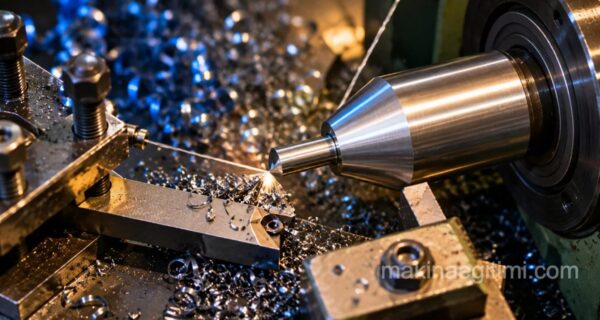
Metal chips that accumulate on the slides should be cleaned after every use, as they can cause scoring and loss of precision on the surfaces.
Precision Check
Wear that builds up over time on unmaintained slides can cause machining precision to deviate by microns.
Maintenance of the Bed and Slides
- Cleaning of the lathe should be done as daily and weekly maintenance.
- After finishing work, chips on the machine should be carefully cleaned.
- Chips that can become lodged between the bed and slides should also be cleaned.
- Care should be taken to prevent coolant residue from causing rust.
- An oil film should be formed on the cleaned surfaces.
Keeping the Lathe’s Auxiliary Parts and Attachments Organized
The following points should be observed for keeping the lathe’s auxiliary parts (chuck, center, etc.) and attachments (steady rest roller, taper-turning attachment, etc.) organized:
- Chucks should be stored in their cabinets in an organized and balanced manner.
- The chuck and its jaws should be kept clean and well maintained.
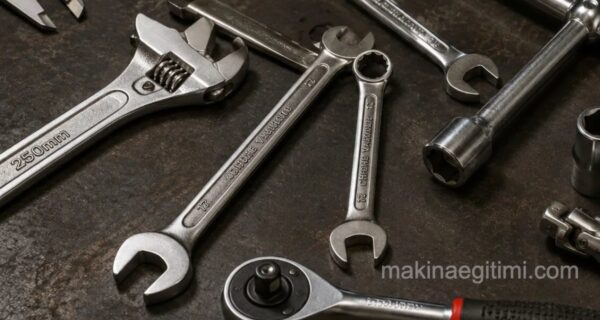
- The tools on the lathe should be kept organized.
- The tip of the center should be clean and lubricated.
- When not in use, the live center should be kept loose on the right side of the lathe.
- Attachments should be stored in their dedicated cases.
Related Questions
Areas such as the bed and slides are places where the operator can easily monitor the amount and condition of the oil through visual inspection. Being a simple and direct method still makes manual lubrication practical for these areas.
The nipple is a special fitting mounted at the mouth of the lubrication hole, to which the tip of a grease gun can be attached. This allows grease to be pumped directly and cleanly to the point where it is needed, under pressure.
Related Posts