This article’s topic will be end mill cutters. What is an end mill cutter. Where are end mill cutters used. What material are end mills made from. We’ll cover details like how it’s mounted on a milling machine.
End Mill Cutters
What is an end mill cutter? An end mill is one of the types of cutting tools with helical cutting edges used in the milling process, which has an important place in the manufacture of machine parts and in mold making. In English it’s called an “End milling cutter,” but in Turkish it’s called “parmak freze” (finger mill) because of its shape.

End mill cutters are made in many different shank and cutting-edge shapes. They’re also called “shank-type cylindrical mills.” Because small-diameter mills can’t be mounted onto milling arbors, small-diameter ones are generally manufactured as one piece with their shank.

Shank shapes are made straight, tapered, or with a drawbar tapping hole. Tooth forms, as shown in the figure, are cut both on the periphery and on the end face; for diameters larger than 6 mm, the peripheral teeth are cut as helical flutes. (You could compare it to a small-diameter helical cylindrical mill.)
Where are end mill cutters used?
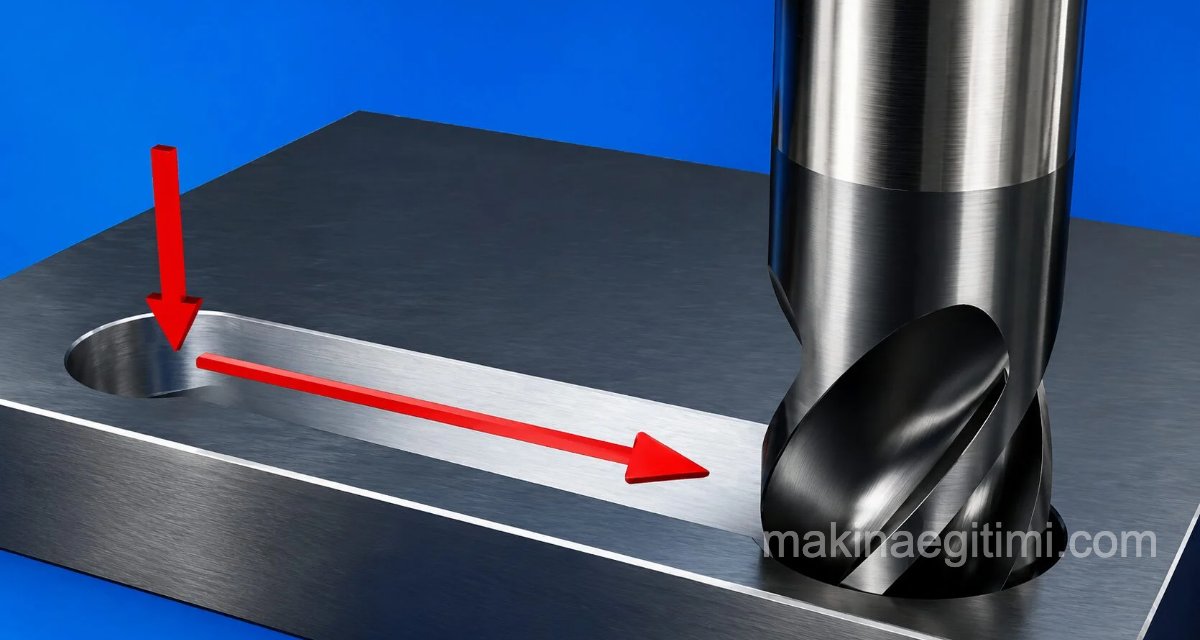
Those with two or three peripheral cutting edges/teeth are used for cutting keyways, and for drilling and hole enlarging operations. Their cutting edges are sharpened so they can also make vertical (plunge) feeds.
When cutting broadly with the side faces of these mills, heavy chip loads shouldn’t be given, since the cutter could break. Their cutting action could be thought of as similar to that of cylindrical helical mills, but they are weaker.

Pocket milling with an end mill (above)

A T-slot end mill used for cutting internal T-slots

Cutting a groove with an end mill (above)

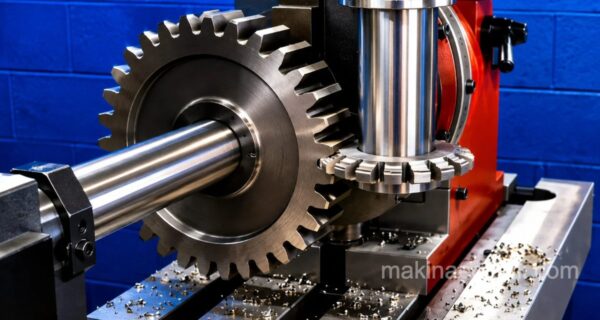
A hobbing cutter or module cutter is usually preferred, but in some cases end mills can also be used for cutting gear teeth.
Shank sections are made cylindrical or Morse-taper shaped, matching the mill’s diameter. They’re mounted on the milling machine by way of collet chucks and Morse taper sleeves.
For detailed information, see: How Are End Mill Cutters Mounted
The shapes of the cutting-tooth sections of end mills are made either “straight” or “helical” fluted. Helical flutes, matching the direction of cut, are at helix angles of 10° to 15°, either right- or left-handed.
Types of End Mills by Shape
There are as many different types of end mills as possible: profiling, contouring, slotting, chamfering, drilling… Here’s a brief overview of the main ones.

Square end mills are the most common type and can be used for many milling applications including slotting, profiling, and plunge cutting.
Corner-radius end mills can produce flat-bottomed grooves with slightly rounded internal corners.
Roughing end mills are used to remove large amounts of material. Their design allows little to no vibration, but leaves a rougher surface finish.
Tapered end mills are cutters that can be used for plunging and are designed for machining angled pockets. They are generally used on castings and molds.

Ball nose end mills have rounded tips and are used for milling 3D shapes or rounded grooves.
T-slot end mills can be used to create applications containing T-slots such as piston-ring grooves and machine table slots, and for cutting keyways.
Straight-flute end mills have a zero-degree helix. They work well for materials such as wood, plastic, and composites, where the lifting effect of a spiral flute could cause undesirable results. For these materials, a straight flute minimizes edge chipping and provides a better surface finish than helical general-purpose end mills.
Helix Angles on End Mill Cutters
End mills typically have a helix angle around 30°. Increasing the helix angle will reduce cutting forces and the amount of heat and vibration. For this reason, end mills with a higher helix angle tend to produce a better surface finish on the workpiece.
However, an end mill with a large helix angle will be weaker and won’t be able to sustain high feed rates and heavy depths of cut. For this reason, cutters with a lower helix angle are stronger, but they produce a rougher surface finish.

What material are end mills made of?

HSS End Mills
High speed steel, or “HSS,” end mills are the cheapest, provide good wear resistance, and can be used to mill many materials such as wood and various metals.

Another easy way to improve the performance of your end mills is to add a good coating. The most common is TiAlN (titanium aluminum nitride), which lets you cut on average 25% faster without spending too much money.

Carbide end mills are more expensive than HSS, but provide better hardness and can be run 2 to 3 times faster than HSS. They’re also extremely resistant to heat, making them suitable for milling hard materials.

Another option is indexable “carbide-tipped” end mills. The ability to replace their inserts is their biggest advantage. They’re used to machine hard materials.
Can vertical cutting be done with end mill cutters?
End mills have teeth cut where the straight or helical peripheral flute meets the end-face tooth surface. Even though they can cut on vertical feeds, this feed shouldn’t exceed 0.5-1 mm. Because once the chip space between the end-face teeth fills up, the feed stalls, and if forced, the tool breaks. Better results are always obtained if feed is made from the side surface with these tools.

When they go dull, large-diameter ones are sharpened both on the periphery and on the end face (until the tooth depth runs out). Small-diameter ones can’t really be sharpened on the end face. But by hollowing out the surface, they can be used a bit longer for side-cutting operations.
In this article we covered end mill cutters. What is an end mill cutter. Where are end mill cutters used. What material end mills are made from. We touched on details like how they’re mounted on a milling machine. In one of our upcoming articles, we’ll take a look at the details of machining with end mills.
Versatile Cutting Ability
End mills are used in versatile milling operations, both for surfacing and for cutting slots.
Effect of Tooth Count
End mills with fewer teeth make chip evacuation easier, while those with more teeth provide a smoother surface finish.
Carbide-Tipped Choice
Carbide-tipped end mills offer the advantage of running at high speeds and having a longer tool life.
Related Questions
A very small-diameter mill can be too delicate to be securely mounted to a separate arbor. Manufacturing it integrated with the shank ensures this small mill is held firmly and reliably on the machine.
The helical tooth structure allows chips to evacuate more smoothly and continuously during cutting. This helps achieve a smoother cutting action and a better surface finish compared to straight teeth.
Related Posts