

In this article we’ll be talking about underwater welding. If you’re wondering how underwater welding is done, keep reading.
Underwater Welding
Underwater welding is one of the toughest jobs in the world. As if being deep underwater weren’t frightening enough, underwater welders are in a constant struggle with their surroundings.
Sometimes just trying to hold a position against strong currents is challenging enough. Poor visibility, oxygen bubbles, the risk of getting caught on rocks or pieces of metal, equipment failure, decompression sickness, and even frightening encounters with marine life are just a few of the risks divers face.
Pressure differences underwater are another hazard. This phenomenon occurs when two bodies of water at different pressures meet. Water from the higher pressure side tries to flow toward the lower pressure body of water. This creates a suction effect that can hold divers underwater and expose them to the risk of drowning or hypothermia.
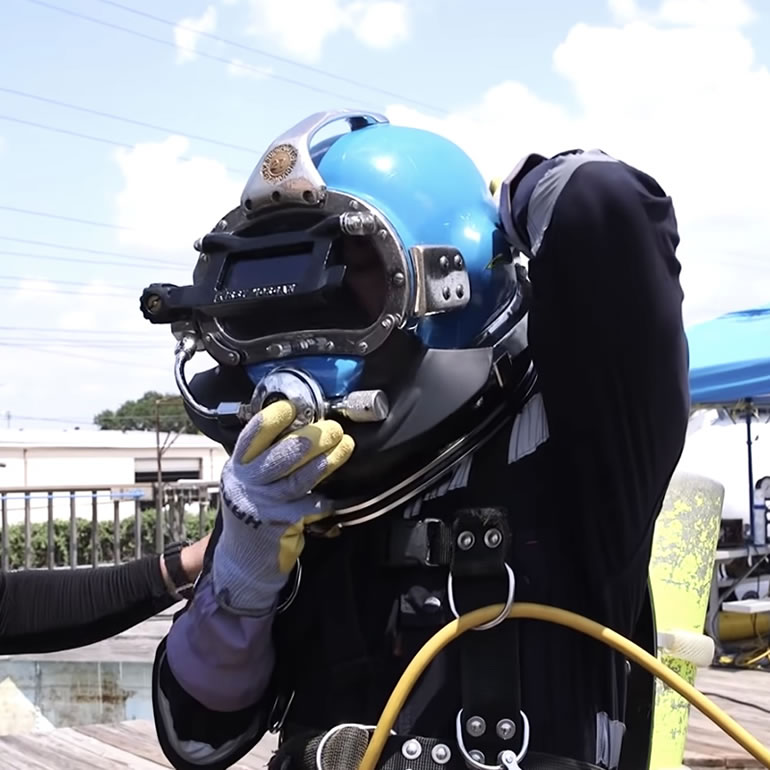
Fortunately, when it comes to commercial diver safety, the industry spares no expense. Rigorous work and safety practices are always applied, and all equipment used is specifically designed for underwater welding purposes.
Everything from the welding rod to the decompression chamber is made for this purpose. For example, if you tried using an underwater welding rod on land, it would overheat and destroy itself within a few minutes.
The two main categories of underwater welding techniques are:
- Wet underwater welding
- Dry underwater welding (also called hyperbaric welding)
What Is Dry Underwater Welding?
This is considered the safest way to weld underwater, and is therefore preferred by most divers.

In this method, welding is performed at the prevailing pressure inside a chamber filled with a gas mixture, sealed around the structure being welded. Gas tungsten arc welding is generally used for this process, and the resulting welds usually have high integrity. A chamber is used to seal off the area that needs to be welded. Inside this enclosed environment, a gas mixture of oxygen and helium is pumped in to create a “dry” environment. These chambers are usually large enough to fit 2 to 3 divers at once.
The applications of underwater welding are quite varied. It’s commonly used to repair and build ships, offshore platforms, and pipelines.
For underwater cutting, oxygen arc cutting with exothermic electrodes and steel tube-shaped electrodes is also used.
In dry underwater welding, divers can work in a more controlled environment. This allows them to achieve better weld results. Other advantages of dry welding over wet welding include increased diver safety and the ability to perform non-destructive testing on the welds.
Depth Limit
Wet underwater welding is generally applicable down to depths of 30-40 meters; deeper jobs require the dry welding method.
Electrode Coating
Underwater welding electrodes are manufactured with a special waterproof coating to prevent short-circuiting on contact with water.
Weld Quality
Wet welding generally provides lower mechanical strength than dry welding due to rapid cooling.
What Is Wet Underwater Welding?
In this method, divers must use a special type of welding machine. The process takes place directly in the water. If you tried using a normal welding machine that runs on electricity, you would most likely get a nasty shock that could kill you.
In this method, shielded metal arc welding using a waterproof electrode is commonly used. Other processes used include flux-cored arc welding and friction welding. In each of these cases, the welding power source is connected to the welding equipment through cables and hoses.
The process is generally limited to lower-carbon-equivalent steels at greater depths, particularly due to hydrogen-induced cracking.
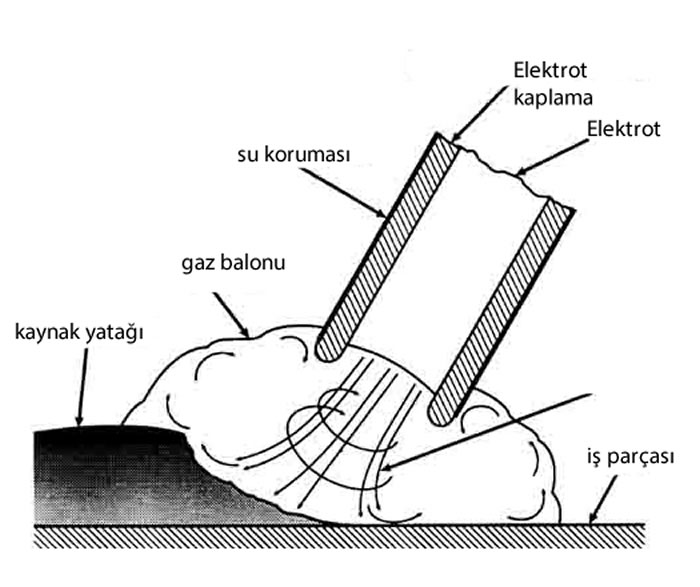
In this method, because welds cool much faster in water, the likelihood of cracking is much higher. Divers must make sure their welds are 100% correct every time, otherwise there is a risk of weld failure.
Wet welding is much faster since divers don’t need to build a dry chamber around the weld point. This also makes it cheaper, especially if the weld is in a hard-to-reach location.
Deep Underwater Welding
The definition of underwater welding generally refers to the wet welding technique, where there is no mechanical barrier separating the welding arc from the water.
Dry underwater welding is most commonly used for deep-water welds and other applications where high strength is required. Research into using dry underwater welding down to depths of 1000 m is ongoing.
In general, since defects are difficult to detect, ensuring the integrity of underwater welds, especially wet underwater welds, can be difficult. For structures welded using wet underwater welding, post-weld inspection can be more difficult than for welds made in air.
How Is Underwater Welding Done
Below, how underwater welding is performed and what needs to be considered in underwater welding are explained.
Hold a pre-job meeting to conduct a job safety analysis. Bring the team together at the start of the job to review hazards and make a plan.
Use a properly sized DC welding generator with straight polarity. Straight polarity is achieved by connecting the negative lead to the torch and the positive lead to the ground lead. Never use AC for burning or welding in water. Electric shock caused by AC current prevents the muscles controlling the hands from relaxing voluntarily. If shocked, a diver may be unable to let go if their body or equipment accidentally enters the electrical circuit.
Divers should always wear insulated gloves when cutting or welding underwater.
Connect the generator’s ground cable as close as possible to the worksite, so the diver is never positioned between the electrode and ground.
Make sure there is a positive-acting disconnect switch on the torch side of the current. Whenever the diver is changing burning rods or doing anything other than burning, the disconnect switch must be in the open position.

It’s important that the switch being opened and closed is directed by the diver. The diver sends on/off signals upward.
Polarity can be checked by dipping the rod tip and ground clamp into a bucket of salt water. Energize the rod by closing the safety switch. A stream of bubbles should rise from the rod tip. If not, reverse the polarity and test again.
After the diver enters the water, the first job is to clear a spot for the ground clamp. The spot should be as close as possible to the weld joint, in front of the diver, and should be scraped or wire-brushed clean until bright. For diver safety, only C-type clamps should be used as ground clamps in underwater cutting or welding operations. The clamp must be secured firmly to the workpiece, and precautions taken to prevent the cable from loosening. When there’s a possibility of the clamp working loose, the diver may choose to lightly tack-weld the clamp in place.
The diver should make a test weld to check the heat at the working depth.
When the electrode is consumed down close to the torch, stop cutting and give the “cut off” signal before attempting to change electrodes. Hold the torch in the cutting position until the tender confirms the “cut off” signal.
It’s not safe to operate the welding torch without the flame guard in place.
Do not cut non-ferrous metals underwater. Cutting non-ferrous metals can cause an explosion.
There should be no ignition underwater when oxygen pressure is low. This would cause the cable to burn internally, potentially create holes in the cable, and lead to a situation that could cause injury.
A diver risks electric shock while welding or cutting when partially submerged in water.
Acetylene is very unstable at pressures above 15 psi and is not used for underwater cutting.
The hand should never be closer than 10 cm to the electrode tip.
The dive supervisor should always keep a written record of the following, in order to repeat what worked during the next welding or cutting session:
- Welding amperage read from the clamp meter.
- Both open-circuit and closed-circuit voltage read from the voltmeter.
- Electrode diameter, type, manufacturer, and waterproof coating material.
- Electrical polarity.
- Length of the welding cable.
- Depth of the work site.
Related Questions
Higher-pressure water tries to flow toward the lower-pressure area, and this creates a suction current. This current can drag the diver and hold them at a certain point, increasing the risk of drowning or hypothermia.
Many hazards, such as poor visibility, strong currents, equipment failure, and decompression sickness, are all present at once. The combination of these risks makes the profession far more challenging than welding done on land.
Related Posts
 Electrodes Used for Welding Stainless Steels
  Advantages and Disadvantages of Laser Welding
  General Information About MIG Welding
  What Is Submerged Arc Welding, How Is It Done
  Welding Methods – Techniques – Types
  Laser Welding, Its Properties and Working Principle
  Welding of Stainless Steels
  Occupational Health and Safety in Welding Work