
Close Menu
  • MAKİNELER ve İMALAT
    • Tools & Equipment
    • Computer-Aided Drawing
    • CAD/CAM Education
    • CNC Machine Programming
    • Casting Technologies
    • Electrical & Electronics Technologies
    • Hydraulics & Pneumatics
    • Manufacturing Processes
    • Manufacturing Technologies
    • Occupational Safety
    • Mold & Die Design
    • Solid Modeling
    • Welding Technology
    • Machine Elements
    • Mechanical Trade Drawing
    • Materials Science
    • Automotive & Vehicle Technologies
    • Robotics Technologies
    • Health Technologies
    • Defense & Aerospace Technologies
    • Descriptive Geometry
    • Technical Drawing
    • Software & Hardware Technologies
    • Innovative Manufacturing Methods
  • TEKNOLOJİ ve YAŞAM
    • OTOMOBİLLER ve TAŞIT
      • Vehicle & Engine Knowledge
      • Safe Driving
      • Sürüş Destek Sistemleri
    • Genel Kültür
      • Movies & TV Shows
      • Görsel ve Grafik Sanat
      • Books & Literature
      • Music
      • Sports
      • History
      • History of Technology
    • GÜNDELİK YAŞAM TEKNOLOJİLERİ
    • Hobbies & Entertainment
    • Internet Technologies
    • Health
    • Mobile Technologies
Makine Eğitimi
  • Machines & Manufacturing
    Machine Elements
    Hydraulics & Pneumatics
    Technical Drawing
    Computer-Aided Design & Manufacturing
    Basic Manufacturing Processes
    Manufacturing Processes
    Industry Technologies
    Other Technical Courses
    Motion & Power Transmission
    Simple Machines
    Chains & Sprockets
    Shafts & Journals
    Gears
    Cams
    Couplings
    Belts & Pulleys
    Springs
    Bearings
    Keys
    Fastening Joining
    Retaining Rings
    Screws, Bolts & Nuts
    Cotter Pins
    Flanges
    Welding
    Rivets
    Pins & Bolts
    Washers
    Calculators
    Gear Ratio Calculator
    Spring Constant Calculator
    Belt Pulley Ratio Calculator
    Other Machine Elements
    Slides & Linear Guides
    Brakes
    Flywheels
    Clamps
    Shock Absorbers
    Gaskets & O-Rings
    Seals & Sealing Elements
    Hydraulics
    Introduction to Hydraulics & Principles
    Hydraulic Systems & Applications
    Accumulators
    Filters
    Motors
    Pumps
    Valves
    Pneumatics
    Introduction to Pneumatics & Principles
    Pneumatic Systems & Applications
    Pneumatic Circuit Components
    Valves
    Cylinders
    Silencers
    Motors
    Compressors
    Dryers
    Conditioning Units
    Common Topics & Maintenance
    Hydraulic & Pneumatic Maintenance
    Study Notes, Exams & Tests
    Technical Drawing
    Introduction to Technical Drawing
    Geometric Drawings
    Perspective & Projection
    Orthographic Views
    Dimensioning
    Sectioning
    Assembly & Detail Drawings
    Tolerances
    Surface Finish Symbols
    Mechanical Engineering Drawing
    Screws, Bolts & Nuts
    Pulley Drawings
    Gear Drawings
    Shafts & Journals
    Bearing Drawings
    Pins & Bolts
    Spring Drawings
    Welds in Technical Drawing
    Washers
    Cotter Pins
    Technical Drawing Exercises
    Mechanical Drawing Exercises
    Gear Exercises
    View Extraction Exercises
    Pulley Exercises
    Pin & Bolt Exercises
    Threaded Fastening Exercises
    Descriptive Geometry
    Computer-Aided Drawing
    AutoCAD Drawing Lessons
    Solid Modeling & Animation
    Solid Model Drawing Files
    Solid Model Assembly Examples
    Solid Model Drawing Lessons
    3D CAD Software Reviews
    Solid Modeling Exercises
    CNC Programming
    CAM
    Measurement & Inspection
    Dial Indicators
    Calipers
    Gauges
    Micrometers
    Materials Science
    Steels
    Cast Iron
    Aluminum
    Plastics
    Material Testing & Hardness Measurement
    Occupational Safety
    Workshop Safety
    Safety When Working With Electricity
    Machine Safety Rules
    Hand Operations
    Filing
    Marking
    Cutting Operations
    Reaming
    Tapping
    Threading With a Die
    Drill Bit Sharpening
    Working With Machines
    Basic Turning Operations
    Basic Milling Operations
    Shaper Machine
    Machining
    Turning
    Milling
    Grinding
    Innovative Manufacturing Methods
    EDM (Electrical Discharge Machining)
    Laser Machining
    Waterjet Machining
    3D Printing
    3D Scanners
    Welding
    Rolling
    Casting
    Mold & Die Design
    Mechanical & Hydraulic Presses
    Blanking & Piercing Dies
    Bending Dies
    Drawing Dies
    Plastic Injection Molds
    Extrusion Dies
    Compound Dies
    Progressive Dies
    Blow Molds
    Spinning Dies
    Spray Molds
    Manufacturing of Machine Parts
    Automotive & Vehicle Technologies
    Motor Vehicle Manufacturing
    Raw Material Production
    History of Technology
    Health & Medical Technologies
    Defense & Aerospace
    Robotics Technologies
    Software & Hardware Technologies
    Mechanics - Strength of Materials
    Physics Topics
  • Technology & Life
    Hobbies & Entertainment
    Sports
    Music
    Vehicle & Engine Knowledge
    Vehicle Maintenance & Repair
    Safe Driving
    Driver Assistance Systems
    History
    Movies & TV Shows
    Books & Literature
    Computers & Internet
    Computer Tips
    Software Reviews
    Hardware & Peripherals
    Practical & Safe Internet Use
    Visual & Graphic Art
    Mobile Technologies
    Travel
    Science
    Health
    First Aid Knowledge
    Everyday Technologies
Makine Eğitimi
Home»Vehicle & Engine Knowledge»What Is a Diesel Particulate Filter (DPF)? What Does It Do?
30 August 2026

What Is a Diesel Particulate Filter (DPF)? What Does It Do?

diesel particulate filter

In this article, we’ll look at what a diesel particulate filter is and what it does. If you’re curious about the purpose and function of a diesel particulate filter, keep reading.

  • What Is a Diesel Particulate Filter
    • The Diesel Particulate Filter’s Function
    • Why the Diesel Particulate Filter Became Necessary
  • What Does a Diesel Particulate Filter Do
  • Related Questions

What Is a Diesel Particulate Filter

The component that filters the black particulates formed by combustion in diesel vehicles and present in the exhaust gas is called a diesel particulate filter.

The Diesel Particulate Filter’s Function

The diesel particulate filter’s function is to clean the exhaust gas of particulates, reducing exhaust particulate emissions. A diesel particulate filter is only found in diesel vehicles.

diesel particulate filter

Why the Diesel Particulate Filter Became Necessary

In diesel vehicles, especially during sudden acceleration when the accelerator pedal is pressed hard, that is, when the engine has a rich mixture (excess fuel-low air), a lot of particulates are released from the exhaust. These particulates are actually carbon particles that didn’t get time to burn in the combustion chamber.

A diesel particulate filter’s construction takes the form of a metal cylindrical-elliptical housing. Inside the particulate filter is a block with a ceramic honeycomb structure impregnated with precious metals.

Although structurally similar to a catalytic converter’s honeycomb block, the channels in the particulate filter’s block are open at one end and closed at the other.

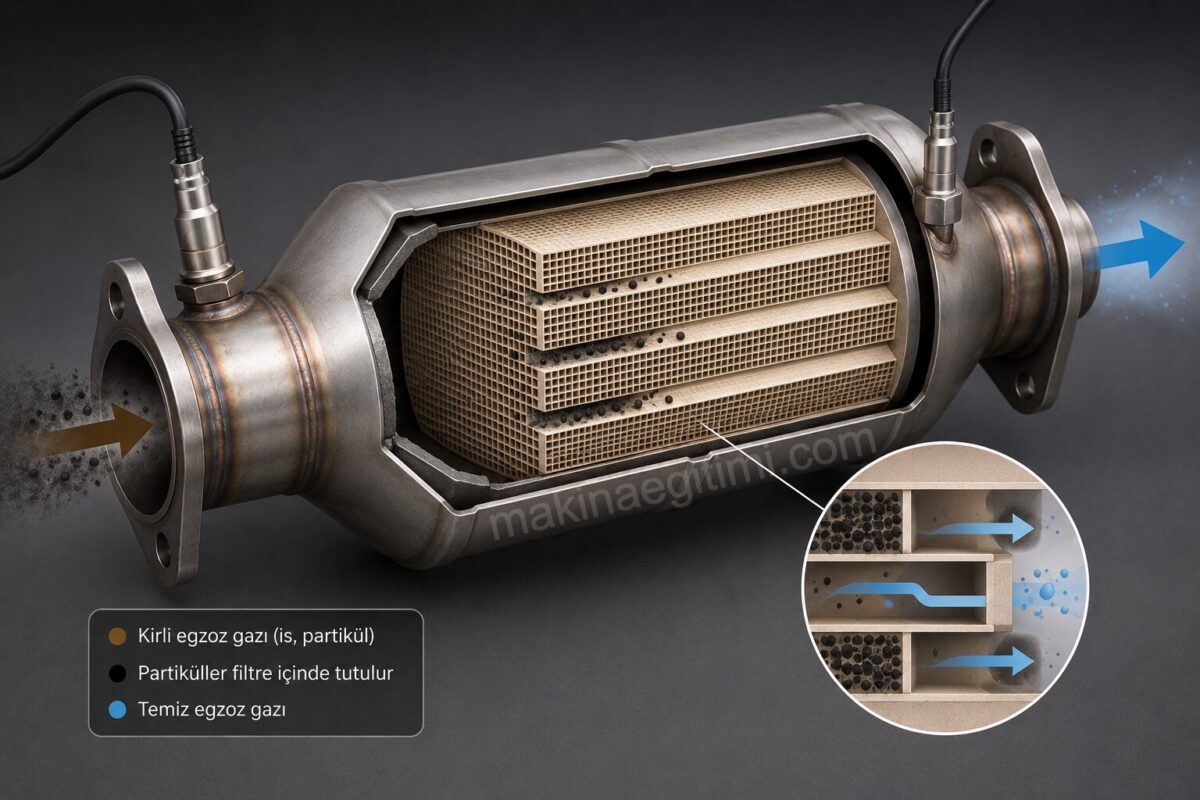
the construction of a diesel particulate filter
dizel partikül filresinin içi

NOx and particulate emissions from diesel engines are a greater threat to the environment. To reduce this impact, automotive engineers developed the DPF to comply with the stricter Euro-6 emission standard. The term DPF stands for Diesel Particulate Filter. It’s used in diesel engines that comply with Euro-6 emission standards.

Soot Capture Rate


DPF filters can capture approximately 85-100% of the soot particles in exhaust gas.

Regeneration Process


The DPF regularly goes through a high-temperature process called “regeneration” to burn off and clean out accumulated soot.

Euro 5/6 Standard Requirement


The DPF has become mandatory in diesel vehicles to meet the Euro 5 and Euro 6 emission standards.

What Does a Diesel Particulate Filter Do

Manufacturers use the diesel particulate filter to filter, store, and burn the soot particles produced by diesel combustion.

To reduce emissions from diesel vehicles, diesel particulate filters capture and store exhaust soot, which needs to be periodically burned off to renew the filter. This renewal process burns off the excess soot accumulated in the filter, preventing harmful exhaust emissions and the black smoke you commonly see from diesel vehicles during acceleration.
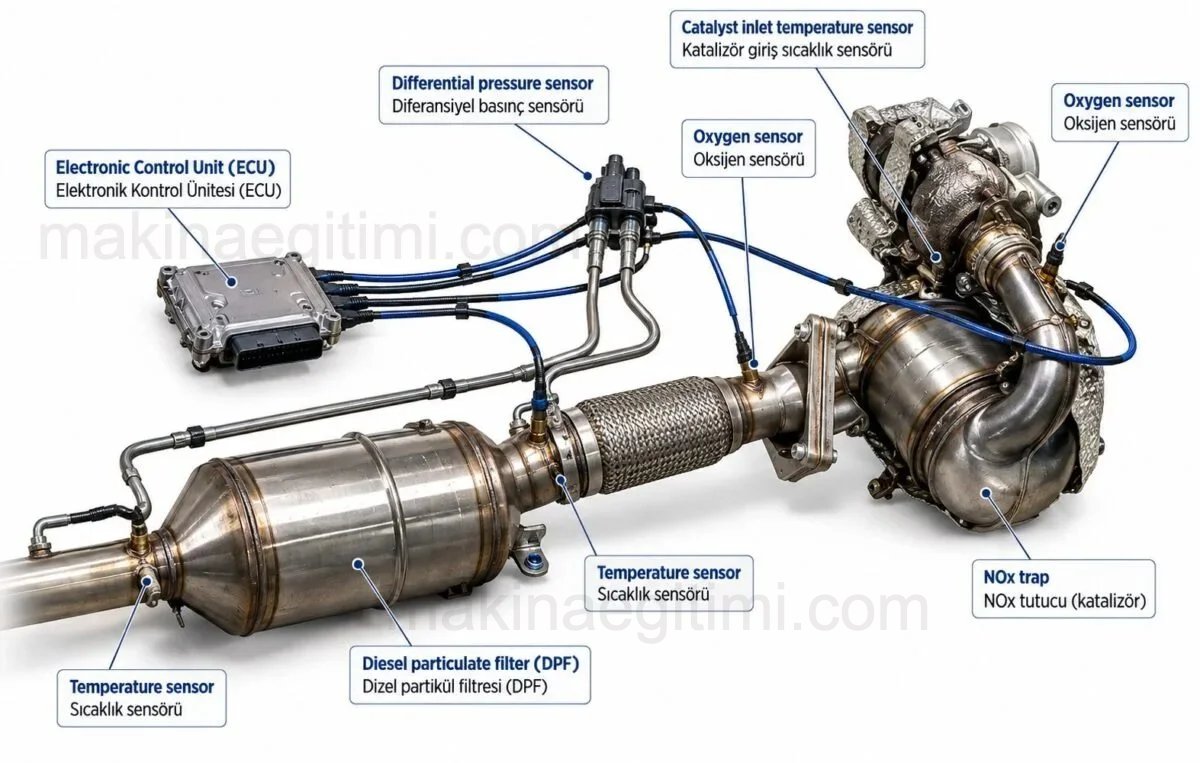
what does a diesel particulate filter do

Diesel particulate filters work by capturing soot particles from the engine exhaust and preventing them from reaching the environment. The particulate filter is designed to capture and hold solid particles until they’re oxidized, or burned off within the DPF itself, through a process called regeneration.


In this article, we looked at what a diesel particulate filter found in diesel vehicles is and what it does. What can happen if the diesel particulate filter fills up. If you’re wondering what to do when you encounter a diesel particulate filter warning on your vehicle’s instrument panel, see the related articles below.

Related Questions

The way diesel engines combust fuel produces more soot and carbon particles than gasoline engines. This filter was developed specifically for diesel engines to capture these particles.

In a catalytic converter, gas passes freely through the channel and is chemically cleaned. In a particulate filter, the goal is to physically capture solid particles; the channel structure with one end closed forces the gas to filter through the wall before it can exit through a neighboring open channel.


Related Posts
Diesel DPF Problems Explained: Why Short Trips Kill Your Particulate Filter Diesel DPF Problems Explained: Why Short Trips Kill Your Particulate Filter Dizel Partikül Filtresi Arızası Nedir. Nasıl Anlaşılır What Is a Diesel Particulate Filter Fault. How Is It Detected Lastiklerin üzerindeki yazıların anlamı What the Markings on a Car Tire Mean Vehicle clutch components diagram What Is a Clutch? How Does It Work? Failures and What Drivers Should Know biggest engines of all time The Biggest and Craziest Engines of All Time what is a coilover What Is a Coilover (Coil Spring Shock Absorber)? What Is It For? What Is a Camshaft, How Does It Work What Is a Camshaft? What Does It Do? How Does It Work? Parts of the Engine, Illustrated Explanation Parts of the Engine, Illustrated Explanation
Share. Facebook Twitter WhatsApp Tumblr Email Telegram Copy Link

Leave A Reply Cancel Reply

Steering Wheel Grip and Turning Techniques
Safe Forklift Use. Forklift Safety Rules
  • Contact
  • Terms of Service
  • Privacy & Cookie Policy

Type above and press Enter to search. Press Esc to cancel.