
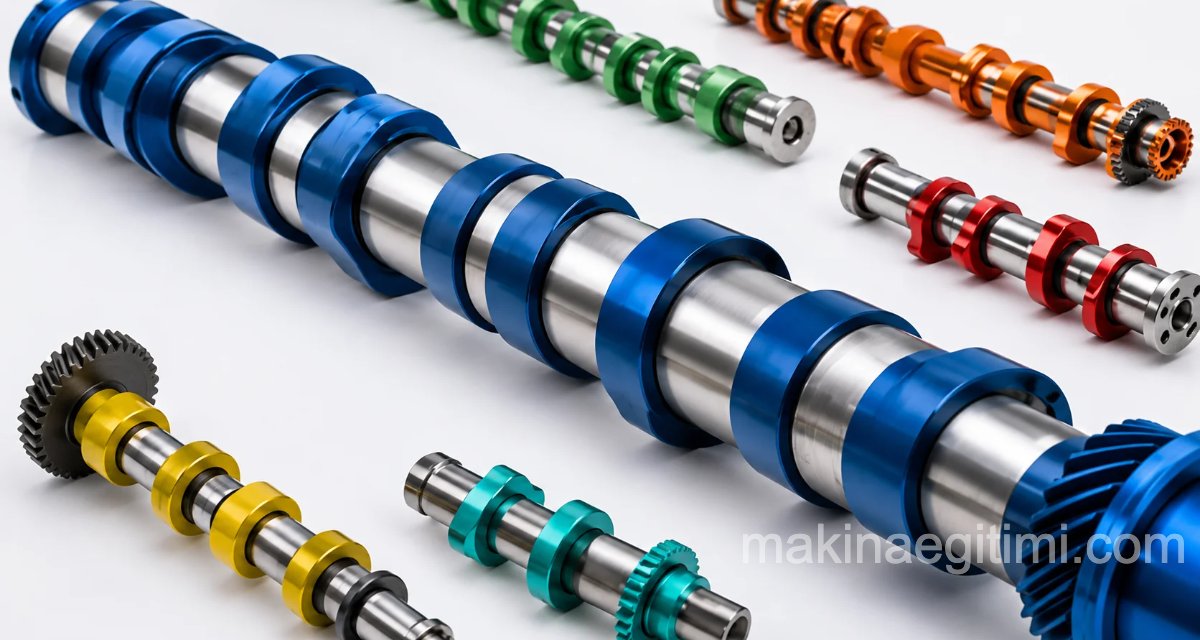
What Is a Camshaft?
The camshaft is a shaft, with cam lobes on it, that opens and closes the valves at the correct time in internal combustion engines. It is manufactured as a single piece, either forged or cast, from spheroidal-graphite (ductile) cast iron or steel alloys.

Where Is the Camshaft Located in the Engine?
The camshaft is located at the top of your vehicle’s engine. While operating, it is in contact with the piston valves and the timing belt. You might want to take a look at our article on the timing belt:
See the related article: What Is a Timing Belt, What Does It Do?

Valve Control
Through the shape of its lobes, the camshaft precisely controls the opening and closing timing of the valves.
Synchronization With the Timing Belt
The camshaft moves in sync with the crankshaft by means of a timing belt or chain.
DOHC vs. SOHC Difference
Dual overhead camshaft (DOHC) engines generally offer higher performance compared to single overhead camshaft (SOHC) engines.
What Does the Camshaft Do?
In an engine, the camshaft performs the tasks of: opening the valves at the desired time, closing the valves at the desired time, and holding the valves open as long as needed. It controls the flow of air and fuel into and out of the engine. This, in turn, determines engine performance, fuel economy, and emissions. The camshaft is one of the most important components in any engine.

In engines with a carbureted fuel system and a classic distributor ignition system, besides the tasks mentioned above, the camshaft also drives the distributor and oil pump via a helical gear mounted on it, and drives the fuel pump via a dedicated cam lobe.

The camshaft is generally connected to the crankshaft using a timing chain or timing belt. In some engines, timing gears may be used instead. The camshaft gear has twice as many teeth as the crankshaft gear, which allows it to rotate at half the crankshaft’s speed. The camshaft governs four separate strokes: intake, compression, combustion, and exhaust.
How Does a Camshaft Work?
The camshaft’s job is to time the valves that allow gases into and out of the cylinder. You don’t want the valves open during the compression stroke or the combustion stroke. Likewise, you don’t want the valves closed during the intake and exhaust strokes. The camshaft’s job is exactly this timing.
The video below can give you an idea of how the camshaft works.
Camshafts are driven by the engine’s crankshaft. The motion transmission ratio from the crankshaft to the camshaft is 1/2. In four-stroke engines, the crankshaft rotates 720° for one complete cycle to occur. The camshaft, on the other hand, rotates 360°.
Depending on the engine’s design, a four-stroke engine has at least one camshaft. Also depending on engine design, camshafts are mounted either in the engine block or the cylinder head.
Today’s engines have fuel injection and an electronically controlled ignition system. The shaft carries the cam lobes, journals, and valve-timing mechanisms. Separate camshafts are generally used for the intake and exhaust valves.

The exhaust camshaft is driven by the crankshaft via the timing belt. The intake camshaft is driven by the exhaust camshaft via a gear

With variable valve timing, the opening timing of the intake valves is adjusted based on engine speed. This depends on the intake camshaft being driven by a chain.

When engines run at high speeds, very little time is left for the strokes to occur. Increasing the number of valves per cylinder allows better filling of the cylinders and better evacuation of exhaust gases at high engine speeds. Today’s engines commonly use two intake and two exhaust valves per cylinder.
Parts of the Cam Lobes on a Camshaft
The cam lobes open the valves as the camshaft rotates. As the camshaft continues to rotate, the valve springs close the valves.
The pointed tip of a cam lobe is called the nose, and the circular section directly opposite it is called the heel. The areas where the cam lobes meet the camshaft are called the ramp (quieting) areas. These areas allow the lifter or valve to open and close gradually. If the valves were to open and close too quickly, they would make noise and the parts would wear out quickly.

Camshafts with a narrow cam profile are generally used in engines. In engines where high power is desired, camshafts with a wide cam profile are used. With wide-profile camshafts, since the valves stay open longer, more air-fuel mixture or air can be drawn into the cylinders. This makes it possible to achieve higher power.
In this article, we tried to explain what a camshaft is and what role it plays in the engine’s operation. For those wondering what a camshaft does, we explained how it works using videos. We covered details such as the parts of the cam lobes on a camshaft. Looking forward to meeting you in future articles.
Related Questions
Whether the valves open and close at the correct time depends on exactly where the piston is. Without this synchronization, provided by the timing belt or chain, the valves could collide with the piston or open at the wrong time, reducing the engine’s efficiency.
Since the intake and exhaust valves are controlled by separate shafts in DOHC engines, the timing of each valve group can be set independently and more precisely. This flexibility lets the engine breathe more efficiently at higher speeds, improving performance.
Related Posts
 Vehicle Drivetrain: Components, How It Works, and Common Failures
  What Does the Noise from the Valves Mean?
  What Is a Turbocharger? How Does It Work? Advantages and Disadvantages
  What Is a Vehicle Ignition System, How Does It Work? What Are Its Failures?
  What Is a Drum Brake System, How Does It Work
  How Hydraulic Brakes Work
  Diesel Engine vs. Gasoline Engine: Which Is More Powerful?
  What Is ESP in Vehicles? What Does It Do? How Does It Work?