Close Menu
  • MAKİNELER ve İMALAT
    • Tools & Equipment
    • Computer-Aided Drawing
    • CAD/CAM Education
    • CNC Machine Programming
    • Casting Technologies
    • Electrical & Electronics Technologies
    • Hydraulics & Pneumatics
    • Manufacturing Processes
    • Manufacturing Technologies
    • Occupational Safety
    • Mold & Die Design
    • Solid Modeling
    • Welding Technology
    • Machine Elements
    • Mechanical Trade Drawing
    • Materials Science
    • Automotive & Vehicle Technologies
    • Robotics Technologies
    • Health Technologies
    • Defense & Aerospace Technologies
    • Descriptive Geometry
    • Technical Drawing
    • Software & Hardware Technologies
    • Innovative Manufacturing Methods
  • TEKNOLOJİ ve YAŞAM
    • OTOMOBİLLER ve TAŞIT
      • Vehicle & Engine Knowledge
      • Safe Driving
      • Sürüş Destek Sistemleri
    • Genel Kültür
      • Movies & TV Shows
      • Görsel ve Grafik Sanat
      • Books & Literature
      • Music
      • Sports
      • History
      • History of Technology
    • GÜNDELİK YAŞAM TEKNOLOJİLERİ
    • Hobbies & Entertainment
    • Internet Technologies
    • Health
    • Mobile Technologies
Makine Eğitimi
  • Machines & Manufacturing
    Machine Elements
    Hydraulics & Pneumatics
    Technical Drawing
    Computer-Aided Design & Manufacturing
    Basic Manufacturing Processes
    Manufacturing Processes
    Industry Technologies
    Other Technical Courses
    Motion & Power Transmission
    Simple Machines
    Chains & Sprockets
    Shafts & Journals
    Gears
    Cams
    Couplings
    Belts & Pulleys
    Springs
    Bearings
    Keys
    Fastening Joining
    Retaining Rings
    Screws, Bolts & Nuts
    Cotter Pins
    Flanges
    Welding
    Rivets
    Pins & Bolts
    Washers
    Calculators
    Gear Ratio Calculator
    Spring Constant Calculator
    Belt Pulley Ratio Calculator
    Other Machine Elements
    Slides & Linear Guides
    Brakes
    Flywheels
    Clamps
    Shock Absorbers
    Gaskets & O-Rings
    Seals & Sealing Elements
    Hydraulics
    Introduction to Hydraulics & Principles
    Hydraulic Systems & Applications
    Accumulators
    Filters
    Motors
    Pumps
    Valves
    Pneumatics
    Introduction to Pneumatics & Principles
    Pneumatic Systems & Applications
    Pneumatic Circuit Components
    Valves
    Cylinders
    Silencers
    Motors
    Compressors
    Dryers
    Conditioning Units
    Common Topics & Maintenance
    Hydraulic & Pneumatic Maintenance
    Study Notes, Exams & Tests
    Technical Drawing
    Introduction to Technical Drawing
    Geometric Drawings
    Perspective & Projection
    Orthographic Views
    Dimensioning
    Sectioning
    Assembly & Detail Drawings
    Tolerances
    Surface Finish Symbols
    Mechanical Engineering Drawing
    Screws, Bolts & Nuts
    Pulley Drawings
    Gear Drawings
    Shafts & Journals
    Bearing Drawings
    Pins & Bolts
    Spring Drawings
    Welds in Technical Drawing
    Washers
    Cotter Pins
    Technical Drawing Exercises
    Mechanical Drawing Exercises
    Gear Exercises
    View Extraction Exercises
    Pulley Exercises
    Pin & Bolt Exercises
    Threaded Fastening Exercises
    Descriptive Geometry
    Computer-Aided Drawing
    AutoCAD Drawing Lessons
    Solid Modeling & Animation
    Solid Model Drawing Files
    Solid Model Assembly Examples
    Solid Model Drawing Lessons
    3D CAD Software Reviews
    Solid Modeling Exercises
    CNC Programming
    CAM
    Measurement & Inspection
    Dial Indicators
    Calipers
    Gauges
    Micrometers
    Materials Science
    Steels
    Cast Iron
    Aluminum
    Plastics
    Material Testing & Hardness Measurement
    Occupational Safety
    Workshop Safety
    Safety When Working With Electricity
    Machine Safety Rules
    Hand Operations
    Filing
    Marking
    Cutting Operations
    Reaming
    Tapping
    Threading With a Die
    Drill Bit Sharpening
    Working With Machines
    Basic Turning Operations
    Basic Milling Operations
    Shaper Machine
    Machining
    Turning
    Milling
    Grinding
    Innovative Manufacturing Methods
    EDM (Electrical Discharge Machining)
    Laser Machining
    Waterjet Machining
    3D Printing
    3D Scanners
    Welding
    Rolling
    Casting
    Mold & Die Design
    Mechanical & Hydraulic Presses
    Blanking & Piercing Dies
    Bending Dies
    Drawing Dies
    Plastic Injection Molds
    Extrusion Dies
    Compound Dies
    Progressive Dies
    Blow Molds
    Spinning Dies
    Spray Molds
    Manufacturing of Machine Parts
    Automotive & Vehicle Technologies
    Motor Vehicle Manufacturing
    Raw Material Production
    History of Technology
    Health & Medical Technologies
    Defense & Aerospace
    Robotics Technologies
    Software & Hardware Technologies
    Mechanics - Strength of Materials
    Physics Topics
  • Technology & Life
    Hobbies & Entertainment
    Sports
    Music
    Vehicle & Engine Knowledge
    Vehicle Maintenance & Repair
    Safe Driving
    Driver Assistance Systems
    History
    Movies & TV Shows
    Books & Literature
    Computers & Internet
    Computer Tips
    Software Reviews
    Hardware & Peripherals
    Practical & Safe Internet Use
    Visual & Graphic Art
    Mobile Technologies
    Travel
    Science
    Health
    First Aid Knowledge
    Everyday Technologies
Makine Eğitimi
Home»Manufacturing Processes»How to Maintain a Lathe
30 August 2026

How to Maintain a Lathe

How to Maintain a Lathe

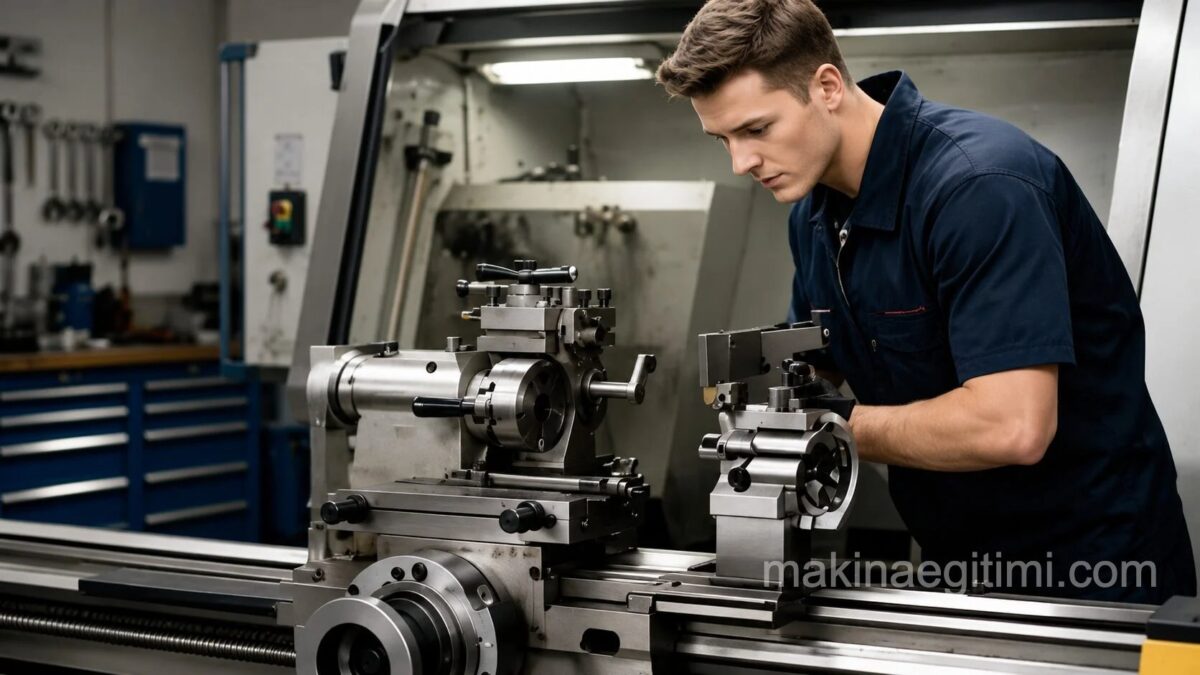
Weekly, monthly, and yearly periodic maintenance of the lathe must be carried out. During lathe maintenance, the operation of the equipment and accessories is checked. The lathe is cleaned. The bed and slides are lubricated. When lathe maintenance is mentioned, the following should come to mind:

  • Lubricating the Lathe
    • Manual lubrication
    • Automatic lubrication:
      • Automatic non-pressurized lubrication
    • Automatic pressurized lubrication
    • Importance of lubrication
    • Points to Consider When Lubricating the Lathe
  • Cleaning the Lathe
  • Maintenance of the Bed and Slides
  • Keeping the Lathe’s Auxiliary Parts and Attachments Organized
  • Related Questions
  • Lubricating the Lathe
    • Manual Lubrication
    • Automatic Lubrication
    • Importance of Lubrication
    • Points to Consider When Lubricating the Lathe
  • Cleaning the Lathe
  • Maintenance of the Bed and Slides
  • Keeping the Lathe’s Auxiliary Parts and Attachments Organized

Lubricating the Lathe

The most important areas requiring lubrication on lathes are the gearboxes, bearings, journals, bed, and similar moving parts. Depending on the type and features of the lathe, the equipment that provides lubrication consists of various systems. The main lubrication systems are as follows:

Manual lubrication

This is done by pouring or pumping oil with hand-held oilers into the reservoirs (lubrication holes) on the machine. On lathes, manual lubrication is most commonly used on the bed and slides. If grease is to be used for lubrication, it is pumped in with a grease gun through the nipple. Since the nipple (grease fitting) is fitted to the mouth of the oil hole, it delivers the pumped grease to the area to be lubricated.

oiler and grease fitting
OILER AND GREASE FITTING

Manual lubrication does not achieve full lubrication; that is, a fluid-friction lubrication film does not form.

Automatic lubrication:

This is done with either non-pressurized or pressurized systems. The effect of the lubrication is small in a non-pressurized system and greater in a pressurized system.

Automatic non-pressurized lubrication

This is self-lubrication achieved through elements such as oil rings and felt wipers fitted on rotating machine parts, which absorb and fling the oil.

After oil is filled up to the gauge level in the lathe’s headstock gearbox, when the machine is run the gears fling the oil, producing automatic non-pressurized lubrication.

Automatic pressurized lubrication

Since the effect of manual or automatic non-pressurized lubrication is limited, oil does not reach the desired locations. For this reason, the oil is made to reach the required points through pressure. In automatic pressurized lubrication on a lathe, oil drawn from a reservoir by a pump is pumped through thin tubes to the necessary locations (such as the spindle bearings, gears, bed, and slides).

Importance of lubrication

Whether a machine operates efficiently and has a long service life depends on whether lubrication is carried out fully. The importance of lubrication can be illustrated in terms of the benefits it provides:

  • Reduces friction.
  • Reduces heating.
  • Extends the service life of parts.
  • Protects parts from corrosion.
  • Facilitates the movement of parts.
  • Saves energy.

Points to Consider When Lubricating the Lathe

Lubrication is of great importance for increasing the service life and efficiency of the lathe. The following points should be observed for proper lubrication:

  1. The amount of oil in the machine’s speed gearbox is checked from the level gauge. When the machine is stopped, the oil level must not fall below the gauge.
  2. When the oil in the headstock gearbox decreases, it must be topped up.
  3. Care must be taken that the oil put into the machine is of the type specified in its own catalog.
  4. Whether the oil has aged should be checked. Oil in use becomes dirty and thickens over time as it ages; since aged oil can no longer perform its function, it must be changed.
  5. When topping up or changing the oil, care must be taken to prevent foreign objects or substances from entering the gearbox.
  6. Inspection of the lubrication equipment must be carried out thoroughly, taking the machine’s specifications into account.
  7. The oil holes provided on the machine for manual lubrication should be checked for blockages, and any blocked holes should be cleared.
  8. Both the inspection of the lubrication equipment and the lubrication operations themselves should be carried out periodically (at set time intervals).

Cleaning the Lathe

For the lathe to operate efficiently, it must be kept fully clean. In particular, cleaning the bed and slides requires care.

On a lathe, it is important that the bed and slide surfaces are parallel to the spindle axis. If the surfaces are not properly maintained, they will develop shape defects over time. Shape defects on the bed and slide surfaces are reflected in the machine’s turning quality (dimensional accuracy, surface roughness, geometric characteristics of the work…).

Importance of Daily Lubrication


The bed and slides of a lathe should be lubricated regularly (usually daily) to prevent wear.

Chip Cleaning


Metal chips that accumulate on the slides should be cleaned after every use, as they can cause scoring and loss of precision on the surfaces.

Precision Check


Wear that builds up over time on unmaintained slides can cause machining precision to deviate by microns.

Maintenance of the Bed and Slides

  • Cleaning of the lathe should be done as daily and weekly maintenance.
  • After finishing work, chips on the machine should be carefully cleaned.
  • Chips that can become lodged between the bed and slides should also be cleaned.
  • Care should be taken to prevent coolant residue from causing rust.
  • An oil film should be formed on the cleaned surfaces.

Keeping the Lathe’s Auxiliary Parts and Attachments Organized

The following points should be observed for keeping the lathe’s auxiliary parts (chuck, center, etc.) and attachments (steady rest roller, taper-turning attachment, etc.) organized:

  1. Chucks should be stored in their cabinets in an organized and balanced manner.
  2. The chuck and its jaws should be kept clean and well maintained.
  3. The tools on the lathe should be kept organized.
  4. The tip of the center should be clean and lubricated.
  5. When not in use, the live center should be kept loose on the right side of the lathe.
  6. Attachments should be stored in their dedicated cases.

Related Questions

Areas such as the bed and slides are places where the operator can easily monitor the amount and condition of the oil through visual inspection. Being a simple and direct method still makes manual lubrication practical for these areas.

The nipple is a special fitting mounted at the mouth of the lubrication hole, to which the tip of a grease gun can be attached. This allows grease to be pumped directly and cleanly to the point where it is needed, under pressure.

Related Posts

Groove Turning Groove Turning Types, Parts, and Maintenance of Dial Indicators Micrometers. Parts, Types, and Maintenance of a Micrometer Types of Wrenches Hand Tools – Types of Wrenches Freze Tezgahında Bölme İşlemleri Indexing Operations on a Milling Machine Workplace Safety with Hand Tools Workplace Safety and Misuse of Hand Tools Taper Turning Methods Taper Turning Methods Parts of a Lathe Parts of a Lathe, Illustrated Information about end mill cutters Information About End Mill Cutters
Basic Turning Operations Turning
Share. Facebook Twitter WhatsApp Tumblr Email Telegram Copy Link

Leave A Reply Cancel Reply

Genghis Khan: From an Abandoned Child to History’s Greatest Emperor
State-of-the-Art High-Efficiency Agricultural Machinery
  • Contact
  • Terms of Service
  • Privacy & Cookie Policy

Type above and press Enter to search. Press Esc to cancel.