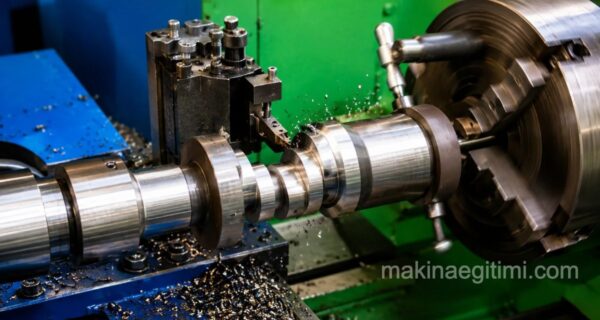
To machine small cylindrical parts in a single setup, shafts called mandrels are used, whose outer surface is machined and ground with a 1°-2° taper. Machine elements with a hole in their center, such as gears, pulleys, and flanges, are turned using a mandrel.


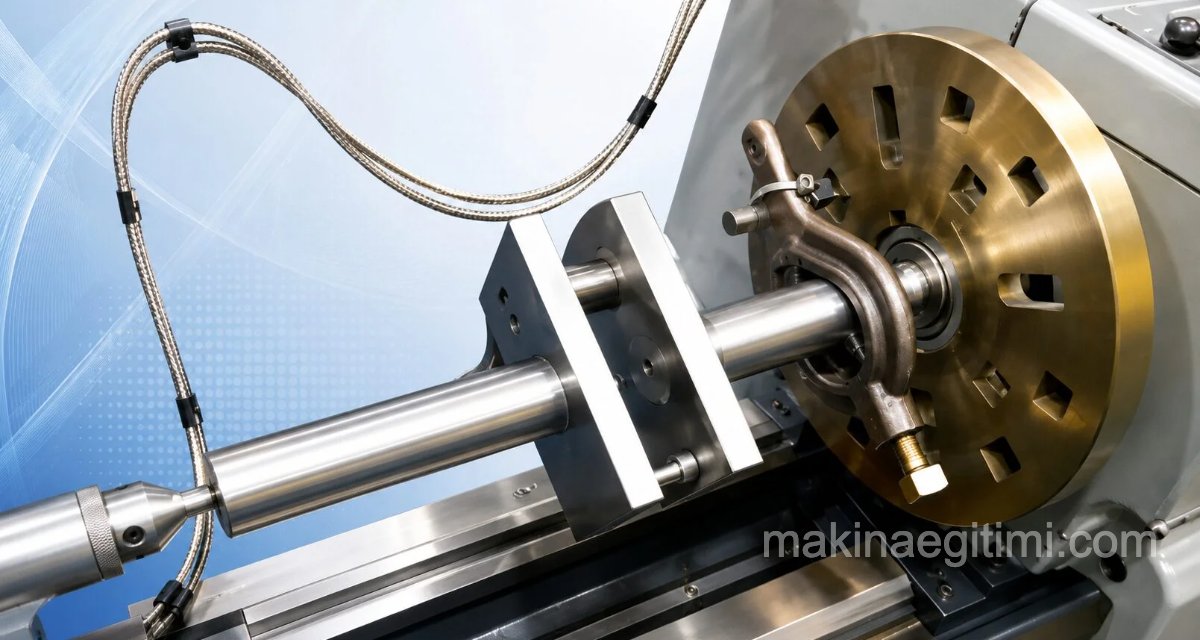
To transmit the spindle’s rotary motion to the mandrel, and to keep the mandrel from stopping while cutting, equipment called a driving plate and lathe dog are used in mandrel turning.

The workpiece mounted on the mandrel is held between two centers. To prevent the workpiece from loosening while cutting, the setup is arranged so that the mandrel’s larger-diameter end faces the chuck side.

Use of the lathe dog fixture (above)

Example of turning with the aid of a mandrel (above)
Fitting the Mandrel to the Workpiece

A mechanical hand press called a mandrel press, or a hydraulic press, is used to fit the mandrel into the workpiece. On a mandrel press, a lever with a gear on it is turned. This gear meshes with a vertically running rack gear. So when the lever is turned, the mandrel press moves downward.
To easily fit the workpiece onto the mandrel, there is a slot in the press table.
A hole is drilled at the center of the workpiece and reamed for precise surface quality. A mandrel matching the hole diameter is selected. The mandrel and the hole are expected to seat against each other with a precise surface fit. This is why mandrels are ground to a taper.
Before fitting the part onto the mandrel, it’s a good idea to lightly oil both the hole and the mandrel.
Purpose of the Mandrel
A mandrel centers a part with a hole from its inner surface, allowing its outer surface to be machined on a lathe.
Interference Fit Principle
A mandrel is generally fitted to the workpiece using an interference fit, preventing it from slipping during machining.
Advantage of a Tapered Mandrel
Tapered mandrels save time on repeated centering operations by accommodating parts with different inner diameters.
Related Questions
The force generated while cutting tends to slide the workpiece along the mandrel. When the larger-diameter end faces the chuck side, this force works to tighten the part instead, preventing loosening.
If such a part were mounted directly in the chuck, its outer surface couldn’t be machined fully and centrally. The mandrel passes through the part’s inner hole, centers it, and fixes it between two centers, allowing the outer surface to be machined without error.
Related Posts